

Immune Thrombocytopenia: Moving Beyond Platelet Counts Toward Durable Remission
From Platelet Recovery to Disease Modification
For decades, the management of immune thrombocytopenia (ITP) has focused on one primary objective: raising platelet counts to reduce bleeding risk.
At the ISTH 2026 Congress, however, it became clear that this approach is no longer sufficient.
Across the session, experts described a fundamental shift in how ITP is understood and treated – from controlling thrombocytopenia to addressing the autoimmune mechanisms driving the disease.
Today, the goals of therapy extend far beyond achieving a “safe” platelet count.
Durable remission, restoration of immune tolerance, reduced treatment burden, and meaningful improvements in quality of life are increasingly becoming the new benchmarks of successful treatment. Rather than simply managing the consequences of autoimmunity, clinicians are beginning to intervene earlier and more precisely to modify the disease itself.
Earlier Use of Thrombopoietin Receptor Agonists
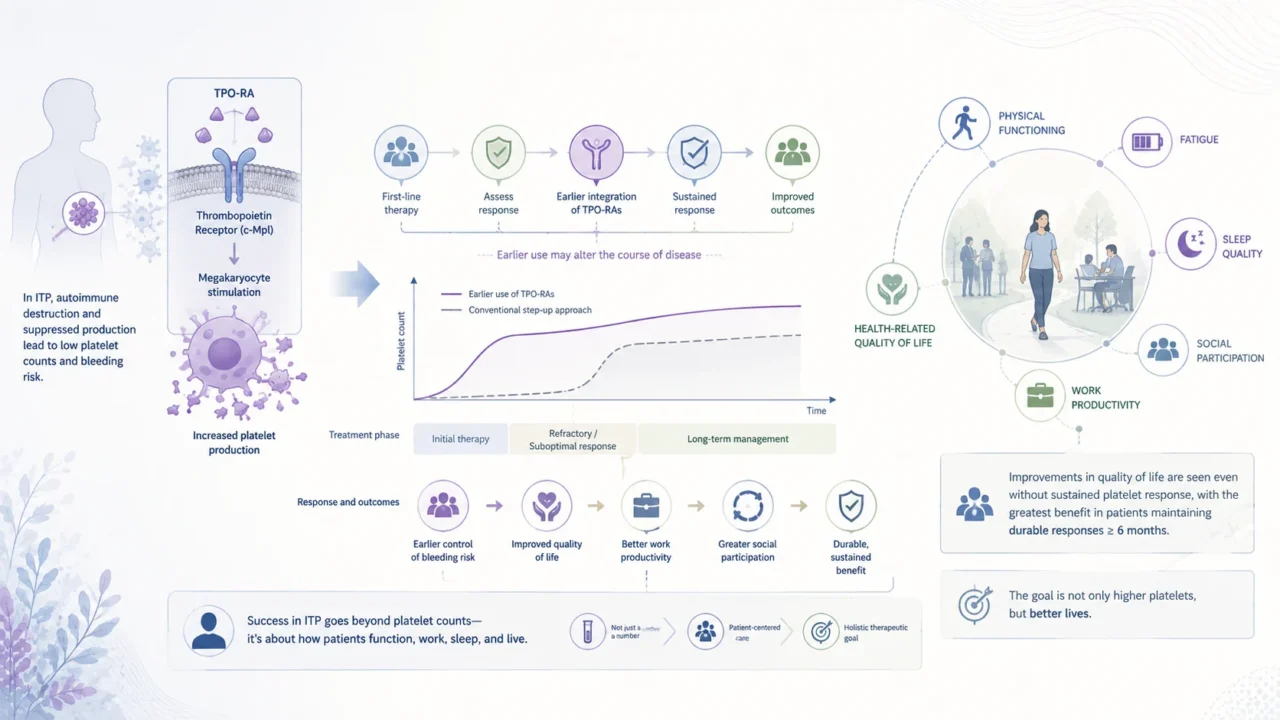
Thrombopoietin receptor agonists (TPO-RAs) remain one of the cornerstones of ITP treatment, but evidence presented during the congress suggests that their greatest value may lie in earlier integration into the treatment pathway.
Real-world studies consistently demonstrated improvements in physical functioning, fatigue, sleep quality, social participation, work productivity, and overall health-related quality of life among patients receiving TPO-RAs.
Notably, improvements in quality of life were observed even in some patients who did not achieve sustained platelet responses, while the greatest benefit was seen in individuals maintaining durable responses for at least six months.
These findings reinforce an important message: treatment success in ITP should no longer be measured solely by platelet counts. How patients function, work, sleep, and live with their disease has become an equally important therapeutic endpoint.
FcRn Inhibition Introduces a New Therapeutic Strategy
Among the most anticipated discussions at ISTH 2026 was the growing clinical experience with neonatal Fc receptor (FcRn) inhibition, representing an entirely new approach to antibody-mediated autoimmune diseases.
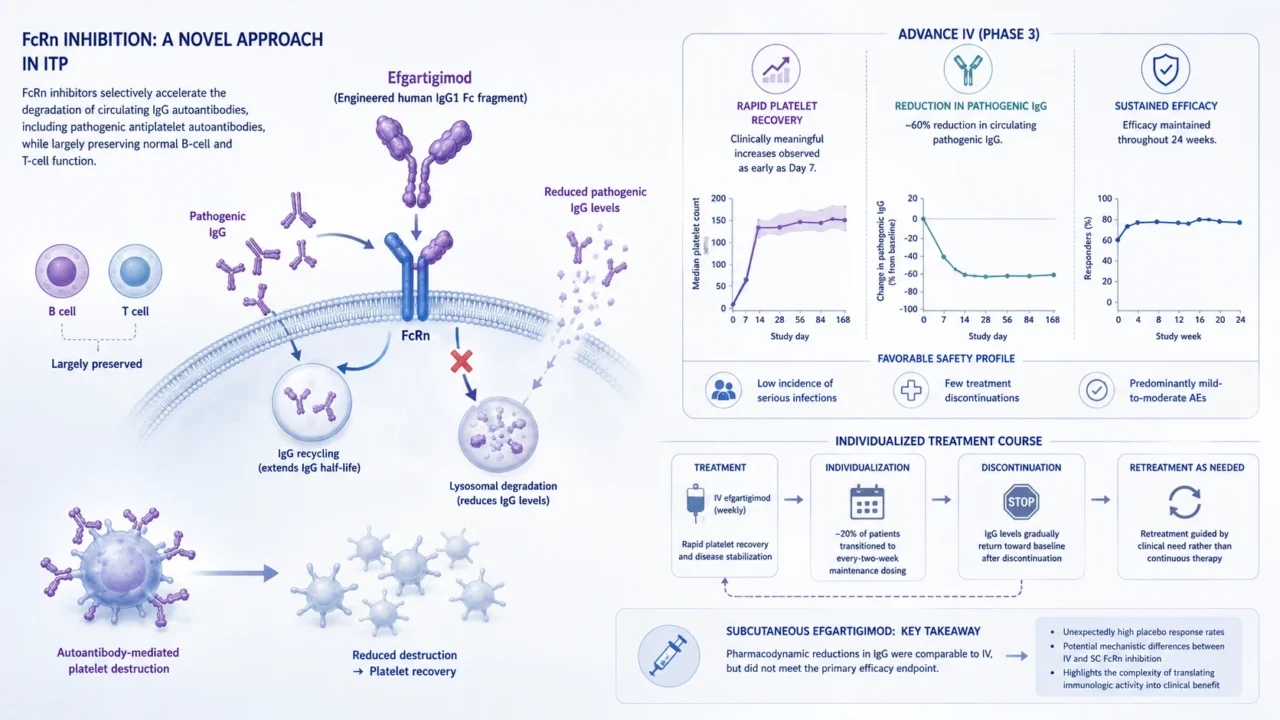
Unlike conventional immunosuppressive therapies, FcRn inhibitors selectively accelerate the degradation of circulating IgG antibodies, including pathogenic antiplatelet autoantibodies, while largely preserving normal B-cell and T-cell function.
Efgartigimod, an engineered human IgG1 Fc fragment, has become the leading agent in this therapeutic class.
By blocking FcRn-mediated IgG recycling, it promotes the clearance of pathogenic antibodies responsible for platelet destruction without broadly suppressing the immune system.
Results from the Phase 3 ADVANCE IV study demonstrated rapid platelet recovery, with clinically meaningful increases observed as early as Day 7.
Treatment also reduced circulating pathogenic IgG concentrations by approximately 60% and maintained efficacy throughout the 24-week study period.
Safety findings were equally reassuring, with a low incidence of serious infections, few treatment discontinuations, and predominantly mild-to-moderate adverse events.
An especially encouraging observation was the opportunity to individualize treatment.
Following disease stabilization, approximately one-fifth of patients successfully transitioned to every-two-week maintenance dosing, reducing treatment burden while maintaining disease control.
After discontinuation, IgG concentrations gradually returned toward baseline, allowing retreatment according to clinical need rather than continuous immunosuppression.
The panel also discussed the development of subcutaneous efgartigimod.
Although pharmacodynamic reductions in IgG were comparable to intravenous administration, the subcutaneous formulation did not achieve its primary efficacy endpoint.
Experts suggested that unexpectedly high placebo response rates and potential mechanistic differences between intravenous and subcutaneous FcRn inhibition may have contributed to these results, highlighting the complexity of translating immunologic activity into clinical benefit.
Targeting the Immune System Rather Than the Platelet
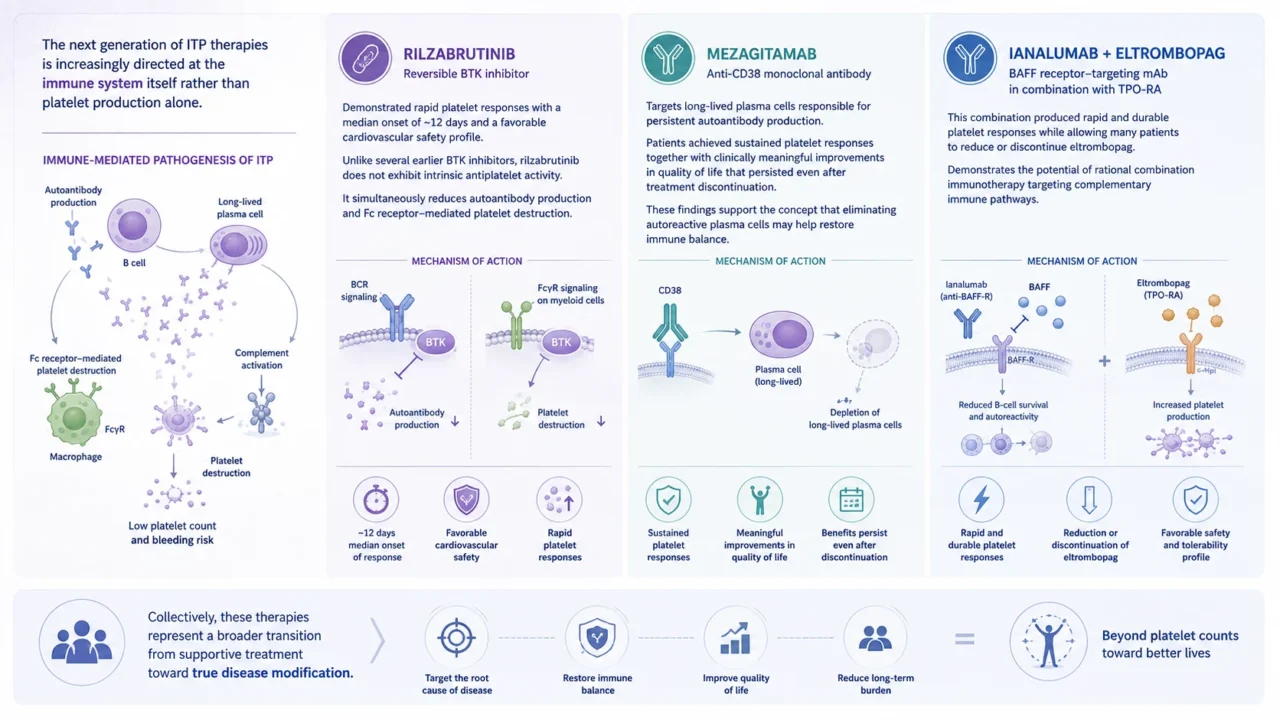
One of the strongest themes throughout the session was that the next generation of ITP therapies is increasingly directed at the immune system itself rather than platelet production alone.
Rilzabrutinib, a reversible Bruton tyrosine kinase (BTK) inhibitor, demonstrated rapid platelet responses with a median onset of approximately 12 days while maintaining a favorable cardiovascular safety profile.
Unlike several earlier BTK inhibitors, rilzabrutinib does not exhibit intrinsic antiplatelet activity. Instead, it simultaneously reduces autoantibody production and Fc receptor-mediated platelet destruction, making it an attractive candidate for earlier use in the treatment algorithm.
Equally promising were data on mezagitamab, an anti-CD38 monoclonal antibody that targets long-lived plasma cells responsible for persistent autoantibody production.
Patients achieved sustained platelet responses together with clinically meaningful improvements in quality of life that persisted even after treatment discontinuation. These findings support the concept that eliminating autoreactive plasma cells may help restore immune balance rather than simply providing temporary disease control.
Another innovative strategy focused on ianalumab, a BAFF receptor-targeting monoclonal antibody evaluated in combination with eltrombopag.
This combination produced rapid and durable platelet responses while allowing many patients to reduce or discontinue eltrombopag, demonstrating the potential of rational combination immunotherapy targeting complementary immune pathways.
Collectively, these therapies represent a broader transition from supportive treatment toward true disease modification.
Accurate Diagnosis Remains the Foundation of Treatment
Despite remarkable therapeutic advances, speakers repeatedly emphasized that immune thrombocytopenia remains fundamentally a diagnosis of exclusion.
Before initiating advanced immune-directed therapies, clinicians must carefully evaluate for secondary causes of thrombocytopenia, including autoimmune diseases, chronic infections, inherited thrombocytopenias, lymphoproliferative disorders, and hematologic malignancies.
As treatment options become increasingly sophisticated, diagnostic precision becomes even more critical.
The success of personalized therapy ultimately depends on establishing the correct diagnosis.
The Future of ITP Is Personalized
The therapeutic landscape of ITP continues to evolve rapidly. Increasingly, clinical trials are moving beyond platelet response as the primary endpoint and instead prioritizing durable remission, treatment-free intervals, restoration of immune tolerance, and patient-reported quality of life.
Future management is expected to rely on biomarker-guided therapeutic selection, individualized treatment sequencing, and rational combination strategies capable of modifying the autoimmune process while minimizing long-term treatment burden.
Rather than applying the same algorithm to every patient, clinicians are moving toward treatment strategies tailored to individual disease biology and clinical characteristics.
The Road Ahead
The ISTH 2026 Congress highlighted a pivotal moment in the evolution of immune thrombocytopenia management.
While thrombopoietin receptor agonists remain essential components of contemporary care, FcRn inhibitors, BTK inhibitors, anti-CD38 antibodies, and BAFF-targeted therapies are reshaping therapeutic expectations and expanding the possibilities for long-term disease control.
Perhaps the most important message from the session was that success in ITP is no longer defined simply by achieving a normal platelet count. Instead, it is increasingly measured by durable remission, restoration of immune homeostasis, reduced dependence on chronic therapy, and meaningful improvements in patients’ daily lives.
As our understanding of ITP biology continues to deepen, the field is moving closer to an era in which treatment is designed not only to control thrombocytopenia, but to change the natural history of the disease itself.
Written by Heghine Khachatryan, MD, PhD, Editor-in-Chief at Hemostasis Today.
Stay updated with Hemostasis Today.
-
Sep 20, 2026, 09:51Ceasovschih Alexandr: A Closer Look at Lipid Disorders in CKM Syndrome
-
Sep 20, 2026, 09:05World Stroke Academy: Can Adjunct IAT Improve Tissue Reperfusion?
-
Sep 20, 2026, 06:46Neeraj Songara: From Donated Blood to Engineered Therapeutics
-
Sep 20, 2026, 06:24Louise St. Germain Bannon: Improving Awareness and Care for Women Across the Lifespan
-
Sep 20, 2026, 05:17Maxime Dely: When ABO Compatibility Isn’t Enough for Safe Transfusion
-
Sep 20, 2026, 04:54William Aird: What Does a Complete History and Physical Really Mean?
-
Sep 20, 2026, 04:34Hons Saurabh Kaushik: Why Uncontrolled LDL Can Be Harmful
-
Sep 20, 2026, 03:58Salih Ehsan: The Complexities of HbF and HbA2
-
Sep 20, 2026, 03:22The Voices of People Living With Bleeding Disorders – EHC