


Melissa Hollo: Are All MS Symptoms Really Due to MS?
Melissa Hollo, Director of Project Management at hc1 and Licensed Independent Clinical Social Worker, shared Jordan Agay‘s post on LinkedIn, adding:
“This is such an important reminder that not every symptom should automatically be attributed to the primary diagnosis.
Fatigue, cognitive changes, and restless legs are all common in MS, but they can also signal iron deficiency, a condition that is identifiable and treatable.
Research like this reinforces the value of using data to uncover what’s hiding in plain sight.
When clinicians have the ability to proactively identify iron deficiency through longitudinal lab insights, they have another opportunity to improve a patient’s quality of life without assuming symptoms are simply disease progression.
Thank you Jordan Agay for sharing this important study and continuing to raise awareness of the critical role iron deficiency plays across so many patient populations.”
Jordan Agay, Public Health and Bioinformatics Student at The George Washington University and Clinical Product Strategy and Feedback Intern at hc1, shared a post on LinkedIn about a recent article by Sarah Patel et al., published in Blood, adding:
“A study published in Blood examining iron deficiency in female multiple sclerosis patients is something so personal to me.
It’s something I had never considered before, yet after reading it, the connection seems clear.
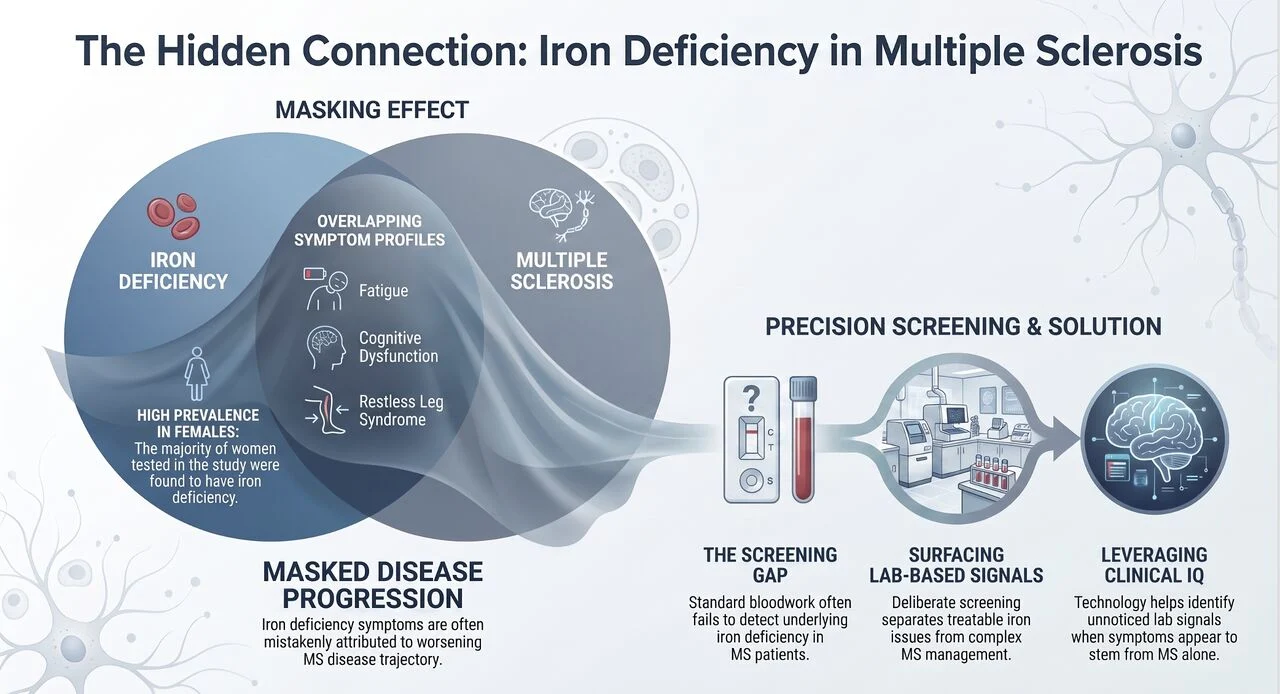
The research found a high frequency of iron deficiency in women with multiple sclerosis.
MS and iron deficiency present with several overlapping symptoms, including fatigue, cognitive dysfunction, and restless leg.
Without deliberate screening, one condition can easily mask the other, and a worsening symptom may be attributed to disease progression when the underlying cause is treatable.
That distinction matters.
Iron deficiency has established causes and treatments, while MS remains a far more complex condition to manage.
Overlooking the iron component can mean missing a meaningful opportunity to improve a patient’s quality of life, separate from the trajectory of the disease itself.
When two clinical pictures can look identical on the surface, only deliberate screening can tell them apart.
hc1’s Clinical IQ module is built for this exact challenge, surfacing lab based signals that often go unnoticed when symptoms appear to stem from a single underlying diagnosis.”
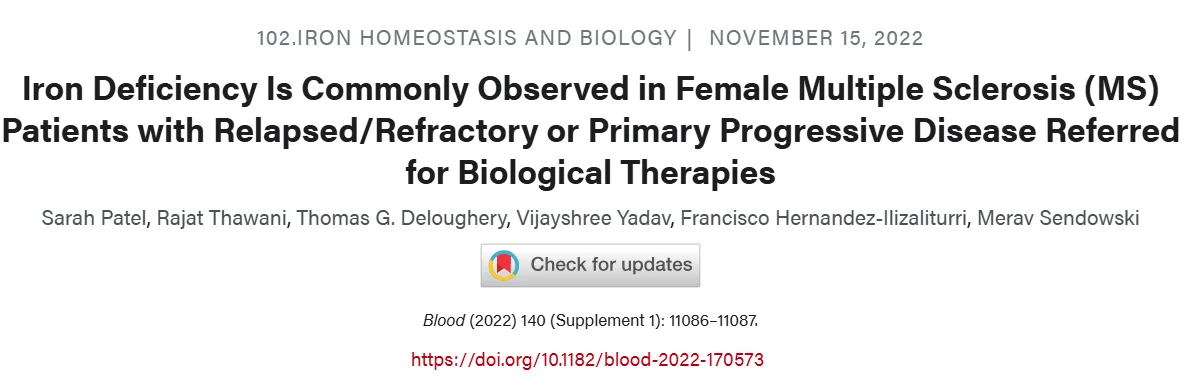
Title: Iron Deficiency Is Commonly Observed in Female Multiple Sclerosis (MS) Patients with Relapsed/Refractory or Primary Progressive Disease Referred for Biological Therapies
Authors: Sarah Patel, Rajat Thawani, Thomas G. Deloughery, Vijayshree Yadav, Francisco Hernandez-Ilizaliturri, Merav Sendowski
Other posts featuring Melissa Hollo on Hemostasis Today.
-
Sep 22, 2026, 08:06Tim Brümmendorf: Exciting Sessions Ahead at ESHBMFS2026
-
Sep 22, 2026, 08:05Samin Mohsenian: Can Factor VII Activity Predict Bleeding Severity?
-
Sep 22, 2026, 07:59Cesar de Almeida Neto: Jehovah’s Witnesses Update Their Position on Blood Components
-
Sep 22, 2026, 07:39Better Trials and Better Treatments Through Greater Inclusion – American Society of Hematology
-
Sep 22, 2026, 07:18X. Long Zheng: From ADAMTS13 to New TTP Treatment
-
Sep 22, 2026, 07:11Platelet Dependent Protection Against Bacterial Pneumonia – JTH
-
Sep 22, 2026, 07:10Sumita Pandey: Apheresis Beyond Automation
-
Sep 22, 2026, 07:04Wafik El-Deiry: Type 1 interferon Alters Clonal Competition in Human Blood Development
-
Sep 22, 2026, 06:53Tania L.: Women in Hematology Take the Stage in Austin