

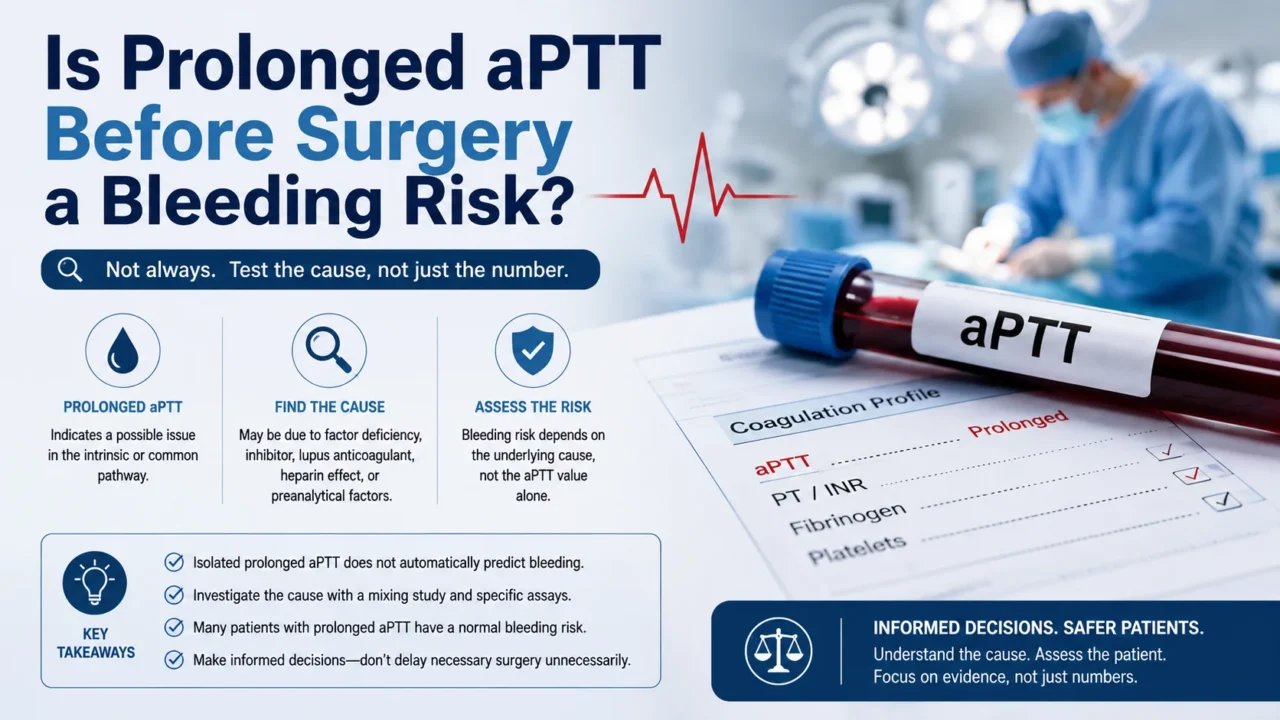
Chaza Alaji: Is Prolonged aPTT Before Surgery a Bleeding Risk?
Chaza Alaji, Medical Laboratory Specialist and Supervisor at Privat University-Private Laboratory-General Hospital, shared a post on LinkedIn:
“Prolonged aPTT Before Surgery: Is This Patient Really at Risk of Bleeding?
A 2-year-old boy is scheduled for surgery for pyloric stenosis.
Preoperative coagulation screening shows:
- PT: 10.8 sec — Normal
- aPTT: 51 sec — Prolonged
- Fibrinogen: 3.0 g/L — Normal
- Thrombin Time: 15 sec — Normal
- The surgeon asks for a hematology consultation before proceeding with surgery.
Step 1 — Don’t treat the number
An isolated prolonged aPTT with a normal PT suggests a problem involving the intrinsic pathway or the presence of an inhibitor.
The first step is simple:
Repeat the aPTT to exclude a pre-analytical or analytical error.
If the prolongation persists, proceed to the:
Mixing Study
Patient plasma is mixed 1:1 with normal plasma.
The corrected aPTT becomes:
51 sec to 37.5 sec
This significant correction suggests:
A clotting factor deficiency rather than an inhibitor.
Why?
Normal plasma supplies the missing coagulation factor, allowing the clotting time to improve.
What if the Mixing Study does NOT Correct?
This is the other major diagnostic pathway.
If the prolonged aPTT fails to correct after mixing patient plasma with normal plasma, think of an inhibitor rather than a simple factor deficiency.
Important possibilities include:
- Lupus anticoagulant — usually associated with thrombosis rather than bleeding.
- Specific factor inhibitors — particularly a Factor VIII inhibitor, which can cause significant bleeding.
- Heparin contamination — especially when the sample is collected from a line or the patient is receiving anticoagulant therapy.
So:
Correction occurs Factor deficiency
No correction indicates inhibitor or anticoagulant effect
Step 2 — Identify the deficient factor
Intrinsic pathway factor assays reveal:
Factor VIII: 89 percent
Factor IX: 78 percent
Factor XI: 72 percent
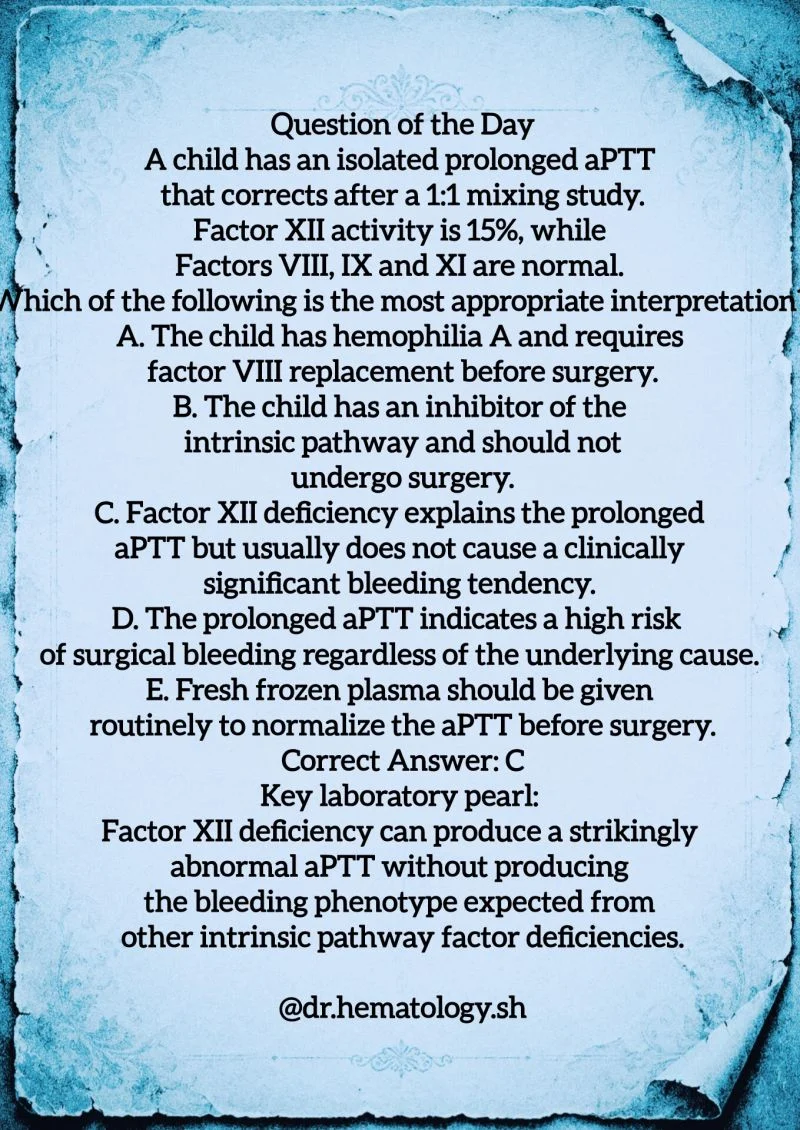
Factor XII: 15 percent
Only Factor XII is significantly reduced.
Now comes the critical clinical question:
Does Factor XII deficiency cause bleeding?
Usually, NO.
This is the important laboratory-clinical paradox.
Factor XII participates in the intrinsic coagulation pathway measured by the aPTT, so its deficiency can produce a markedly prolonged aPTT in vitro.
However, Factor XII deficiency generally does not produce a clinically significant bleeding tendency.
Therefore:
A prolonged aPTT does not automatically mean increased bleeding risk.
What does this mean for surgery?
If Factor XII deficiency is confirmed and there is no personal or family history suggesting a bleeding disorder, prophylactic plasma or factor replacement is generally not required simply to normalize the aPTT.
The laboratory abnormality should be interpreted in the context of the patient’s clinical bleeding history, not in isolation.
bleeding tendency.
Stay updated with Hemostasis Today.
-
Oct 2, 2026, 09:20Anticoagulants, Blood Thinners, or Antithrombotic Medications? – World Thrombosis Day
-
Oct 2, 2026, 06:00Susan Wickersham: Gradual Shift towards Autologous Blood Transfusion is a Current Trend
-
Oct 2, 2026, 05:54Shamee Shastry: When Every Cell Reacts – The Hunt for Rare Blood
-
Oct 2, 2026, 05:49David Mclntosh: Expanding Plasma Protein Therapies in Underserved Regions
-
Oct 2, 2026, 05:38Dianne E. van der Wal: C-Terminal Endings Impact PAR1/PAR4 Peptide Potency in In Vitro Platelet Assays
-
Oct 2, 2026, 05:29Mohammed Alo: Your LDL Isn’t a Snapshot – It’s a Smoking Habit Measured in Years
-
Oct 2, 2026, 00:33Marwa Mostafa: Hemoglobinopathies – When Globin Genes Go Wrong
-
Oct 1, 2026, 23:46Behnood Bikdeli: Global Burden of Venous Thromboembolism
-
Oct 1, 2026, 23:46Sthanu Subramanian: Clinical Presentation, Risk Factors, Diagnosis, and Neuroimaging Findings in CVT