


Ravi Kumar: Anti-Cardiolipin Antibodies – Beyond a Positive Test
Ravi Kumar, Rheumatologist at Christian Medical College, shared a post on X:
“Anti-Cardiolipin Antibodies: Beyond a Positive Test
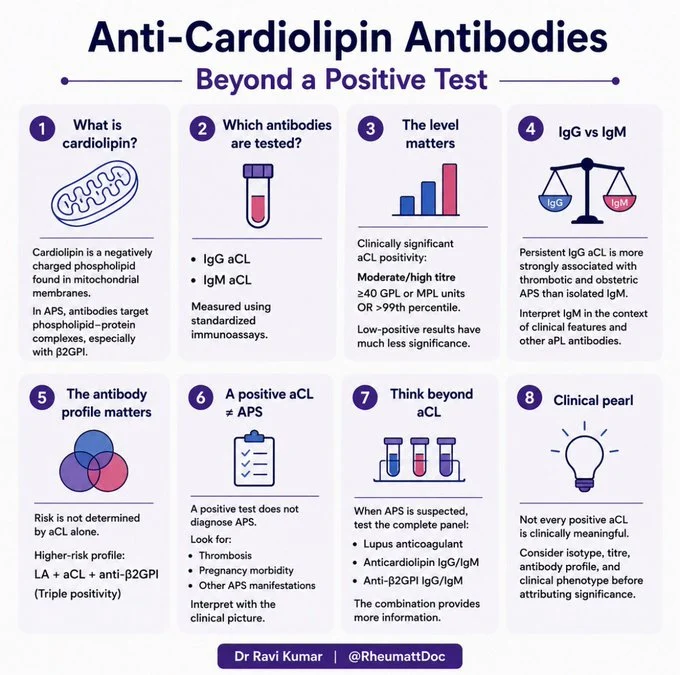
Anti-cardiolipin (aCL) antibodies are one of the three major laboratory antibodies tested in antiphospholipid syndrome (APS).
But what does a positive aCL actually mean?
Here are the key clinical points.
What is cardiolipin?
Cardiolipin is a negatively charged phospholipid found predominantly in mitochondrial membranes.
In APS, antibodies are typically directed against phospholipid – protein complexes, particularly those involving β2-glycoprotein I.
Which antibodies are tested?
APS laboratory testing includes:
- IgG aCL
- IgM aCL
These are measured using standardized immunoassays.
The level matters
For APS classification, clinically significant aCL positivity is generally:
Moderate or high titre, defined as at least 40 GPL or MPL units, or above the 99th percentile.
A low-positive result alone has much less clinical significance.
IgG vs IgM
Persistent IgG aCL is generally more strongly associated with thrombotic and obstetric APS than isolated IgM positivity.
However, IgM positivity should always be interpreted in the context of the clinical phenotype and other antiphospholipid antibodies.
The antibody profile matters
Risk is not determined by aCL alone.
A higher-risk profile includes: LA with aCL and anti-β2GPI
This is triple positivity and is associated with increased thrombotic risk.
A positive aCL test does not diagnose APS.
Look for compatible clinical manifestations such as:
- Thrombosis
- Pregnancy morbidity
- Other relevant APS manifestations
Then interpret the antibody result alongside the clinical picture.
Think beyond aCL
When APS is suspected, test the complete laboratory profile:
- Lupus anticoagulant
- Anticardiolipin IgG and IgM
- Anti-β2GPI IgG and IgM
The combination provides more information than any single antibody.
Take Home
Not every positive aCL is clinically meaningful.
Consider the isotype, titre, antibody profile, and clinical phenotype before attributing clinical significance to the result.”
Stay updated with Hemostasis Today.
-
Oct 4, 2026, 05:03Hisham Fahmi: Thromboprophylaxis in Children With ALL A Risk Adapted Approach
-
Oct 4, 2026, 05:00Mary Cushman: Erin Michos Highlights Rising Heart Disease Mortality Among Younger Women in the US
-
Oct 4, 2026, 04:48Liv Tybjærg Nordestgaard: Is Fasting Necessary Before Blood Sampling?
-
Oct 4, 2026, 04:31Sonal Sonu: Gen Z doesn’t just set trends – Gen Z saves lives
-
Oct 4, 2026, 04:22Registration Opens for 2027 Highlights of ASH – American Society of Hematology
-
Oct 4, 2026, 04:06Konstantinos Stavroulakis: Vessel Preparation in Lower Limb Revascularization
-
Oct 4, 2026, 03:34Liselotte Hyveled: Exploring Opportunities to Improve Hemophilia and Sickle Cell Care in Ghana
-
Oct 4, 2026, 02:46Arman Qamar: Drug-Coated Balloons in Coronary Bifurcation PCI
-
Oct 4, 2026, 01:13Francesc Formiga: Updated Evidence on LAA Closure Versus Oral Anticoagulation in AF