

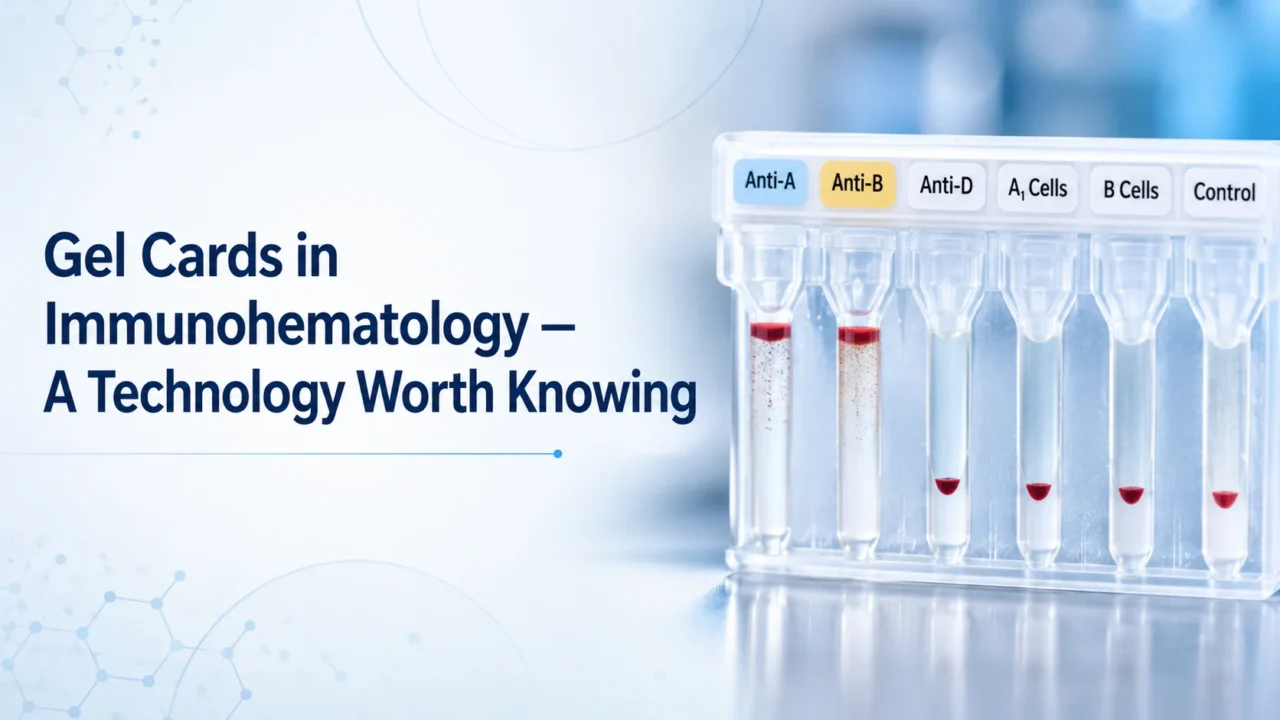
Sumyea Kabir: Gel Cards in Immunohematology – A Technology Worth Knowing
Sumyea Kabir, Assistant Professor at Zainul Haque Sikder Women’s Medical College and Hospital, shared a post on LinkedIn:
“Gel Cards in Immunohematology – A Technology Worth Knowing
Recently, I had the opportunity to meet the Bio-Rad Laboratories – team via a Renowned distributor in Dhaka , who visited our department and introduced us to their gel-card technology.
It brought back a specific memory from my residency, when I had the opportunity to work with Tulip Diagnostics PVT. Ltd. gel cards – an experience I had only once, but one that left a lasting impression.
I would genuinely like to work with gel technology again, hopefully someday soon when budget will be feasible.
What should we know about gel cards?
Column Agglutination Technology (CAT) uses a gel/matrix within microtubes to separate agglutinated and non-agglutinated RBCs during centrifugation.
- Agglutinated RBCs – remain within the gel column
- Non-agglutinated RBCs – migrate to the bottom
Major applications
Depending on the validated system and reagent:
- ABO and RhD grouping
- Reverse grouping
- Antibody screening
- Antibody identification
- DAT
- IAT / AHG testing
- Compatibility testing / crossmatch
- Antigen phenotyping
- Weak/variant D investigation
- Newborn/cord blood testing
Why is gel technology valuable?
- Standardized testing conditions
- Defined reaction endpoints
- Reproducibility
- Convenient interpretation and documentation
- Reduced manual steps in many AHG procedures
- Potential for automation
- Useful for routine immunohematology
The most important point
- The gel card detects the reaction.
- The transfusion specialist interprets it.
A positive antibody screen may still require:
- Antibody identification
- DAT/autocontrol correlation
- Phenotyping or genotyping
- Selected-cell testing
- Dosage assessment
- Adsorption/elution when indicated
- Review of transfusion and pregnancy history
- Selection of appropriate antigen-negative blood
Technology can standardize testing.
It cannot replace immunohematologic thinking.
Pros, Cons and Pitfalls of Gel Cards
Pros:
- Standardized
- Reproducible
- Easy interpretation
- Efficient workflow
- Excellent for routine serological testing
Cons:
- Higher cost
- Requires dedicated equipment and reagents
- Not a standalone solution for every complex serological problem
Pitfalls:
- Incorrect cell concentration
- Improper incubation temperature/time
- Centrifugation issues
- Poor sample quality
- Misinterpretation of weak reactions
Not every laboratory can adopt every technology immediately. But every laboratory can continue to learn, strengthen quality, and work toward better transfusion practices.”
Stay updated with Hemostasis Today.
-
Oct 12, 2026, 17:53Donna Morelli: Hydroxyurea Safe and Effective for Pediatric Sickle Cell in Africa
-
Oct 12, 2026, 17:39Annie Bauzon: Differentiating Direct and Indirect Coombs Tests in Hematology
-
Oct 12, 2026, 17:15Cedric Hermans: Identifying and Diagnosing Hemophilia Carriers and Affected Females
-
Oct 12, 2026, 17:01Bianca Rocca: Evaluating Factor XI Inhibition Lessons from LIBREXIA-ACS
-
Oct 12, 2026, 13:58Francisco Chacón-Lozsán: Catastrophic Antiphospholipid Syndrome A Rapidly Progressive Multiorgan Thrombotic Emergency
-
Oct 12, 2026, 12:50Nawsherwan Mohammad: Study Examines Thrombotic Events in Patients with Polycythemia Vera in Iraq
-
Oct 12, 2026, 12:30Chanakya Nayudu: Looking Beyond Blood Clots – Patient-Reported Outcomes in Antiphospholipid Syndrome
-
Oct 12, 2026, 12:12Jean-Jacques Kiladjian: Improving Treatment Strategies with JAK Inhibitors in Myelofibrosis
-
Oct 12, 2026, 12:04Chloe Homich: AABB Annual Meetings – Building Connections and Advancing Transfusion Medicine