


Francisco Chacón-Lozsán։ Why the Endothelial Glycocalyx Matters at the Bedside
Francisco Chacón-Lozsán, Fellow at World Extreme Medicine, Member of European Society of Intensive Care Medicine (ESICM) and American College of Cardiology, shared a post on LinkedIn about a recent article by Marcela de Almeida Lopes et al, published in Journal of Critical Care, adding:
”The endothelial glycocalyx: why it matters at the bedside
The endothelial glycocalyx is increasingly changing how we understand microcirculation, vascular permeability and fluid therapy in critically ill patients.
Rather than being simply a physical barrier covering the endothelium, the glycocalyx is a dynamic structure involved in mechanotransduction, vascular tone, anticoagulation and regulation of inflammatory cell adhesion.
This becomes particularly relevant during critical illness.
In sepsis, septic shock, trauma, burns, cardiac surgery and ARDS, inflammatory cytokines, oxidative stress, ischemia reperfusion, hyperglycemia and high catecholamine exposure can promote glycocalyx shedding. Importantly, excessive intravenous fluid administration may further contribute to this injury.
The consequence is not simply ‘capillary leak.’
Loss of glycocalyx integrity promotes interstitial edema, impaired oxygen diffusion, leukocyte and platelet adhesion, inflammation, microthrombosis and ultimately microcirculatory dysfunction.
One of the most clinically important concepts is its relationship with the revised Starling principle.
The effective oncotic pressure gradient is considered to exist primarily between plasma and the subglycocalyx space, rather than between plasma and the interstitium. Sustained venous end capillary reabsorption is minimal, with excess interstitial fluid predominantly returning through the lymphatic system.
This helps explain an everyday ICU observation:
Giving more fluid does not necessarily produce sustained intravascular volume expansion.
When the endothelial surface is already damaged, aggressive fluid administration may instead increase edema and potentially aggravate glycocalyx injury. This provides a physiological rationale for increasingly individualized and restrictive fluid strategies rather than indiscriminate liberal resuscitation.
Can we monitor the glycocalyx?
Syndecan 1, heparan sulfate, glycosaminoglycans and hyaluronan have been studied as circulating markers of shedding. Handheld vital microscopy can evaluate the microcirculation and estimate parameters associated with glycocalyx integrity, but these remain indirect measurements and are not yet standardized for routine clinical practice.
For now, perhaps the most clinically applicable strategy is prevention: avoid unnecessary fluid overload, control hyperglycemia, treat sepsis effectively and minimize ischemia reperfusion injury. No therapy has yet been conclusively demonstrated to regenerate the human glycocalyx.”
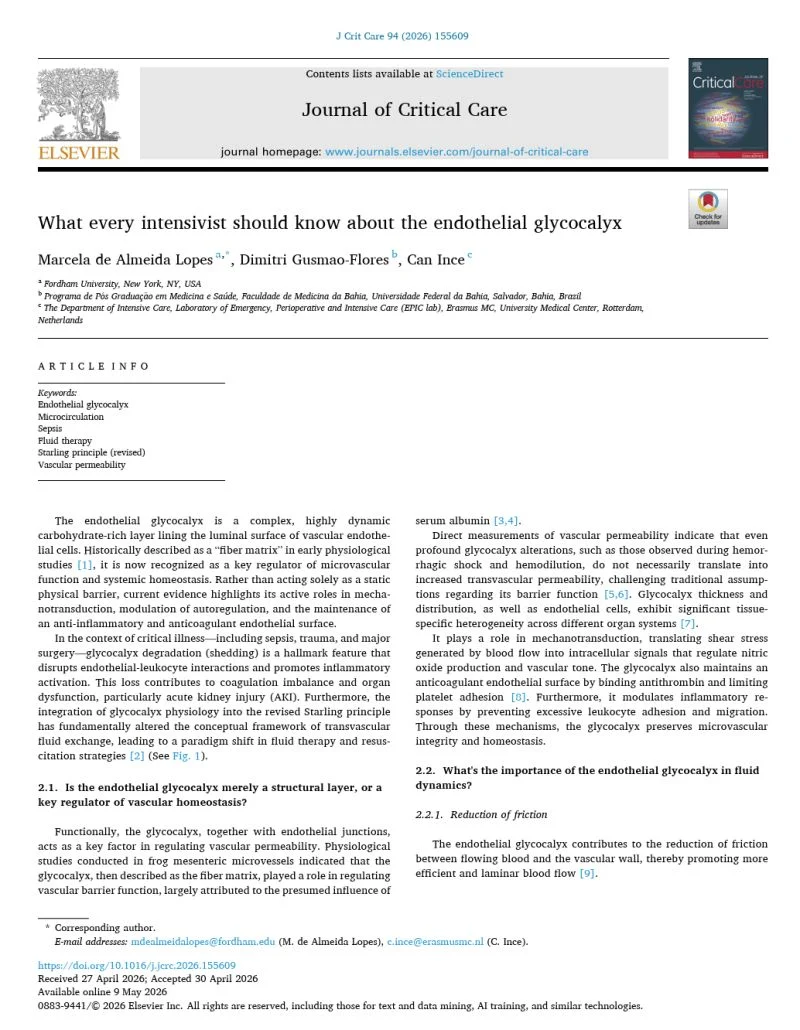
Title: What every intensivist should know about the endothelial glycocalyx
Authors: Marcela de Almeida Lopes, Dimitri Gusmao-Flores, Can Ince
Stay updated on all scientific advances with Hemostasis Today.
-
Oct 12, 2026, 17:53Donna Morelli: Hydroxyurea Safe and Effective for Pediatric Sickle Cell in Africa
-
Oct 12, 2026, 17:39Annie Bauzon: Differentiating Direct and Indirect Coombs Tests in Hematology
-
Oct 12, 2026, 17:15Cedric Hermans: Identifying and Diagnosing Hemophilia Carriers and Affected Females
-
Oct 12, 2026, 17:01Bianca Rocca: Evaluating Factor XI Inhibition Lessons from LIBREXIA-ACS
-
Oct 12, 2026, 13:58Francisco Chacón-Lozsán: Catastrophic Antiphospholipid Syndrome A Rapidly Progressive Multiorgan Thrombotic Emergency
-
Oct 12, 2026, 12:50Nawsherwan Mohammad: Study Examines Thrombotic Events in Patients with Polycythemia Vera in Iraq
-
Oct 12, 2026, 12:30Chanakya Nayudu: Looking Beyond Blood Clots – Patient-Reported Outcomes in Antiphospholipid Syndrome
-
Oct 12, 2026, 12:12Jean-Jacques Kiladjian: Improving Treatment Strategies with JAK Inhibitors in Myelofibrosis
-
Oct 12, 2026, 12:04Chloe Homich: AABB Annual Meetings – Building Connections and Advancing Transfusion Medicine