


Reza Shojaei: What the First U.S. Freeze-Dried Plasma Approval Means
Reza Shojaei, Chief Operating Officer at Canadian Plasma Resources, shared a post on LinkedIn:
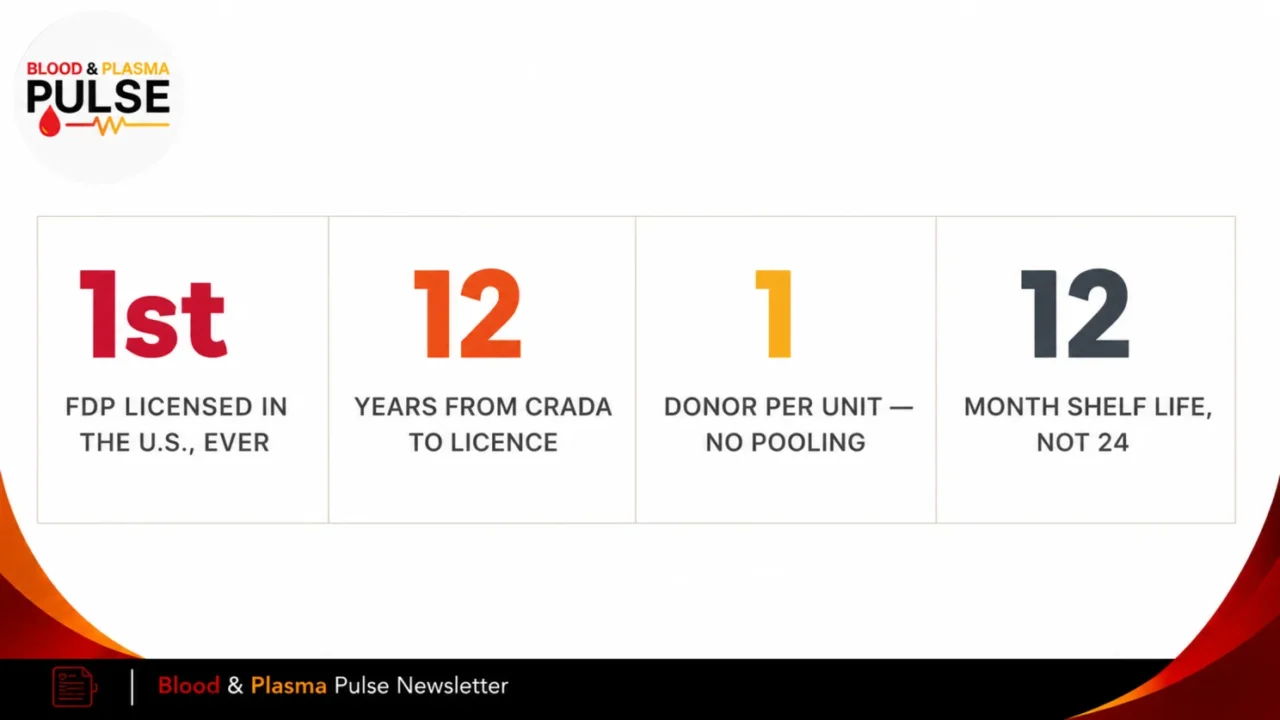
“On 29 July 2026, the FDA licensed the first freeze-dried plasma product in United States history. The interesting part is not that it happened; it is what it took, and what the label quietly concedes.
In Issue N44, Blood Plasma in a Backpack, we closed the sector-implications section with a complaint: regulatory frameworks needed to catch up with the technology, the United States had funded both the original WWII research and its revival yet had no approved product on the market, and every year of delay was a year of preventable deaths.
Seven weeks later, that gap closed (U.S. Food and Drug Administration [FDA], 2026).
This issue is not a re-telling of the dried plasma story.
If you want the 80-year arc, Strumia in 1938, the WWII tin cans, the hepatitis crisis, the 1953 suspension and 1968 withdrawal, France and Germany carrying the technology through the wilderness years, and the global adoption map as it stood in May, Issue N44 covers it all.
What follows assumes you have read it, or already know it.
What issue N44 could not tell you is how the gap closed, and what a licensed North American product changes. That turns out to be the more interesting question, because the answer is not the one the innovation narrative predicts.
The Mechanism: This Was Not Market Pull
The instinct is to read a first-ever licensure as evidence that the science finally matured or the business case finally pencilled out. Neither is what happened.
The diagnosis was published seven years ago.
Buckley and Gonzales (2019) identified the obstacles to dried plasma with precision: the regulatory pathway, funding, logistics, implementation, and commercial viability, and observed that American development efforts had been military-driven from the start, arising from the Iraq and Afghanistan conflicts.
Nothing about the 2026 licensure contradicts that diagnosis. It confirms it.
Three things had to line up, and two of them were acts of government.
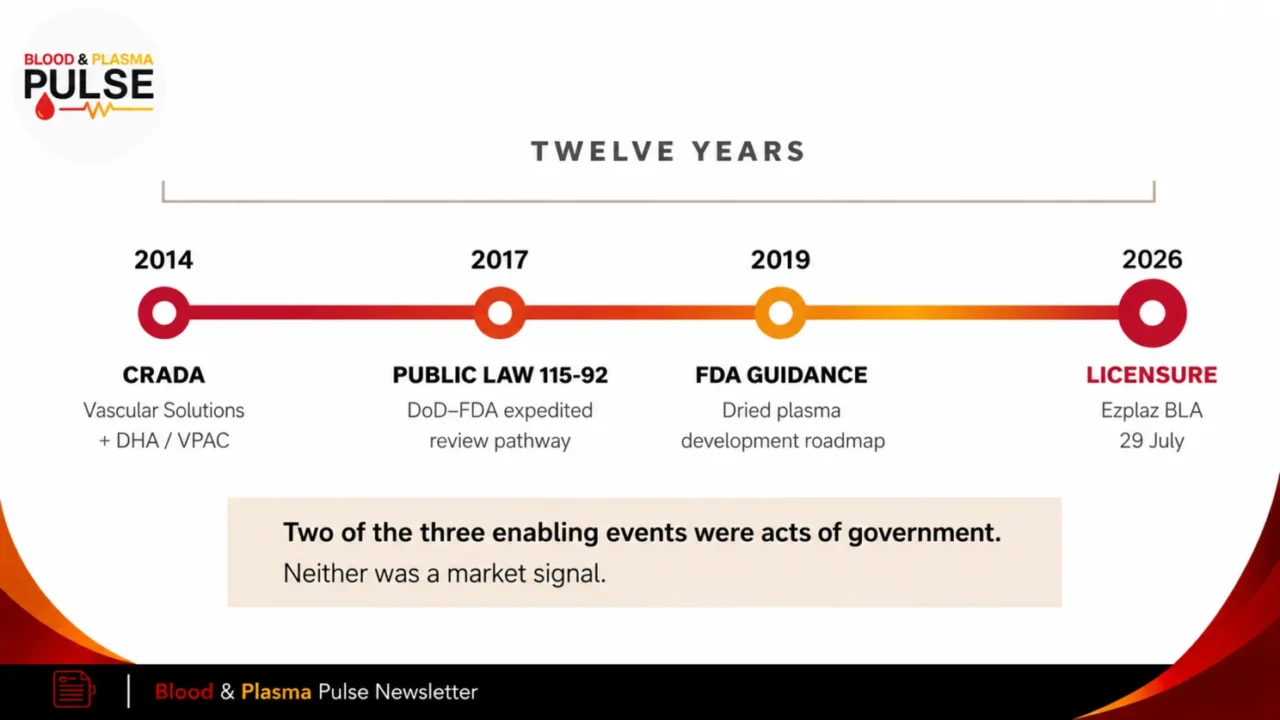
April 2014 – the CRADA: Vascular Solutions, LLC entered into a Cooperative Research and Development Agreement with the programme now known as Warfighter Protection and Acute Care (WPAC), within the Defense Health Agency (DHA).
DHA had made commercially available, FDA-approved freeze-dried plasma a stated priority precisely because the logistics of frozen plasma, freezers, thawing equipment, long thaw times, and post-thaw refrigeration do not survive battlefield conditions (Teleflex Incorporated, 2026).
December 2017 – Public Law 115-92: This authorized the DoD–FDA collaboration to expedite development and review of products for serious or life-threatening conditions facing American military personnel.
Freeze-dried plasma was among the first products identified under it (FDA, 2026).
2019 – FDA guidance: on considerations for the development of dried plasma products intended for transfusion. A roadmap, finally, for what a sponsor would have to demonstrate (FDA, 2019).
Twelve years from CRADA to licence. A commercial partner absorbed a decade of development cost against a commercial base that remains genuinely uncertain, on the strength of a defence procurement priority.
The regulatory gap we identified in June (issue N44) was real. But it did not close through regulatory reform. It closed through defence policy borrowing a regulator.
What Was Licensed; And What the Label Concedes
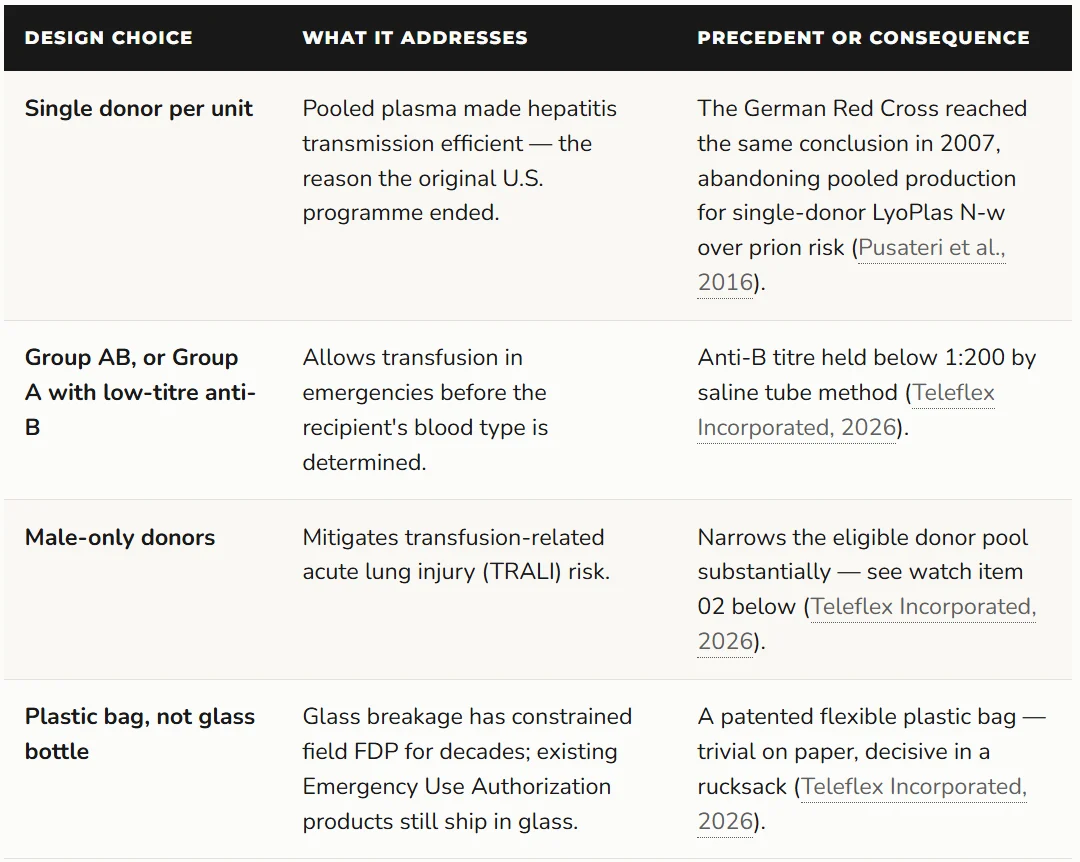
Four product decisions are worth reading closely, because each one is a lesson taken directly from the failures of the past; or a constraint the coverage has largely missed.
Table 1: Design decisions and the history behind them
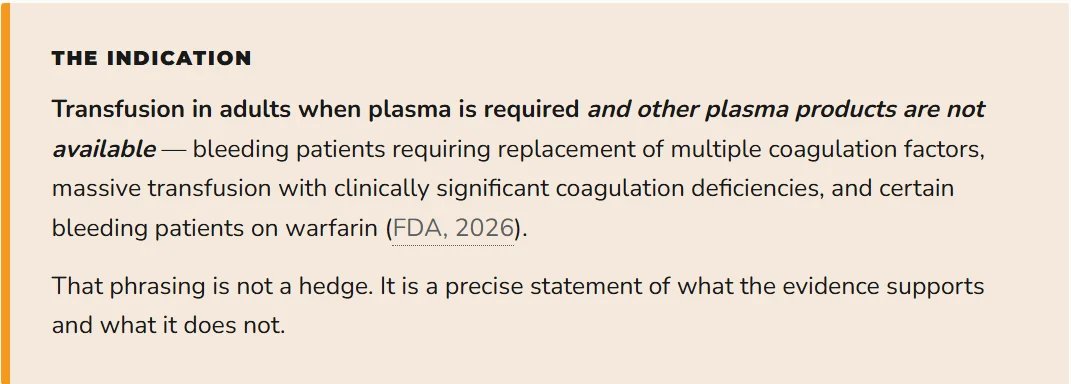
Then the indication, which is where the FDA said the quiet part out loud:
Issue N44 made this point about the literature, and the systematic evidence is unambiguous.
Sheffield et al. (2024) identified three randomized controlled trials of FDP in trauma involving 607 patients, and none reported improved clinical outcomes compared with saline or the standard of care.
The RePHILL trial found no mortality benefit (Crombie et al., 2022); PREHO-PLYO found no difference in INR at hospital arrival (Jost et al., 2022). The FDA has now written that limitation into the label itself.
The logistical case is closed. The comparative-efficacy case is not, and the label knows it.
The shelf-life problem nobody is mentioning
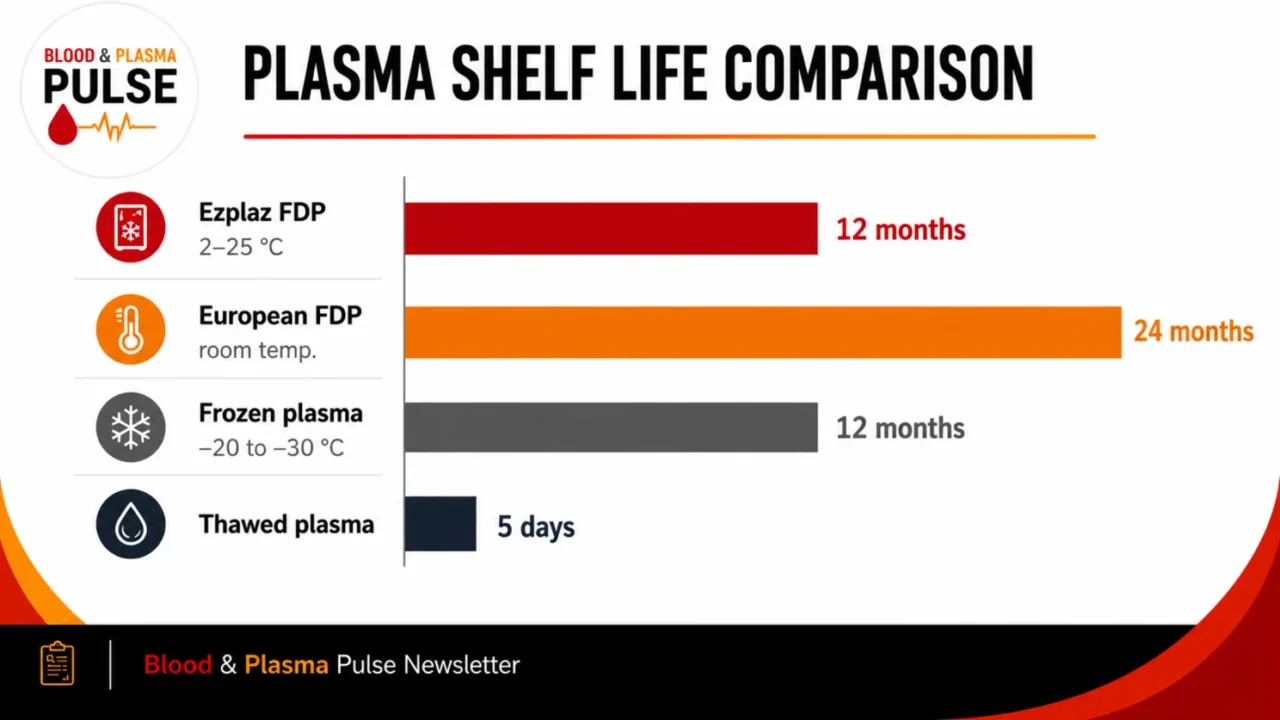
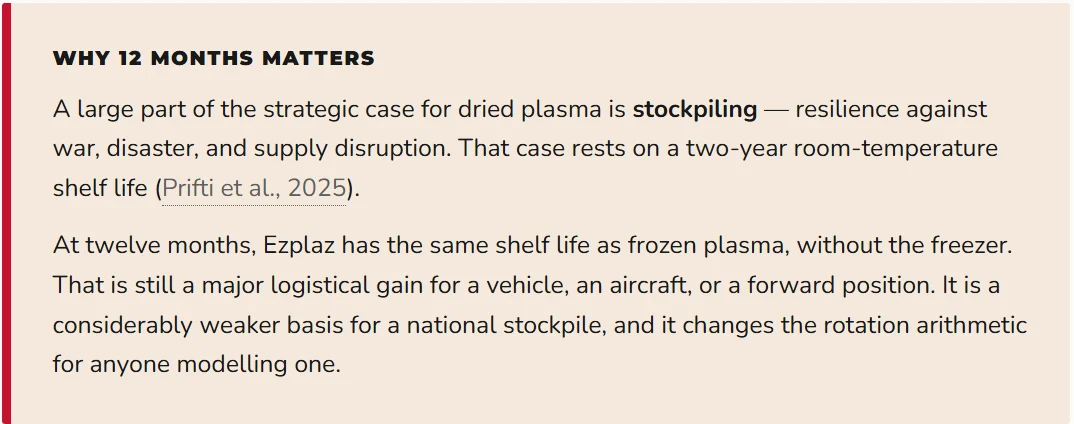
Here is the detail that has slipped past most of the coverage, and it matters more than the plastic bag.
The Two Drying Technologies Just Diverged
Issue N44 framed freeze-drying and spray-drying as two routes to the same destination: the bakery and the food truck.
That framing held in June. It does not hold now.
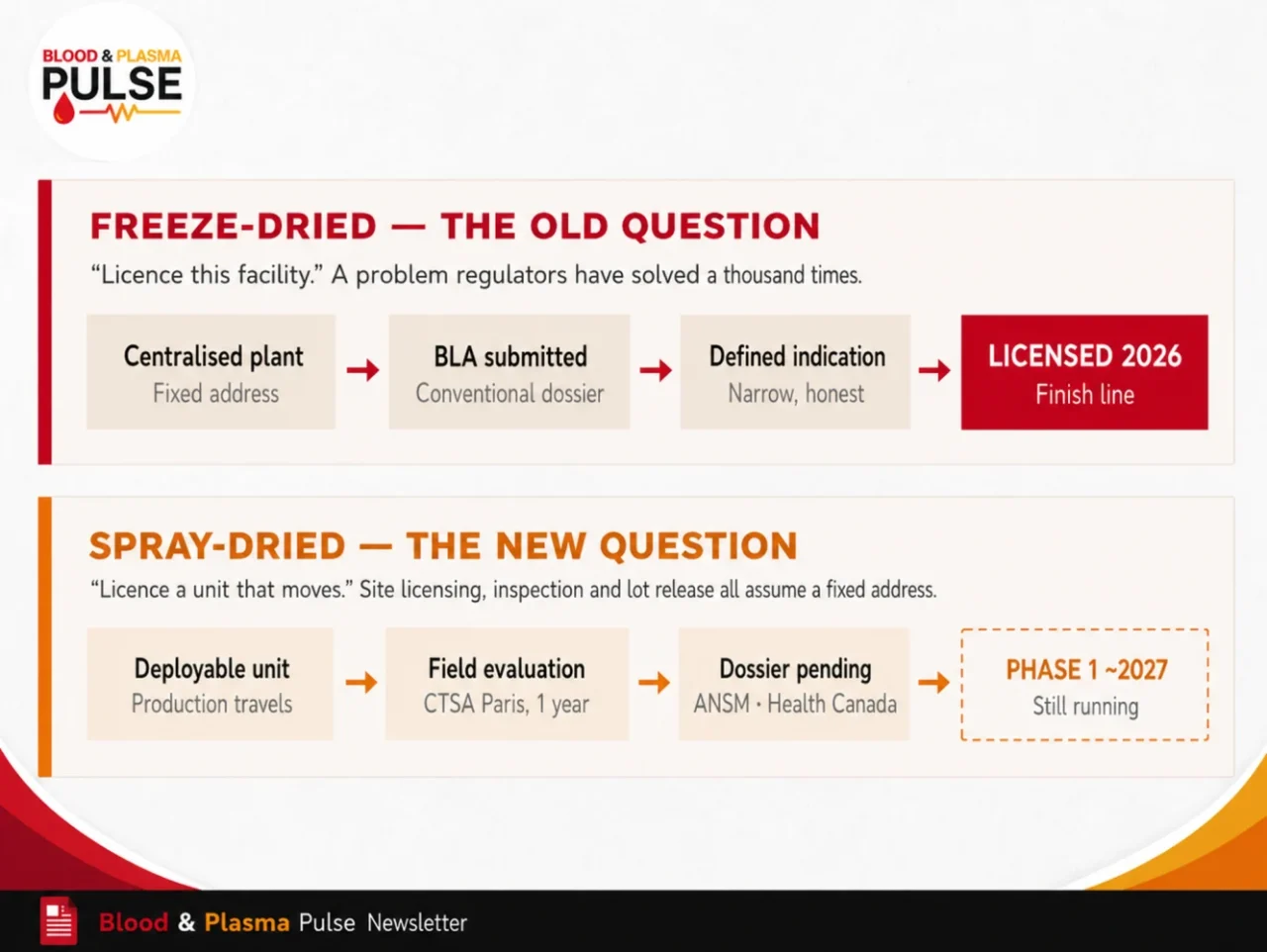
Freeze-drying has taken the conventional route: centralized manufacture, a biologics licence application, a full approval, a defined indication, and a supply chain built around a fixed facility.
Spray-drying is taking the decentralized route: Canadian Blood Services, with the Department of National Defense, is developing a domestic dried plasma using spray-drying technology and Canadian donors; that product is currently for research use only and is expected to enter phase 1 trials by 2027, pending Health Canada approval (Prifti et al., 2025). Internationally, interest in single-donor spray-dried plasma is rising in both military and civilian settings (Peddle et al., 2026).
These are now genuinely different regulatory propositions, not two variants of one product category. Licensing a manufacturing facility is a problem regulators have solved a thousand times.
Licensing a deployable manufacturing unit, where the entire point is that production happens wherever the container goes, is a problem nobody has fully solved.
The site-licensing model, the inspection model and the lot-release model all assume a fixed address.
What Changes for Canada, This Quarter
This is the part with the nearest-term operational consequence, and #44 barely touched it. Canada is running two tracks, and the product on each is architecturally different from Ezplaz.
Table 2: Regulatory status, not adoption status
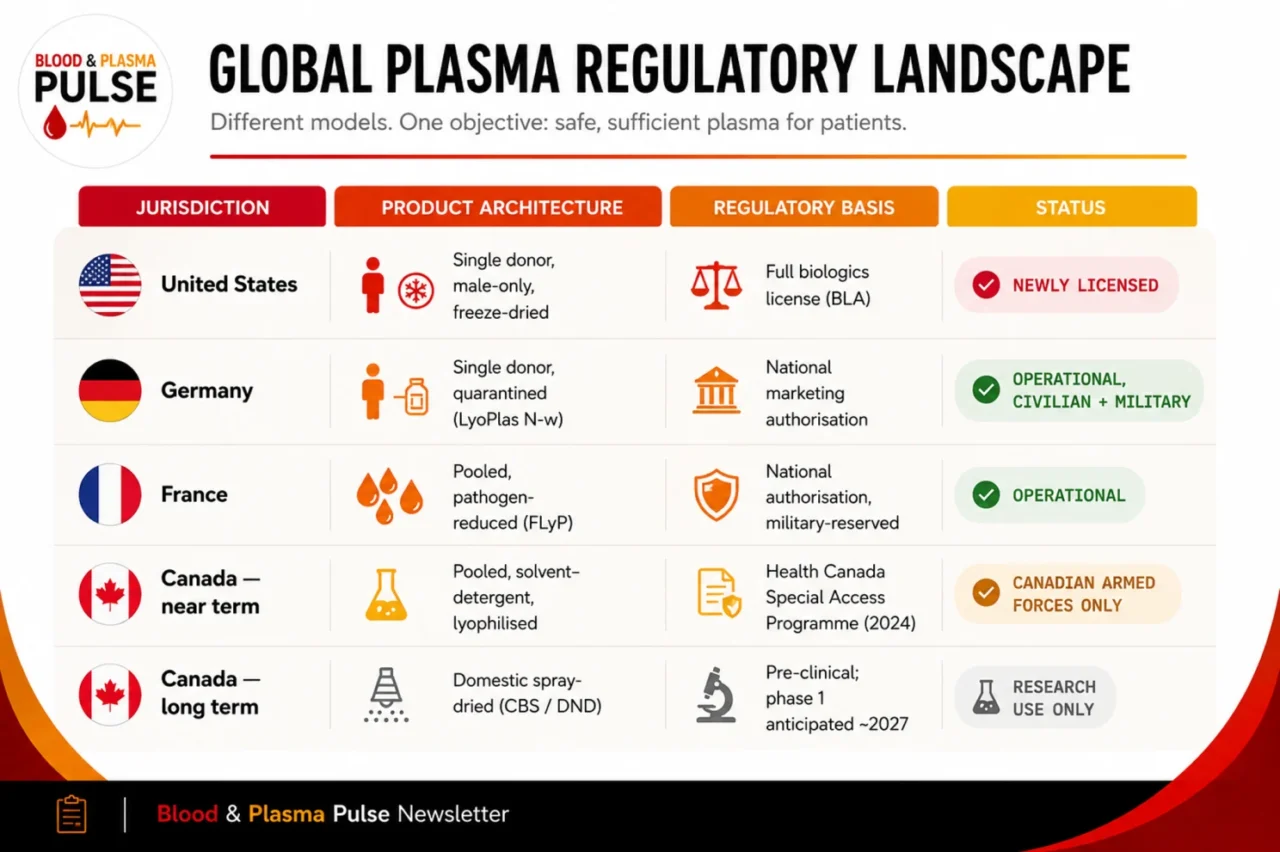
Near-term access: In 2024, under Health Canada’s Special Access Programme, the Canadian Armed Forces were authorized to use a commercially produced dried plasma for trauma resuscitation (Prifti et al., 2025).
That product is a pooled-donor, solvent–detergent-lyophilized plasma, and its authorization is limited to the CAF (Peddle et al., 2026).
SAP is a case-by-case, unlicensed-product mechanism; it is workable but not a foundation for civilian scale-up.
Long-term sovereignty: The domestic Canadian Blood Services programme aims to achieve broader military and civilian access, lower costs, and improved supply security during crises (Prifti et al., 2025). It is years from licensure.
A licensed North American product materially changes the first track. A U.S. BLA is not a Health Canada authorization, but the procurement conversation, the evidentiary package, the manufacturing inspection history, and the supply reliability argument all look different when the product on offer is licensed on this continent rather than imported on a case-by-case basis under special access.
Note also the architectural contrast: the SAP product is pooled and solvent–detergent treated; Ezplaz is single-donor and male-only. Those are different safety philosophies, and a Canadian evaluation would have to reason about both.
The question is no longer whether dried plasma belongs in civilian trauma care.
It is whether Canada runs a licensed-import bridge while the domestic programme matures, and what the rural, remote and Indigenous trauma burden costs during the waiting.
The equity argument is not rhetorical. Peddle et al. (2026) describe Canadian ‘blood deserts’ where patients, disproportionately in rural, remote and Indigenous communities, wait hours for any blood product, and argue that deployment strategies should prioritize exactly those communities, in partnership with Indigenous leadership and local health authorities.
Three Things the Sector Should Be Watching
01 A device company just entered blood components
This is Teleflex’s first biologics licence for a blood component (Teleflex Incorporated, 2026).
Medical technology manufacturer – QuikClot, Arrow, LMA – now holds a BLA. Expect more of this. The competencies that make a company good at deployable emergency kit, are not the competencies of a traditional fractionator, and the field-medicine segment rewards the former.
02 The donor pool for this product is narrower than it looks
Issue N44 suggested dried plasma could create a third pathway alongside fractionation and hospital frozen plasma. Ezplaz makes that concrete, and constrained.
Each unit must be Group AB or low-titre Group A and from a male donor (Teleflex Incorporated, 2026). AB is scarce to begin with; the male-only TRALI mitigation halves what remains.
If volumes ramp, the allocation question gets real, and collection organizations should model it now rather than react later.
03 Wastage economics, not unit price, will decide civilian adoption
Dried plasma runs roughly $500–800 per unit against about $150 for frozen plasma (Prifti et al., 2025), a three- to five-fold premium.
But thawed plasma wastage at low-volume sites is chronic: one Canadian transport programme saw thawed-plasma wastage double after adding it to a blood-on-board service, driven by the five-day post-thaw window (Peddle et al., 2026).
Total cost of ownership at a base that transfuses plasma unpredictably is what matters, and nobody has published it convincingly yet.
The Bottom Line
Issue N44 ended by saying dried plasma was back and the challenge was scale. That was right, but incomplete. The challenge was scale and a pathway, and the pathway turned out to require a defence statute, a twelve-year industrial partnership, and a regulator willing to write an honest indication.
None of that is repeatable in most markets.
Which is the uncomfortable implication: the countries with operational dried plasma programmes today, France, Germany, and now the United States, got there through military necessity, not through health-system planning. The places with the highest trauma burden and the weakest cold chain have no such lever.
Eighty years to get back to a product that already worked. The next question is whether it takes another eighty to get it anywhere that does not have an army willing to pay for it.
Missed the background?
Issue N44: Blood Plasma in a Backpack (5 June 2026) covers the full history of dried plasma, the freeze-dried versus spray-dried comparison, the clinical evidence base, and the global adoption picture as of mid-2026.
This issue picks up exactly where it left off.”
Other posts featuring Reza Shojaei on Hemostasis Today.
-
Oct 7, 2026, 16:44Amor Salah: 2026 NCS/SCCM Guidelines for Managing Antithrombotic-Associated ICH
-
Oct 7, 2026, 16:04NETs in Thrombosis: From Mechanism to Therapeutic Target
-
Oct 7, 2026, 15:28Amir Samimi: Prognostic Value of Platelet Count in Resected HNSCC
-
Oct 7, 2026, 15:21Eloïse Laouenan: Bridging Immunity and Thrombosis in MVTE
-
Oct 7, 2026, 15:10Uthra Sundaram: Honouring Donors During International Plasma Awareness Week
-
Oct 7, 2026, 15:04Daniel Victor Ortigoza: Should Frail Older Patients With AF Switch From VKA to DOACs?
-
Oct 7, 2026, 14:53Susan Noone: Donor Turned Recipient Shares Lifesaving Transfusion Story
-
Oct 7, 2026, 14:49Aimee Burtenshaw: The Impact of the Infected Blood Inquiry on Hospital Transfusion Laboratories
-
Oct 7, 2026, 14:41Vikash Jaiswal: Does Timing Matter for Calcium in Pre-Eclampsia Prevention?