


Ahmed Alotaibi: Could Spray-Dried Plasma Redefine Transfusion Medicine?
Ahmed Alotaibi, Senior specialist (Blood bank and blood transfusion) at Afif General Hospital – Riyadh Third Health Cluster (Ministry of Health), shared a post on LinkedIn:
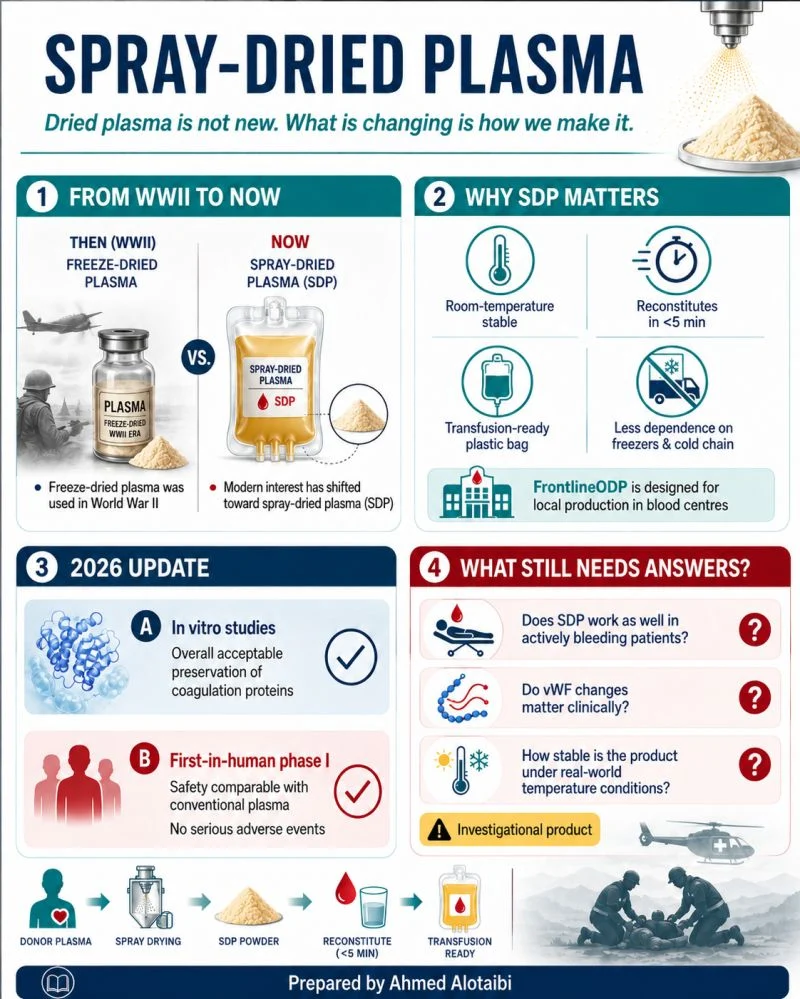
”Dried plasma is not new. What is changing is how we produce and deploy it.
Dried plasma was used extensively during World War II because it could be stored and transported without the cold-chain requirements of conventional plasma.
Even spray-dried plasma has historical roots, but modern technology is bringing the concept back in a very different form:
Spray-dried plasma (SDP).
Plasma is atomised into tiny droplets and rapidly dried into a fine powder that can later be reconstituted for transfusion.
Why does that matter?
The potential advantages are practical:
- Room-temperature storage potential
- Rapid reconstitution within minutes
- Packaging in a transfusion-ready plastic bag
- Reduced dependence on freezers and cold-chain infrastructure
One product in development, FrontlineOD, is particularly interesting because the system is designed to be installed directly in blood centres, potentially allowing decentralised local production.
And 2026 brought important progress.
Recent in-vitro studies reported overall acceptable preservation of coagulation proteins after spray drying, although changes in factors including vWF activity and FXIII have been observed.
A first-in-human phase I trial involving 24 healthy volunteers also reported a safety profile comparable with conventional frozen plasma.
But important questions remain.
Does SDP provide equivalent haemostatic efficacy in actively bleeding patients?
Do changes in vWF activity matter clinically?
How stable will the product remain across real-world temperature conditions?
So the development is not simply dried plasma itself.
The real advance is whether modern spray drying can make plasma easier to manufacture, store, transport and deploy closer to the bleeding patient.
That could matter enormously in prehospital, military and remote transfusion medicine.
References:
- Walsh GM. Transfusion Today, ISBT. 2026.
- Pusateri AE, et al. Transfusion. 2026.
- Booth GS, et al. Transfusion. 2012.
- Liu QP, et al. Transfusion. 2019.
- Sohn J, et al. Transfusion. 2026.
- Bower L, et al. Transfusion. 2026.
- Cancelas JA, et al. Transfusion. 2026.
- Mitra B, et al. Transfusion. 2025.”
Stay updated with Hemostasis Today.
-
Oct 12, 2026, 17:39Annie Bauzon: Differentiating Direct and Indirect Coombs Tests in Hematology
-
Oct 12, 2026, 17:15Cedric Hermans: Identifying and Diagnosing Hemophilia Carriers and Affected Females
-
Oct 12, 2026, 17:01Bianca Rocca: Evaluating Factor XI Inhibition Lessons from LIBREXIA-ACS
-
Oct 12, 2026, 13:58Francisco Chacón-Lozsán: Catastrophic Antiphospholipid Syndrome A Rapidly Progressive Multiorgan Thrombotic Emergency
-
Oct 12, 2026, 12:50Nawsherwan Mohammad: Study Examines Thrombotic Events in Patients with Polycythemia Vera in Iraq
-
Oct 12, 2026, 12:30Chanakya Nayudu: Looking Beyond Blood Clots – Patient-Reported Outcomes in Antiphospholipid Syndrome
-
Oct 12, 2026, 12:12Jean-Jacques Kiladjian: Improving Treatment Strategies with JAK Inhibitors in Myelofibrosis
-
Oct 12, 2026, 12:04Chloe Homich: AABB Annual Meetings – Building Connections and Advancing Transfusion Medicine
-
Oct 12, 2026, 11:51Daniel Sop: Sickle Cell Research Takes Center Stage at ASCAT 2026