


Pall T. Onundarson: The Role of Measuring Treatment Effect in Optimizing DOAC and Warfarin Therapy
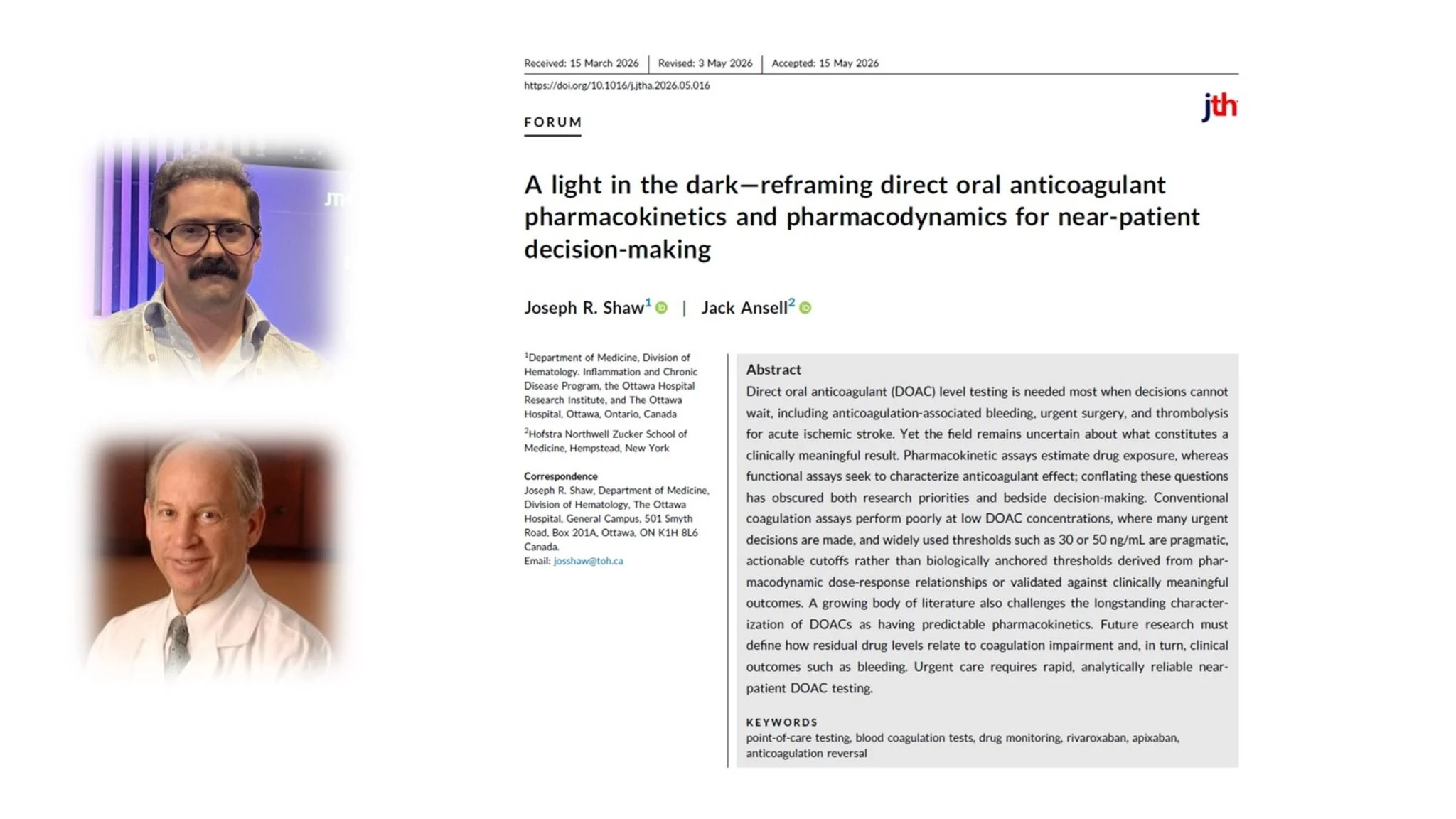
Pall T. Onundarson, Professor Emeritus of Hematology at University of Iceland, shared a post on LinkedIn, about a recent article by Joseph R Shaw and Jack Ansell, published in Journal of Thrombosis and Haemostasis, adding:
“In no monitoring of anticoagulant drugs a form of laziness?
A forum article by Joseph Shaw and Jack Ansell in the August 2026 JTH issue discusses anticoagulant monitoring of DOACs.
They argue that DOACs need measurement. They ask if we should measure drug concentrations or biological effects such as anti-FXa activity or thrombin generation.
They discuss the challenge of monitoring drugs with rapid peak–trough fluctuations (DOACs) versus those with a more stable within-day anticoagulant effect (warfarin).
I have long argued that anticoagulant dosing should be tailored to a patient´s need by measuring anticoagulant effect, rather than simply to age, body weight, drug concentration, or creatinine clearance.
The same drug concentration can produce different anticoagulant effects in different individuals. For over 20 years, I have argued that anti-FXa levels are preferable to APTT for monitoring heparins.
About 10 years ago we had anti-Xa based DOACs assays available 24/7. Based on own and others´experimental and clinical evidence, I have questioned whether PT-INR accurately reflects the anticoagulant effect of VKAs. I concluded that measuring a different effect, namely factors II and X only, improves warfarin treatment and outcomes.
We know that well-managed PT-INR monitored warfarin (‘PT-warfarin’) performs at least as well as unmonitored DOAC treatment.
Furthermore, RCTs have shown warfarin to be superior to DOACs in several high-risk conditions, including mechanical heart valves, rheumatic heart disease with AF, frail AF patients, and antiphospholipid syndrome.
Warfarin remains important in LVAD patients and many AF and VTE patients. Warfarin isn´t going anywhere.
Good PT-warfarin management generally means maintaining PT-INR in therapeutic range >70percent of the time. Outcomes are best with self-management in select patients and centralized anticoagulation services using dosing software.
Our Fiix-NR studies challenge the assumption that PT-INR should be used at all to manage long-term warfarin/VKAs.
Fiix-NR more accurately reflects thrombin generation, stabilizes treatment, reduces dose changes, and improves clinical outcomes. Independent studies are now underway.
Unfortunately, the medical profession seems to have little interest in improving warfarin monitoring. The decades-old “warfarin hate factor” remains strong, while the appealing “no monitoring” concept of DOACs has been widely embraced. It is so easy…
But as people increasingly realize that DOAC treatment requires anticoagulation stewardship, this “no-monitoring” argument is losing force.
Patients age, conditions change, and drug interactions occur – often without measurement to alert the physician. DOAC treatment is therefore not simply a matter of writing a prescription and letting the patient loose.
As Shaw and Ansell emphasize, measuring DOAC exposure or biological anticoagulant effect is important in selected situations, particularly with bleeding or treatment failure.”
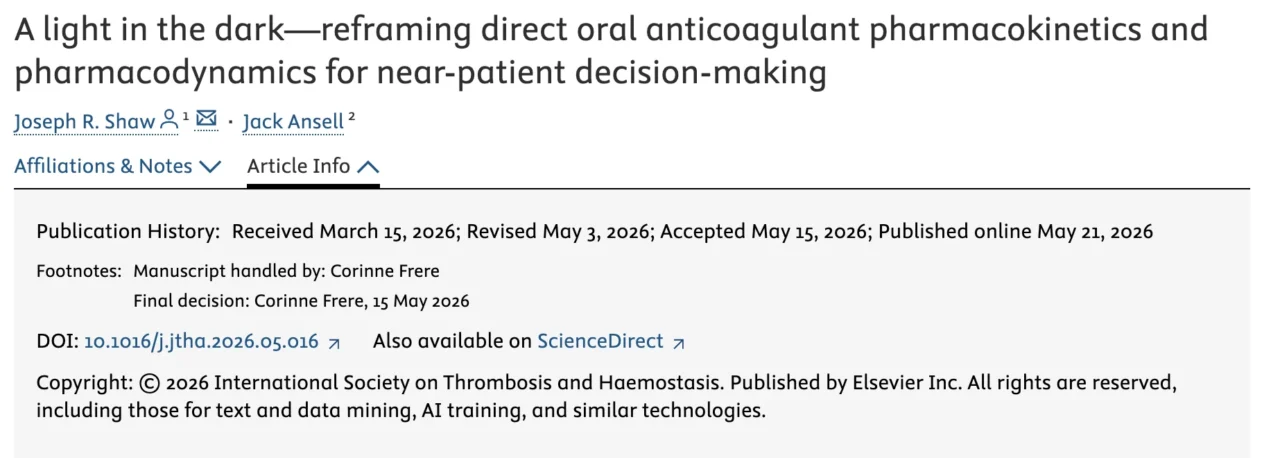
Title: A light in the dark—reframing direct oral anticoagulant pharmacokinetics and pharmacodynamics for near-patient decision-making
Authors: Joseph R. Shaw, Jack Ansell
Stay updated on all scientific advances with Hemostasis Today.
-
Oct 12, 2026, 13:58Francisco Chacón-Lozsán: Catastrophic Antiphospholipid Syndrome A Rapidly Progressive Multiorgan Thrombotic Emergency
-
Oct 12, 2026, 12:50Nawsherwan Mohammad: Study Examines Thrombotic Events in Patients with Polycythemia Vera in Iraq
-
Oct 12, 2026, 12:30Chanakya Nayudu: Looking Beyond Blood Clots – Patient-Reported Outcomes in Antiphospholipid Syndrome
-
Oct 12, 2026, 12:12Jean-Jacques Kiladjian: Improving Treatment Strategies with JAK Inhibitors in Myelofibrosis
-
Oct 12, 2026, 12:04Chloe Homich: AABB Annual Meetings – Building Connections and Advancing Transfusion Medicine
-
Oct 12, 2026, 11:51Daniel Sop: Sickle Cell Research Takes Center Stage at ASCAT 2026
-
Oct 12, 2026, 10:36PAI-1 Inhibition as a New Strategy for Enhancing Fibrinolysis and Clot Resolution
-
Oct 12, 2026, 07:39Emmanuel J Favaloro: 100 Years of von Willebrand Disease and the Importance of Local Diagnosis and Management
-
Oct 12, 2026, 07:39Post-Stroke Fatigue Trajectories – 38% Recovered at 12 Months, While 16% Developed New Fatigue – International Journal of Stroke