


Ahmed Alotaibi: How Common are Clinically Important Red Cell Antibodies in Pregnancy?
Ahmed Alotaibi, Senior Specialist (Blood bank and blood transfusion) at Afif General Hospital – Riyadh Third Health Cluster (Ministry of Health), shared a post on LinkedIn:
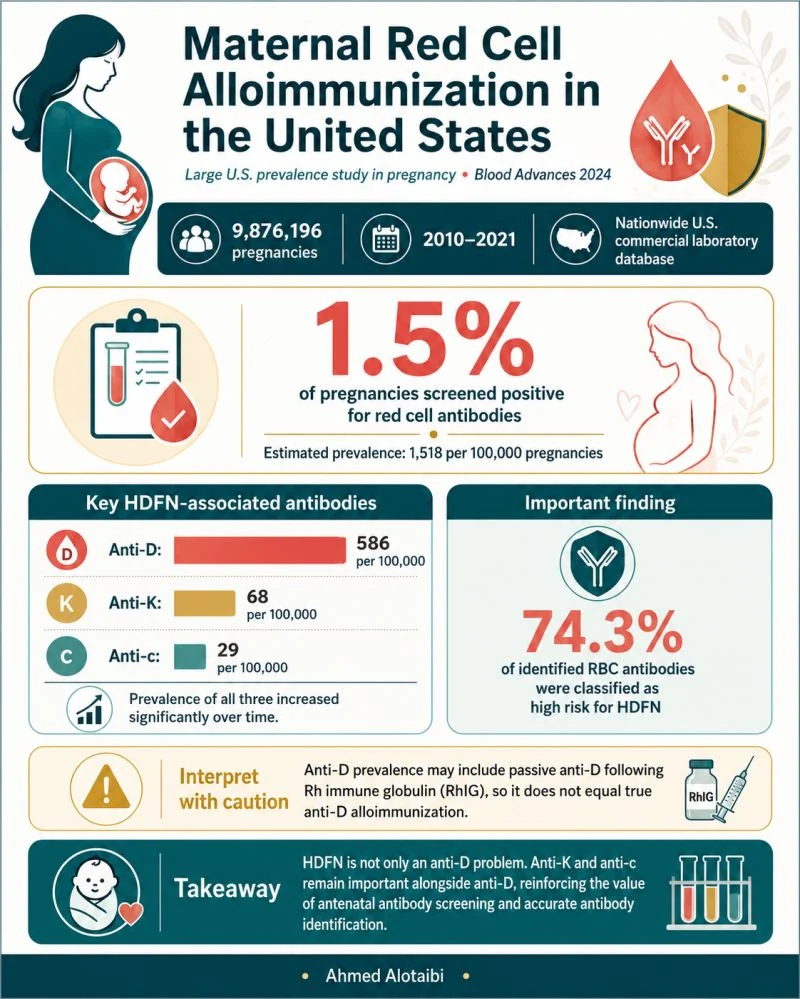
“How common are clinically important red cell antibodies in pregnancy?
A large U.S. study published in Blood Advances gives us one of the clearest recent pictures.
The investigators analysed 9,876,196 pregnancies between 2010 and 2021 using a nationwide commercial laboratory database.
The headline finding:
1.5% of pregnancies screened positive for red cell antibodies, corresponding to an estimated prevalence of 1,518 per 100,000 pregnancies.
Among important HDFN-associated antibodies:
- Anti-D: 586 per 100,000 pregnancies
- Anti-K: 68 per 100,000
- Anti-c: 29 per 100,000
The prevalence of all three increased significantly over the study period.
Another striking finding was that 74.3% of the identified RBC antibodies were classified by the investigators as high risk for HDFN.
One important caveat: anti-D accounted for a large proportion of detected antibodies, but the laboratory data could not reliably distinguish true immune anti-D from passive anti-D following Rh immune globulin, so the anti-D prevalence must be interpreted carefully.
What I found particularly interesting is that anti-K and anti-c remain important alongside anti-D. HDFN is clearly not only an ‘anti-D problem.’
For blood banks, this reinforces the importance of antenatal antibody screening, accurate antibody identification, appropriate follow-up, and close communication between transfusion laboratories, obstetric teams, and fetal medicine services.
Question for discussion:
Should we place greater emphasis on preventing red-cell alloimmunisation before pregnancy, for example through more extensive antigen matching in females of reproductive potential?”
Stay updated with Hemostasis Today.
-
Oct 12, 2026, 17:39Annie Bauzon: Differentiating Direct and Indirect Coombs Tests in Hematology
-
Oct 12, 2026, 17:15Cedric Hermans: Identifying and Diagnosing Hemophilia Carriers and Affected Females
-
Oct 12, 2026, 17:01Bianca Rocca: Evaluating Factor XI Inhibition Lessons from LIBREXIA-ACS
-
Oct 12, 2026, 13:58Francisco Chacón-Lozsán: Catastrophic Antiphospholipid Syndrome A Rapidly Progressive Multiorgan Thrombotic Emergency
-
Oct 12, 2026, 12:50Nawsherwan Mohammad: Study Examines Thrombotic Events in Patients with Polycythemia Vera in Iraq
-
Oct 12, 2026, 12:30Chanakya Nayudu: Looking Beyond Blood Clots – Patient-Reported Outcomes in Antiphospholipid Syndrome
-
Oct 12, 2026, 12:12Jean-Jacques Kiladjian: Improving Treatment Strategies with JAK Inhibitors in Myelofibrosis
-
Oct 12, 2026, 12:04Chloe Homich: AABB Annual Meetings – Building Connections and Advancing Transfusion Medicine
-
Oct 12, 2026, 11:51Daniel Sop: Sickle Cell Research Takes Center Stage at ASCAT 2026