


Ifeanyichukwu Ifechidere: Coagulation Knowledge in Cardiology
Ifeanyichukwu Ifechidere, Specialist Biomedical Scientist at Sheffield Teaching Hospitals, shared on LinkedIn:
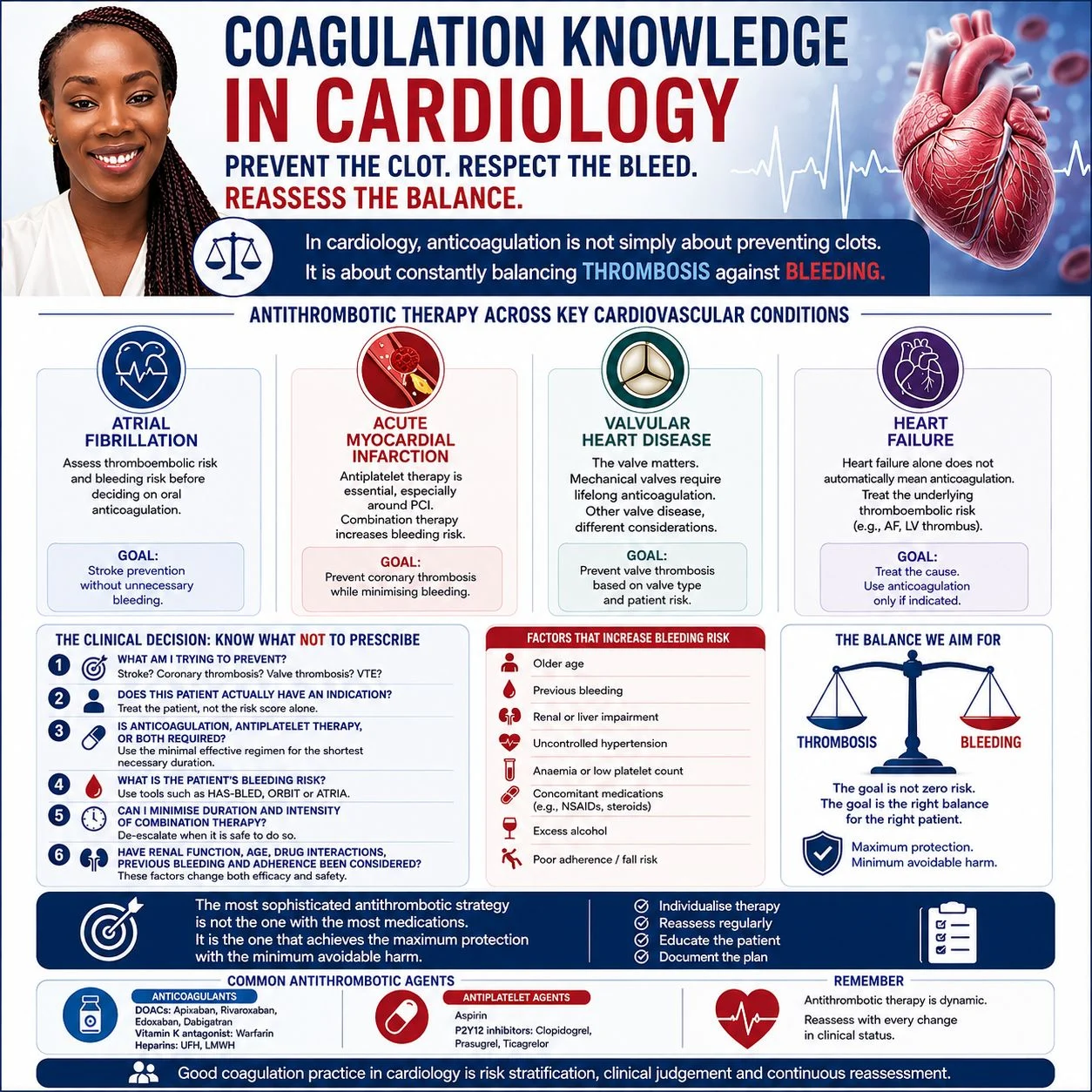
“In cardiology, anticoagulation is not simply about preventing clots.
It is about constantly balancing thrombosis against bleeding.
Consider a patient with atrial fibrillation.
Their stroke risk may make anticoagulation essential—but that does not mean the safest approach is automatically to prescribe an anticoagulant and move on.
The same principle applies across cardiovascular medicine:
Atrial fibrillation
Assess thromboembolic risk and bleeding risk before deciding on oral anticoagulation. The goal is stroke prevention without exposing the patient to unnecessary bleeding.
Acute myocardial infarction
Antiplatelet therapy is fundamental to preventing recurrent coronary thrombosis, particularly around PCI. But combining antiplatelet and anticoagulant therapies can substantially increase bleeding risk.
Valvular heart disease
The valve matters. Mechanical valves require lifelong anticoagulation, while other valvular conditions have different thromboembolic and antithrombotic considerations.
Heart failure
Heart failure alone does not automatically mean a patient needs anticoagulation. The indication should come from the underlying thromboembolic risk – such as atrial fibrillation, ventricular thrombus, or another established indication.
The real skill is knowing what not to prescribe.
- What am I trying to prevent?
- Stroke? Coronary thrombosis? Valve thrombosis? VTE?
- Does this patient actually have an indication?
- Is anticoagulation, antiplatelet therapy, or both required?
- What is the patient’s bleeding risk?
- Can I minimise the duration and intensity of combination therapy?
- Have renal function, age, drug interactions, previous bleeding and adherence been considered?
The most sophisticated antithrombotic strategy is not the one with the most medications.
It is the one that achieves the maximum protection with the minimum avoidable harm.
In cardiology, coagulation knowledge is therefore not just pharmacology.
It is risk stratification, clinical judgement, and continuous reassessment.
Prevent the clot. Respect the bleed. Reassess the balance.”
Stay updated with Hemostasis Today.
-
Oct 12, 2026, 13:58Francisco Chacón-Lozsán: Catastrophic Antiphospholipid Syndrome A Rapidly Progressive Multiorgan Thrombotic Emergency
-
Oct 12, 2026, 12:50Nawsherwan Mohammad: Study Examines Thrombotic Events in Patients with Polycythemia Vera in Iraq
-
Oct 12, 2026, 12:30Chanakya Nayudu: Looking Beyond Blood Clots – Patient-Reported Outcomes in Antiphospholipid Syndrome
-
Oct 12, 2026, 12:12Jean-Jacques Kiladjian: Improving Treatment Strategies with JAK Inhibitors in Myelofibrosis
-
Oct 12, 2026, 12:04Chloe Homich: AABB Annual Meetings – Building Connections and Advancing Transfusion Medicine
-
Oct 12, 2026, 11:51Daniel Sop: Sickle Cell Research Takes Center Stage at ASCAT 2026
-
Oct 12, 2026, 10:36PAI-1 Inhibition as a New Strategy for Enhancing Fibrinolysis and Clot Resolution
-
Oct 12, 2026, 07:39Emmanuel J Favaloro: 100 Years of von Willebrand Disease and the Importance of Local Diagnosis and Management
-
Oct 12, 2026, 07:39Post-Stroke Fatigue Trajectories – 38% Recovered at 12 Months, While 16% Developed New Fatigue – International Journal of Stroke