

Miguel Bronchud: Making Monoclonal Antibodies Safer in Pregnancy
Miguel Bronchud, Co-Founder at Regenerative Medicine Solutions, shared a post on LinkedIn about a recent article by Jeannette Nilsen et al., published in Science Immunology, adding:
“What can be done about monoclonal antibodies drugs, used against cancer, autoimmune disease and migraines, that are risky to use safely in pregnancy (because they are actively carried to the fetus via a receptor called FcRn)?
Fusion of IgG antibodies to albumin inhibits transport across the placenta Science Immunology – a good step towards safer-mab therapy in pregnant women?
Researchers from Norway have engineered a possible way around the risk some antibody drugs pose in pregnancy.
Precision Immunotherapy Alliance (PRIMA), University of Oslo, Oslo, Norway.
These monoclonal antibodies drugs, used against cancer, autoimmune disease and migraines, are hard to use safely in pregnancy because they are actively carried to the fetus via a receptor called FcRn.
But the process has a quirk: mouse models and human tissue showed that the receptor binds to both IgG antibodies – which are used in the majority of approved antibody therapies – and albumin, but only shuttles the antibody across the placenta.
By fusing therapeutic antibodies to albumin, the team made drugs that reached the fetus far less and reduced adverse events in mice
Immunoglobulin G (IgG)-based monoclonal antibodies are effective therapies for cancer, autoimmune diseases, and migraine.
However, they are actively transported across the placenta by the neonatal Fc receptor (FcRn), limiting their use during pregnancy.
Using mouse models and an ex vivo human placental perfusion system, researchers show that although FcRn binds albumin independently of IgG, albumin is not transported to the fetus in mice or across human placental tissue.
Fusion of IgG to albumin markedly reduced transplacental transport in both models while preserving the prolonged plasma half-life conferred by FcRn.
Similarly, fragment antigen-binding fragments fused to engineered albumin with enhanced FcRn binding showed minimal fetal exposure.
In a mouse model of fetal and neonatal alloimmune thrombocytopenia, albumin fusion of an anti-human platelet antigen IgG reduced fetal antibody transfer and attenuated thrombocytopenia in the offspring.
These findings identify albumin as an attractive fusion partner for biologics intended to minimize fetal exposure during pregnancy.”
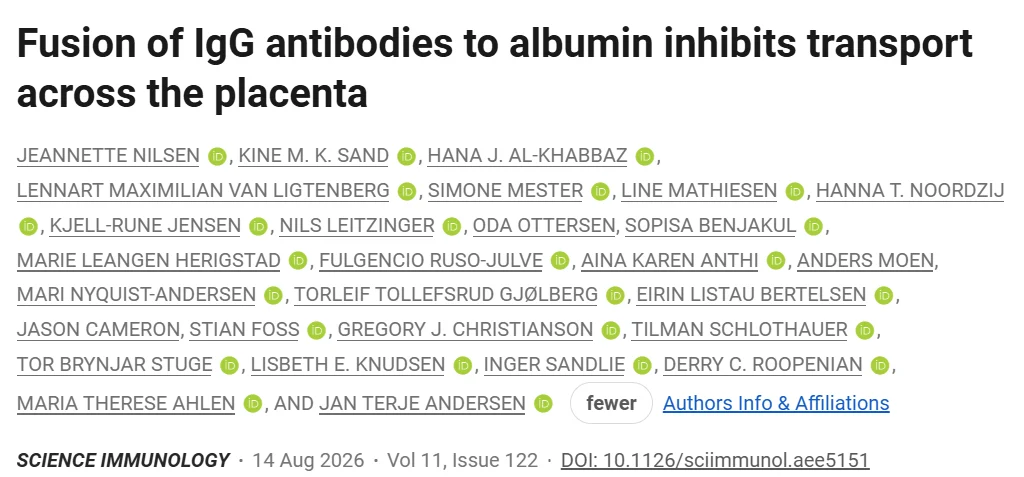
Title: Fusion of IgG antibodies to albumin inhibits transport across the placenta
Authors: Jeannette Nilsen, Kine M. K. Sand, Hana J. Al-Khabbaz, Lennart Maximilian van Ligtenberg, Simone Mester, Line Mathiesen, Hanna T. Noordzij, Kjell-Rune Jensen, Nils Leitzinger, Oda Ottersen, Sopisa Benjakul, Marie Leangen Herigstad, Fulgencio Ruso-Julve, Aina Karen Anthi, Anders Moen, Mari Nyquist-Andersen, Torleif Tollefsrud Gjølberg, Eirin Listau Bertelsen, Jason Cameron, Stian Foss, Gregory J. Christianson, Tilman Schlothauer, Tor Brynjar Stuge, Lisbeth E. Knudsen, Inger Sandlie, Derry C. Roopenian, Maria Therese Ahlen, Jan Terje Andersen
Stay updated with Hemostasis Today.
-
Oct 12, 2026, 13:58Francisco Chacón-Lozsán: Catastrophic Antiphospholipid Syndrome A Rapidly Progressive Multiorgan Thrombotic Emergency
-
Oct 12, 2026, 12:50Nawsherwan Mohammad: Study Examines Thrombotic Events in Patients with Polycythemia Vera in Iraq
-
Oct 12, 2026, 12:30Chanakya Nayudu: Looking Beyond Blood Clots – Patient-Reported Outcomes in Antiphospholipid Syndrome
-
Oct 12, 2026, 12:12Jean-Jacques Kiladjian: Improving Treatment Strategies with JAK Inhibitors in Myelofibrosis
-
Oct 12, 2026, 12:04Chloe Homich: AABB Annual Meetings – Building Connections and Advancing Transfusion Medicine
-
Oct 12, 2026, 11:51Daniel Sop: Sickle Cell Research Takes Center Stage at ASCAT 2026
-
Oct 12, 2026, 10:36PAI-1 Inhibition as a New Strategy for Enhancing Fibrinolysis and Clot Resolution
-
Oct 12, 2026, 07:39Emmanuel J Favaloro: 100 Years of von Willebrand Disease and the Importance of Local Diagnosis and Management
-
Oct 12, 2026, 07:39Post-Stroke Fatigue Trajectories – 38% Recovered at 12 Months, While 16% Developed New Fatigue – International Journal of Stroke