


Chokri Ben Lamine: Antiphospholipid Syndrome After Kidney Transplantation
Chokri Ben Lamine, Hematologist at King Faisal Specialist Hospital and Research Center, shared a post on X about a recent article by Agnieszka Furmańczyk-Zawiska et al., published in Journal of Clinical Medicine, adding։
”Antiphospholipid syndrome after kidney transplantation
APS increases the risk of:
- Early graft thrombosis
- Thrombotic microangiopathy
- Stroke or venous thromboembolism
- Recurrent graft loss
- Catastrophic antiphospholipid syndrome
Multicenter cohort:
- APS: 19 recipients
- Controls: 21
- 15-year graft survival: 73.9 percent vs 90.5 percent
- Mean graft duration: 11.2 vs 14.4 years
- Both were significantly inferior with APS.
Outcomes were particularly poor when APS was diagnosed only after transplantation:
First-graft survival: 0 percent
69 percent when APS was recognized before transplantation
Early recognition enables peri-transplant thromboprophylaxis and closer monitoring.
Thrombosis–bleeding dilemma
Despite anticoagulation:
Recurrent thrombosis: 6 of 19 patients
Thrombotic microangiopathy: 2 patients
Stroke: 2 patients
Venous thromboembolism: 1 patient
Arteriovenous fistula thrombosis: 1 patient
Meanwhile, bleeding complicated thromboprophylaxis in 5 of 19 patients.
Practical anticoagulation approach
Vitamin K antagonist: target INR 2–3
Alternatively, renal-adjusted low-molecular-weight heparin with anti-Xa monitoring
For invasive procedures: interrupt oral anticoagulation and consider carefully controlled heparin bridging
Avoid direct oral anticoagulants in triple-positive APS or arterial APS
Who should undergo antiphospholipid antibody testing before transplantation?
- Candidates with systemic lupus erythematosus
- Previous arterial or venous thrombosis
- Recurrent vascular-access thrombosis
- Pregnancy morbidity suggestive of APS
- Unexplained prior graft thrombosis or thrombotic microangiopathy
This is targeted screening, not established universal screening for every candidate.
Suspect catastrophic APS when rapid multiorgan thrombosis occurs after surgery, infection, rejection or anticoagulation interruption
Treatment may include:
- Therapeutic heparin
- Corticosteroids
- Plasma exchange
- Intravenous immunoglobulin
- Rituximab or complement inhibition in selected refractory cases
Bottom line:
Kidney transplantation remains the preferred renal-replacement strategy in APS, but success requires pre-transplant diagnosis, individualized anticoagulation, bleeding surveillance, antiphospholipid-antibody monitoring and multidisciplinary follow-up.
Evidence limitation: retrospective study with only 19 APS recipients; findings are clinically important but not definitive.”
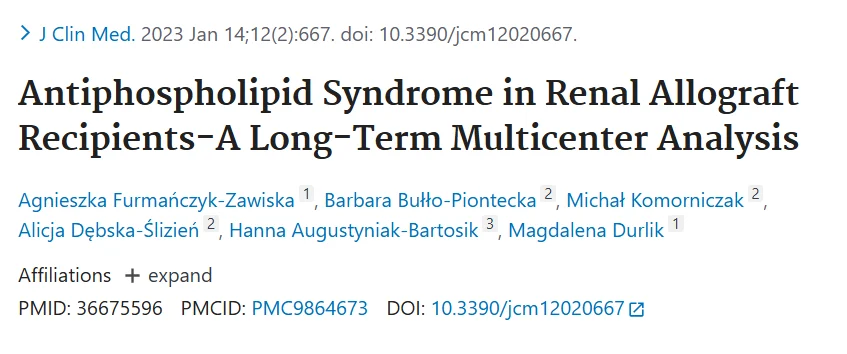
Title: Antiphospholipid Syndrome in Renal Allograft Recipients-A Long-Term Multicenter Analysis
Authors: Agnieszka Furmańczyk-Zawiska, Barbara Bułło-Piontecka, Michał Komorniczak, Alicja Dębska-Ślizień, Hanna Augustyniak-Bartosik, Magdalena Durlik
Other posts featuring Chokri Ben Lamine on Hemostasis Today.
-
Oct 13, 2026, 12:29Mariam Al Mansoori: 5th International Hemophilia Conference
-
Oct 13, 2026, 12:13Hemophilia Outreach of Wisconsin Attends VWD Connect Conference
-
Oct 13, 2026, 11:41Abhishek Kumar: How Three Hemophilia Patients Helped Secure Life-Saving Treatment in Bihar
-
Oct 13, 2026, 11:24Brandon Daniel D’Costa: Building Stronger Stakeholder Relationships Through Empathy and Open Communication
-
Oct 13, 2026, 11:08Renel Tique: 5th International Conference on Hemophilia and Rare Bleeding Disorders
-
Oct 13, 2026, 02:01Nour Al-Mozain: Is It Really Anti-D? – Unraveling Auto-Anti-LW in the Transfusion Laboratory
-
Oct 13, 2026, 01:51Berenice Villegas: The Role of Morphologic Evaluation in Body Fluid Differential Analysis
-
Oct 13, 2026, 01:44Debadrita Ray: Evaluating vWF and VITRO Score for Detecting CSPH in cACLD Patients
-
Oct 13, 2026, 01:34Nagesh Ramesh: Donating Blood for International Plasma Awareness Week