


Nour Al-Mozain: Is It Really Anti-D? – Unraveling Auto-Anti-LW in the Transfusion Laboratory
Nour Al-Mozain, Associate Professor at Alfaisal University, shared this post on LinkedIn:
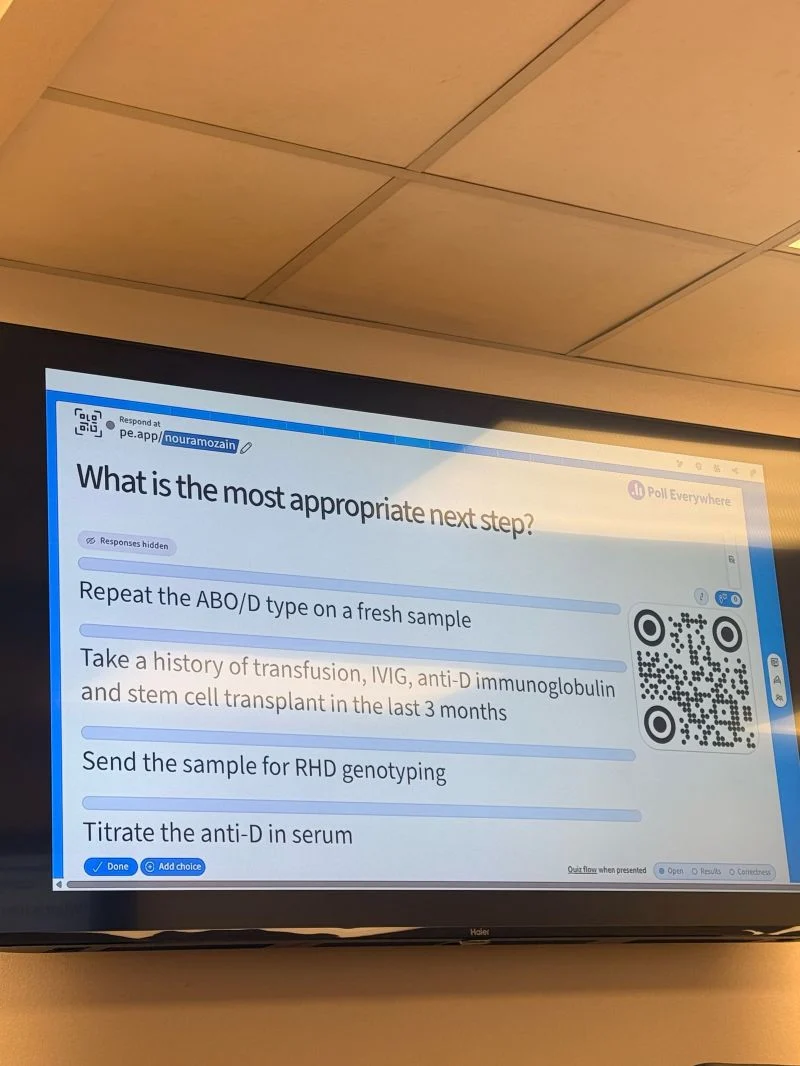
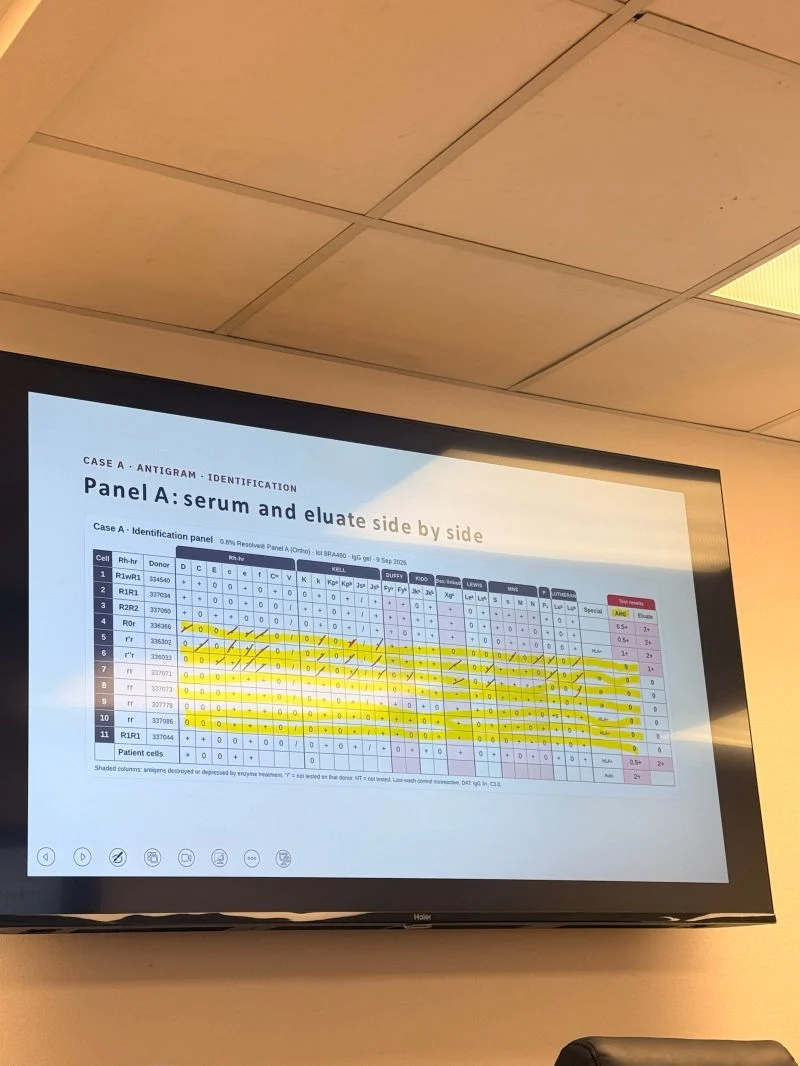
“We started this year’s academic activity series for our transfusion medicine residents with a puzzle from our transfusion lab: an anti-D in a D-positive patient.
The eluate reacted with every D-positive panel cell, more weakly with the single-dose R0r cell, and not at all with any D-negative cell.
Anti-G and the other Rh specificities were excluded on the panel.
No recent transfusion history and drug history was not significant for drug induced antibodies
So Could it be a mimicker?
LW Blood Group System (LW) is an intercellular adhesion molecule (ICAM-4) sits in the Rh complex and is expressed more strongly on D-positive than on D-negative adult cells, so on a routine panel anti-LW reproduces an anti-D pattern almost exactly.
Auto-anti-LW typically appears when LW expression is transiently suppressed, as in pregnancy, hematologic malignancy or immune-mediated disease.
How to differentiate
- DTT-treated D-positive cells: DTT destroys LW but not D, so anti-D still reacts and anti-LW does not.
- Cord-blood D-negative cells: they carry plenty of LW, so anti-LW reacts and anti-D does not.
Why it matters?
Recording this as ‘anti-D’ would wrongly commit a D-positive patient to D-negative blood and could mislead future workups and pregnancy care.
LW alloantibodies are not generally considered clinically significant, but LW autoantibodies may have caused autoimmune haemolytic anaemia.
Having said that, while D-negative units are usually crossmatch-compatible, D-positive units are a viable alternative if there is no active clinical hemolysis and you need to prioritize matching for other Rh subgroups or Kell antigens.”
More posts featuring Nour Al-Mozain on Hemostasis Today.
-
Oct 13, 2026, 01:51Berenice Villegas: The Role of Morphologic Evaluation in Body Fluid Differential Analysis
-
Oct 13, 2026, 01:44Debadrita Ray: Evaluating vWF and VITRO Score for Detecting CSPH in cACLD Patients
-
Oct 13, 2026, 01:34Nagesh Ramesh: Donating Blood for International Plasma Awareness Week
-
Oct 12, 2026, 21:51Sam Botchey: Orthobiologics Are Advancing but the Evidence Must Keep Pace
-
Oct 12, 2026, 21:50Serum Vitamin D, Platelet Function, and Bleeding in Primary ITP – Platelets Journal
-
Oct 12, 2026, 21:30Nika Samadzadeh Tabrizi: Looking Forward to the PACeS Trial on Anticoagulation for POAF
-
Oct 12, 2026, 21:28Michael Megaly: Does Coronary Ectasia Affect Outcomes in Acute Coronary Syndromes?
-
Oct 12, 2026, 21:25Vitor Borin P. de Souza: Think Twice Before Anticoagulating an Isolated Subsegmental PE
-
Oct 12, 2026, 20:43Jazlyn A Selvasingh: Excited to Share Our Research at AAO-HNSF 2026 in Los Angeles