

Amir Hesam Karbakhsh: The Science Behind Platelet-Rich Plasma Preparation
Amir Hesam Karbakhsh, Medical Equipment and Sales Specialist at Salamat Tajhiz Barsava, shared a post on LinkedIn:
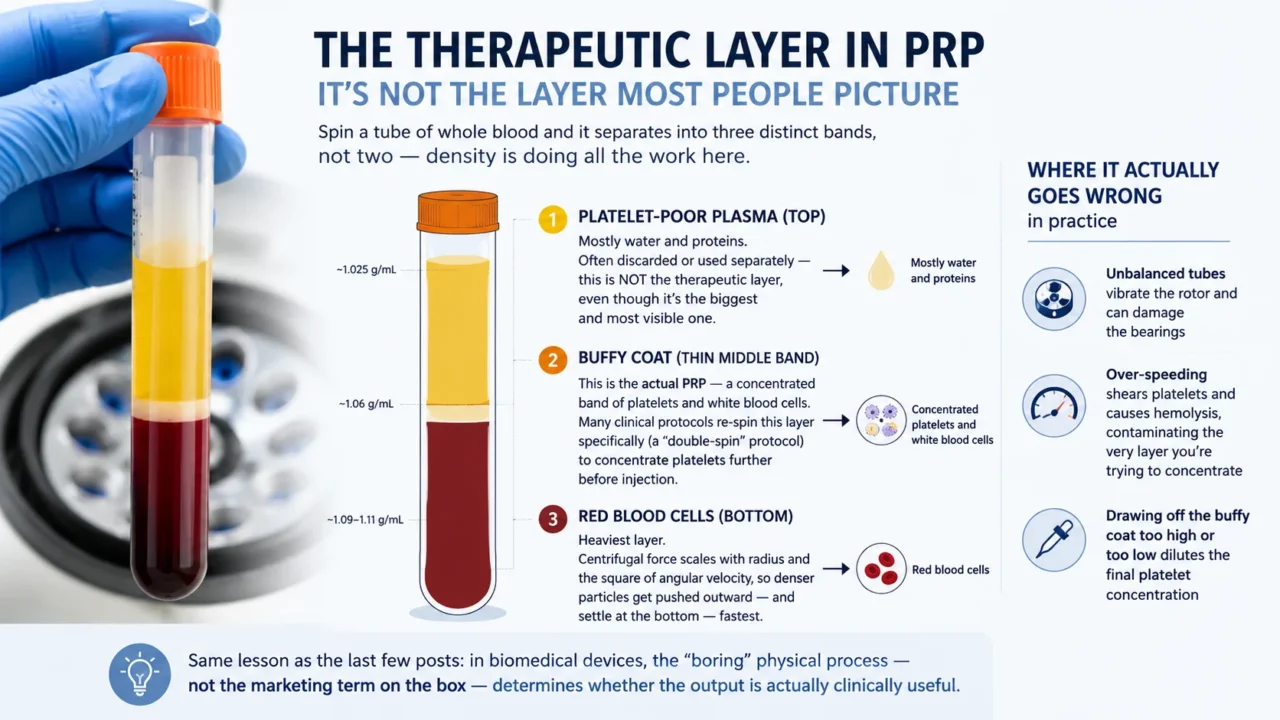
“The therapeutic layer in PRP isn’t the layer most people picture.
Spin a tube of whole blood and it separates into three distinct bands, not two — density is doing all the work here.
1. Platelet-Poor Plasma (top, approximately 1.025 g/mL)
Mostly water and proteins.
Often discarded or used separately — this is NOT the therapeutic layer, even though it’s the biggest and most visible one.
2. Buffy Coat (thin middle band, approximately 1.06 g/mL)
This is the actual PRP — a concentrated band of platelets and white blood cells.
Many clinical protocols re-spin this layer specifically (a ‘double-spin’ protocol) to concentrate platelets further before injection.
3. Red Blood Cells (bottom, approximately 1.09–1.11 g/mL)
Heaviest layer.
Centrifugal force scales with radius and the square of angular velocity, so denser particles get pushed outward — and settle at the bottom — fastest.
Where it actually goes wrong in practice isn’t the physics, it’s the execution:
- Unbalanced tubes vibrate the rotor and can damage the bearings
- Over-speeding shears platelets and causes hemolysis, contaminating the very layer you’re trying to concentrate
- Drawing off the buffy coat too high or too low dilutes the final platelet concentration
Same lesson as the last few posts: in biomedical devices, the ‘boring’ physical process — not the marketing term on the box — determines whether the output is actually clinically useful.”
Stay updated with Hemostasis Today.
-
Oct 20, 2026, 01:43Oliver Weingärtner: Deprescribing of Lipid Lowering Drug after MI is Associated with Cardiovascular Events
-
Oct 19, 2026, 19:44Where You Live Should not Determine Whether You Receive Care – World Federation of Hemophilia
-
Oct 19, 2026, 19:42Belen Bianco: Prevention, Early Suspicion and an Interdisciplinary Approach Save Lives
-
Oct 19, 2026, 19:40Christina Chrysohoou: Catheter-Based LAAC vs OAC for Stroke Prevention in Atrial Fibrillation
-
Oct 19, 2026, 19:38Matthew Flick: A Two-Day Research Meeting on Fibrinogen, Hemostasis and Thrombosis
-
Oct 19, 2026, 19:37Hayat Saeed: Excited to Share Our Publication on the FGL1–Hepcidin Axis in Iron Homeostasis and Disease
-
Oct 19, 2026, 19:08IPAW 2026 Comes to a Close, but the Work Continues – PPTA
-
Oct 19, 2026, 17:44Paul Riley: Moderating a Webinar on Anticoagulation Monitoring
-
Oct 19, 2026, 16:36Christopher Pittman: Blood Clot Prevention Cannot End at Hospital Discharge