


Omid Khalafi: When the ‘Rules of Three’ Break – What Is Really Happening?
Omid Khalafi, Technical Support Specialist and After Sale Service Manager at Pharmateb, shared a post on LinkedIn:
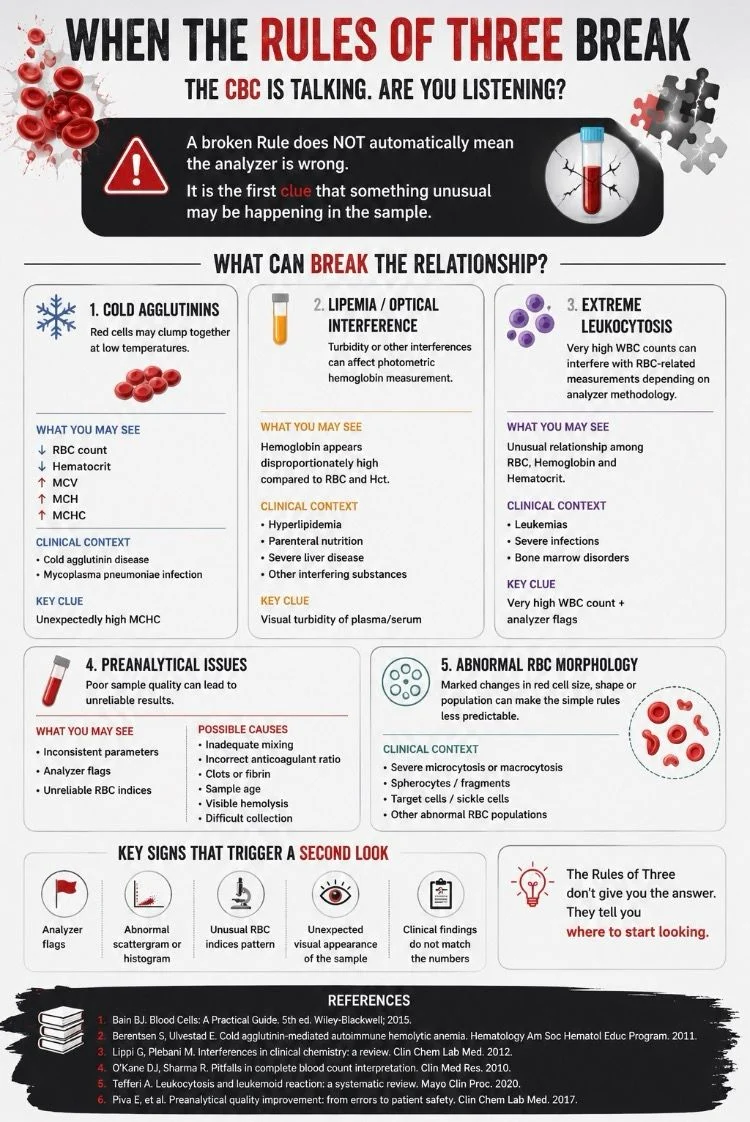
“When the ‘Rules of Three’ Break – What Is Really Happening?
In the previous post, we used the Rules of Three as a quick check for internal consistency between:
RBC – Hemoglobin – Hematocrit
But here is the important part:
- A broken Rule does not automatically mean the analyzer is wrong.
Sometimes, it is the first clue that something unusual is happening in the sample.
1.Cold agglutinins
One of the classic causes.
RBCs may form aggregates and the analyzer can count an aggregate as a single cell.
The result may show:
- RBC
- Hct
- MCV
- MCH
- MCHC
Suddenly, the CBC no longer obeys the expected relationships.
Clue: An unexpectedly high MCHC should make you stop and investigate.
2.Lipemia / Optical Interference
Hemoglobin is commonly measured after RBC lysis using a photometric method.
Severe turbidity or other sample interference can affect the Hb measurement.
If Hb becomes disproportionately high compared with RBC/Hct:
- RBC multiplied by 3 does not equal Hb.
The Rule has not ‘diagnosed’ the problem.
That simply told us, something doesn’t add up.
3.Extreme Leukocytosis
When the WBC count is extremely high, the contribution of WBCs to measured hemoglobin and/or hematocrit-related calculations can become relevant, depending on the analyzer methodology.
Again, the RBC–Hb–Hct relationship may look unusual.
Don’t interpret the three RBC parameters in isolation.
Look at the complete CBC and the analyzer’s flags.
4.Sample / preanalytical problems
Not every inconsistency is an analytical problem.
Check the basics:
• Adequate mixing?
• Correct anticoagulant-to-blood ratio?
• Clots or fibrin?
• Sample age?
• Visible hemolysis?
• Difficult collection?
A technically perfect analyzer cannot produce a reliable result from a poor specimen.
5.Abnormal RBC morphology
Marked microcytosis, macrocytosis, RBC fragments or other abnormal cell populations can also make the simple Rules of Three less predictable.
This is why Rule of Three isn’t Law of Three.
It is a screening mechanism, not a replacement for:
Flags plus histograms pkus scattergrams plus smear plus clinical correlation
When the numbers don’t agree, don’t immediately go for “Which parameter is wrong?”
Ask ‘Why don’t these parameters agree?’
That change in thinking is what turns a CBC from a list of numbers into a laboratory interpretation.
The Rules of Three don’t tell you the answer.
They tell you where to start looking.”
Stay updated with Hemostasis Today.
-
Oct 20, 2026, 01:43Oliver Weingärtner: Deprescribing of Lipid Lowering Drug after MI is Associated with Cardiovascular Events
-
Oct 19, 2026, 19:44Where You Live Should not Determine Whether You Receive Care – World Federation of Hemophilia
-
Oct 19, 2026, 19:42Belen Bianco: Prevention, Early Suspicion and an Interdisciplinary Approach Save Lives
-
Oct 19, 2026, 19:40Christina Chrysohoou: Catheter-Based LAAC vs OAC for Stroke Prevention in Atrial Fibrillation
-
Oct 19, 2026, 19:38Matthew Flick: A Two-Day Research Meeting on Fibrinogen, Hemostasis and Thrombosis
-
Oct 19, 2026, 19:37Hayat Saeed: Excited to Share Our Publication on the FGL1–Hepcidin Axis in Iron Homeostasis and Disease
-
Oct 19, 2026, 19:08IPAW 2026 Comes to a Close, but the Work Continues – PPTA
-
Oct 19, 2026, 17:44Paul Riley: Moderating a Webinar on Anticoagulation Monitoring
-
Oct 19, 2026, 16:36Christopher Pittman: Blood Clot Prevention Cannot End at Hospital Discharge