


Stefano Garzon: SELUTION DeNovo HBR – Weren’t HBR Patients Supposed to Bleed More with DES?
Stefano Garzon, Interventional Cardiologist, PhD candidate, shared a post on X:
“SELUTION DeNovo HBR: weren’t HBR patients supposed to bleed more with DES?
SELUTION DeNovo (NCT04859985) randomised 3,323 patients with de novo coronary lesions to a sirolimus-eluting balloon strategy with provisional stenting or to systematic DES.
The HBR substudy (Rissanen et al., EuroInterventio 2026, doi 10.4244/EIJ-D-26-00889) reports the 522 patients who met ARC-HBR criteria, 17.0% of the 3,064 with HBR data.
269 were allocated to SEB and 253 to DES. 17.1% of SEB patients received a bailout stent.
The subgroup was prespecified.
The trial is open-label.
At 1 year, target vessel failure occurred in 13 of 269 (4.9%) with SEB and 20 of 253 (7.9%) with DES.
Risk difference −3.05 percentage points (95% CI −7.27 to 1.17).
BARC 3–5 bleeding: 6 vs 8 (2.3% vs 3.2%), difference −0.91 (−3.71 to 1.89). NACE: 18 vs 27 (6.8% vs 10.7%), difference −3.94 (−8.80 to 0.92).
The Central Illustration states that the substudy ‘suggests that an SEB strategy with minimal stenting is a safe and effective alternative to systematic DES implantation.’
Let’s use the parent trial as our reference.
TVF was 88 of 1,661 (5.3%) with SEB and 73 of 1,662 (4.4%) with DES, difference 0.91 (−0.55 to 2.38), non-inferior against a 2.44-point margin (one-sided p is equal 0.02).
In the per-protocol population the difference was 1.09 (−0.45 to 2.63) and non-inferiority was not confirmed. As a non-inferiority trial, ITT and PP should agree. As they don’t, we’ll stick to PP and say it wasn’t non-inferior.
Cardiac death 0.7% vs 1.0%, target vessel MI 2.7% vs 2.6%, clinically driven TVR 3.3% vs 2.1% (difference 1.22, 0.11 to 2.33).
Repeat revascularisation was in favour of the DES. Among non-HBR patients, TVF was 5.7% vs 4.0%, difference +1.79 (0.12 to 3.47).
Now, in the substudy, the HBR interval runs from −7.27 to +1.17, which contains +0.91 (the parent trial estimate). The HBR result is compatible with the parent result.
However, it has too few events to test it. RR 0.61 (0.31 to 1.20) contains a 69% relative reduction and a 20% relative increase, both compatible with 13 versus 20 events.
With 33 events, the smallest effect detectable at 80% power is a HR ~ 0.38. Bleeding: RR 0.71 (0.25 to 2.00); a 75% reduction and a doubling fit 6 versus 8 events equally well. NACE: RR 0.63 (0.35 to 1.11).
None of the three intervals excludes harm, but none excludes a large benefit.
One would think that there would be a distinct effect in HBR, but on the interaction test we got a p is equal 0.49 for bleeding. Conversely, we got p is equal 0.04 for TVF. Why would HBR have better outcomes for TVF?
Maybe because cutting antithrombotic medication would translate into higher lesion thrombosis or spontaneous MI, but both lesion thrombosis (1 vs 2; definite 1 vs 1) and TV-MI (8 vs 11) were comparable.
The HBR TVF difference is built from cardiac death 4 vs 6, target vessel MI 8 vs 11 and clinically driven TVR 4 vs 9.
All-cause death was 14 vs 13 (5.3% vs 5.2%). The protocol classifies unwitnessed and unknown-cause deaths as cardiac.
Stroke was 5 vs 1 (1.9% vs 0.4%) but it wasn’t included in the primary outcomes.
Bleeding, the only endpoint with a plausible HBR-specific mechanism, shows nothing (6 vs 8), and it behaves opposite to the logical mechanism (1 vs 7 in the first 30 days under identical regimens, 5 vs 1 afterwards).
Now, there’s something else I would like to address and it’s about the writing.
I’m no Shakespeare, but the Methods state that the intervals ‘should not be used to infer definitive treatment effects.’
The Impact box states that the data support ‘its use as an alternative revascularisation strategy in HBR patients.’
Both sentences are in the same paper, which seems contradictory to me.
To wrap this up, what I think the substudy establishes: an SEB-first strategy in 522 HBR patients had 1-year TVF of 4.9% (95% CI 2.8 to 8.1%) and lesion thrombosis 0.4%.
The patients were 68% anticoagulated and selected by operators for an anticipated bailout probability below 30%.
What it doesn’t: whether the strategy is non-inferior or superior to DES in HBR.
No hypothesis was tested, and 33 events are too few to test one.
Detecting 7.9% against 4.9% at 80% power takes about 1,040 patients per arm, four times this subset. Nonetheless, it is an important piece in building our knowledge regarding DCB PCI.
Congratulations to the authors!”
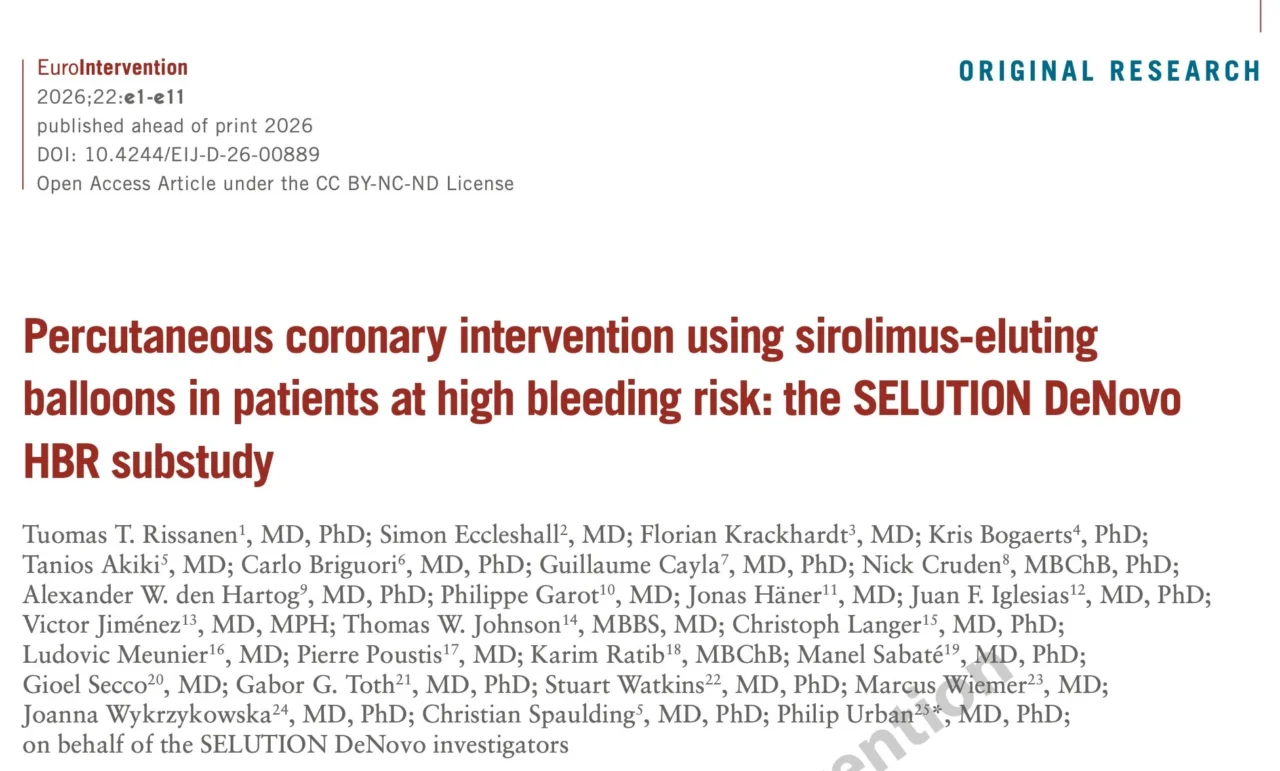
Title: Percutaneous coronary intervention using sirolimus-eluting balloons in patients at high bleeding risk: the SELUTION DeNovo HBR substudy
Authors: Tuomas T. Rissanen, Simon Eccleshall, Florian Krackhardt, Kris Bogaerts, Tanios Akiki, Carlo Briguori, Guillaume Cayla, Nick Cruden, Alexander W. den Hartog, Philippe Garot, Jonas Häner, Juan F. Iglesias, Victor Jiménez, Thomas W. Johnson, Christoph Langer, Ludovic Meunier, Pierre Poustis, Karim Ratib, Manel Sabaté, Gioel Secco, Gabor G. Toth, Stuart Watkins, Marcus Wiemer, Joanna Wykrzykowska, Christian Spaulding, Philip Urban
-
Oct 21, 2026, 17:40Tetsuzan Ron: Iron Deficiency Without Anemia Clinical Impact and Management
-
Oct 21, 2026, 17:29Amir Hossien Esfandiari։ The Association Between Viral Infections and Aplastic Anemia
-
Oct 21, 2026, 17:16Melissa Hollo: A Meaningful Step Forward for Women’s Health
-
Oct 21, 2026, 17:09Chipili Ng’onga: Have You Ever Seen a Result That Just Didn’t Make Sense?
-
Oct 21, 2026, 16:57Fabrice Cognasse: Celebrating the Next Generation of Platelet Research and Transfusion Medicine
-
Oct 21, 2026, 16:47Christabel Odeta: Treating Pediatric Cancer in Children With Sickle Cell Disease
-
Oct 21, 2026, 16:36Sharlene Haywood: Bringing Multidisciplinary Learning Into Nursing Practice
-
Oct 21, 2026, 16:19Vanessa Carvalho: New Research on Platelet-Derived Extracellular Vesicles in Preeclampsia
-
Oct 21, 2026, 15:41Women and Hemostasis Across Hormonal Transition