


Thirunavukkarasu Angappan: Why Hemophilia B Still Needs Both Plasma-Derived and Recombinant Factor IX
Thirunavukkarasu Angappan, Vice President of Operations and Manufacturing at PopVax, shared a post on LinkedIn:
“BeneFIX Is Recombinant. Mononine Isn’t. Hemophilia B Patients Still Need Both on the Shelf.
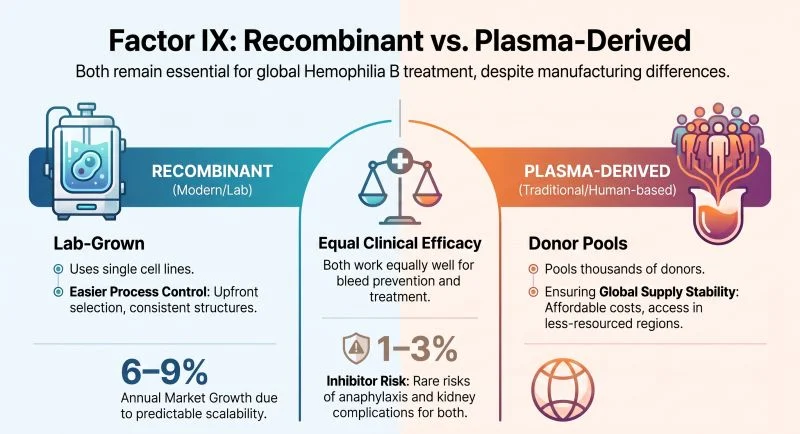
Every vial of plasma-derived Factor IX carries a bit of thousands of different donors in it. Every vial of recombinant Factor IX, like BeneFIX, comes from just one carefully chosen cell line grown in a lab.
- Plasma-derived products pool thousands of donors into each batch, which means small differences — in sugar structures on the protein, in donor variation — that manufacturers have to control for every single time.
- Recombinant products come from one fully characterized cell bank. RIXUBIS, for example, is made in a CHO (Chinese hamster ovary) cell line and doesn’t use any human or animal material in its manufacturing. There’s still some batch-to-batch variation even here, but it’s the kind you can select for and control upfront, not something that changes with every new donor pool.
- Recombinant Factor IX keeps growing its market share — about 6 to 9% a year — largely because that kind of control is easier to build a process around.
But here’s where it gets more interesting than ‘manufacturing wins’.
Plasma-derived and recombinant Factor IX actually work equally well for normal bleed prevention and treatment — that’s well established. The real complication shows up with inhibitors.
Hemophilia B inhibitors are rare, about 1 to 3% of patients, but when they happen, they bring a real risk that Factor VIII inhibitors don’t carry the same way — anaphylaxis, and sometimes kidney complications like nephrotic syndrome, and this can happen whether the product is plasma-derived or recombinant.
Trying to build immune tolerance in these patients is much harder and riskier in hemophilia B than in hemophilia A, with fairly unpredictable success. So for these patients, doctors usually don’t just give more Factor IX of either kind — they turn to bypassing agents instead.
I’ve spent my career validating both mammalian cell platforms and reviewing plasma product quality systems, and here’s my honest read: the case for keeping plasma-derived Factor IX around isn’t about it being clinically better for any one group of patients.
It’s about keeping supply steady, keeping costs manageable, and making sure patients in places where recombinant supply isn’t always reliable still have a treatment option.
As recombinant manufacturing keeps scaling up, does plasma-derived Factor IX still have a real clinical reason to stick around — or does it end up being mainly a backup option for less-resourced healthcare systems?”
Other posts featuring Thirunavukkarasu Angappan on Hemostasis Today.
-
Oct 21, 2026, 16:57Fabrice Cognasse: Celebrating the Next Generation of Platelet Research and Transfusion Medicine
-
Oct 21, 2026, 16:47Christabel Odeta: Treating Pediatric Cancer in Children With Sickle Cell Disease
-
Oct 21, 2026, 16:36Sharlene Haywood: Bringing Multidisciplinary Learning Into Nursing Practice
-
Oct 21, 2026, 16:19Vanessa Carvalho: New Research on Platelet-Derived Extracellular Vesicles in Preeclampsia
-
Oct 21, 2026, 15:41Women and Hemostasis Across Hormonal Transition
-
Oct 21, 2026, 15:35Danny Hsu: Pharma’s 2025 Blockbusters Through a Hematologist’s Lens
-
Oct 21, 2026, 15:12Yue Zhang: Flow Cytometry for Translational Immunology and Cancer Research
-
Oct 21, 2026, 14:58Radoš Stefanović: How Red Blood Cells Adapt After Exercise
-
Oct 21, 2026, 14:08Vera Ghali: The Role of Hepcidin Assays in Diagnosing Iron Disorders