


Kalyan Roy: Could Alzheimer’s-Related Proteins Be Transmitted Through Blood Transfusion?
Kalyan Roy, Transfusion Medicine Specialist at Square Hospitals LTD, shared a post on LinkedIn about a recent article by Gargi Banerjee et al., published in The Lancet, adding:
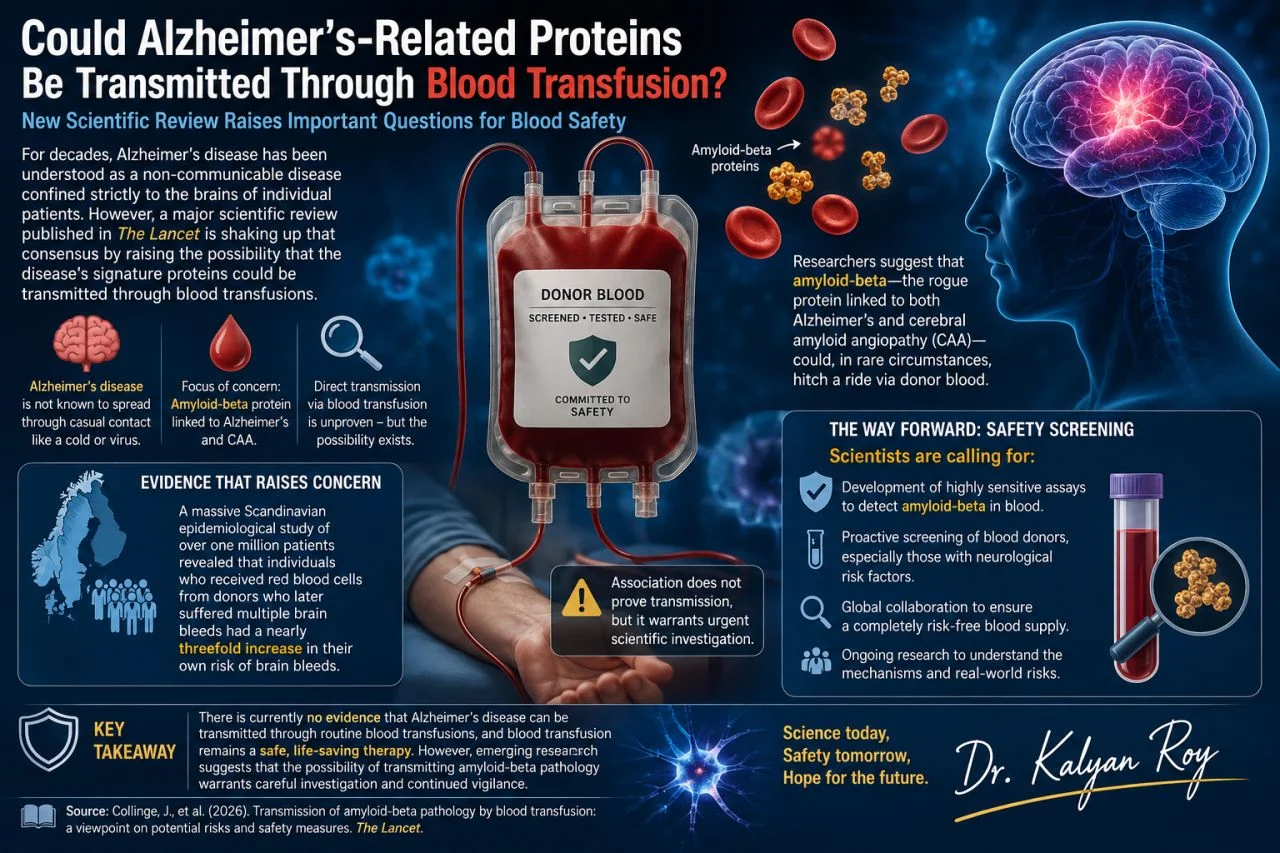
“Could Alzheimer’s-Related Proteins Be Transmitted Through Blood Transfusion?
A recent review published in The Lancet has raised an intriguing – and important – question for the transfusion medicine community:
- Could amyloid-beta pathology potentially be transmitted through blood transfusion?
Amyloid-beta is a protein strongly associated with Alzheimer’s disease and cerebral amyloid angiopathy (CAA).
Researchers from University College London have reviewed emerging evidence suggesting that the possibility of medically acquired transmission deserves closer scientific investigation.
What caught attention?
A large Scandinavian epidemiological study involving more than one million patients reported that individuals who received red blood cells from donors who later developed multiple cerebral hemorrhages had an approximately threefold higher risk of brain bleeding.
But an important distinction is essential:
This association does նօտ prove that amyloid-beta was transmitted through transfusion, nor does it demonstrate that Alzheimer’s disease is transmissible through blood.
There is currently no evidence that Alzheimer’s disease can be ‘caught’ through casual contact, and routine blood transfusion remains an essential and life-saving medical therapy.
However, the findings raise an important scientific question:
Could certain pathological proteins be transferred through blood and, under particular circumstances, contribute to neurological disease years later?
The authors therefore highlight the need for:
- Development of highly sensitive assays for amyloid-beta
- Further investigation of transfusion-associated neurological risks
- Robust donor and blood safety surveillance
- Large-scale epidemiological and mechanistic studies
- International collaboration to clarify the real-world risk
The message is not alarm – but vigilance.
Transfusion medicine has always evolved by identifying potential risks before they become major safety problems.
This emerging area deserves careful, evidence-based investigation without creating unnecessary fear among blood donors or transfusion recipients.
Science today. Safety tomorrow. Better transfusion medicine for the future.”
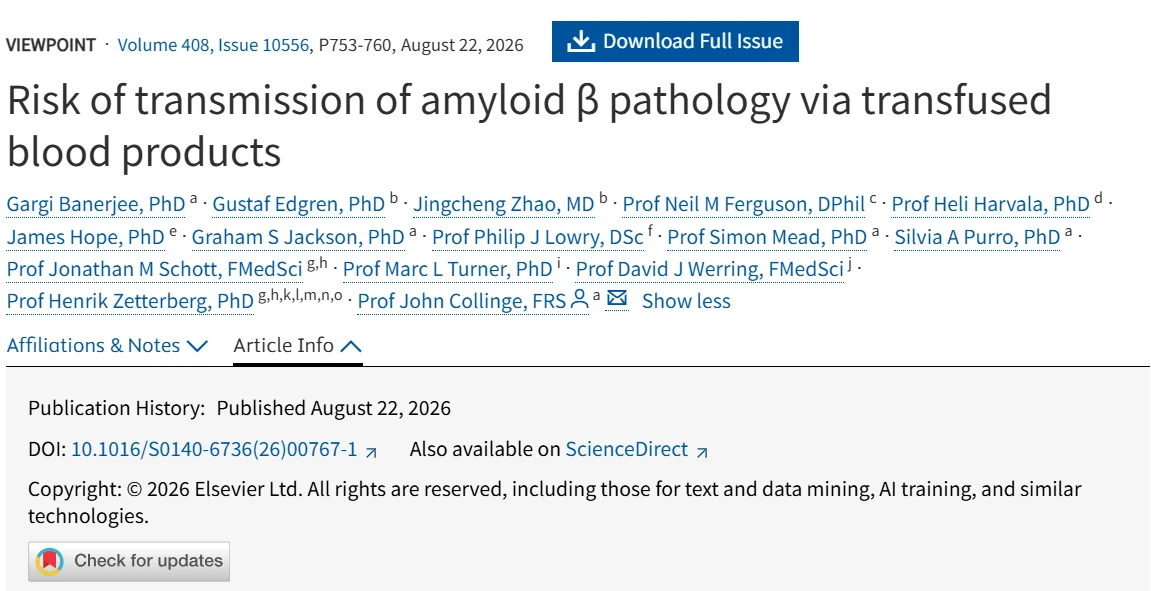
Title: Risk of transmission of amyloid β pathology via transfused blood products
Authors: Gargi Banerjee, Gustaf Edgren, Jingcheng Zhao, Neil M Ferguson, Heli Harvala, James Hope, Graham S Jackson, Philip J Lowry, Simon Mead, Silvia A Purro, Jonathan M Schott, Marc L Turner, David J Werring, Henrik Zetterberg, John Collinge
Find more posts featuring Kalyan Roy on Hemostasis Today.
-
Sep 9, 2026, 14:30Alejandro González Veliz: 2026 ESC Guidelines Expand Cardiac Rehabilitation Beyond Post-Event Recovery
-
Sep 9, 2026, 13:59Natalie Arnold: Biomarkers and the Hidden Burden of CHD
-
Sep 9, 2026, 13:11Ron DePinho: A Negative Trial Does Not Repudiate Inflammation as a Cardiovascular Target
-
Sep 9, 2026, 13:10Ahmad Gharehbaghian: Visiting the Alborz Provincial Blood Transfusion Center
-
Sep 9, 2026, 13:09Oraianthi Fiste: New Collection on Cancer-Associated Thrombosis From Mechanisms to Precision Medicine
-
Sep 9, 2026, 13:07Can Özlü: Can the HALP Score Help Identify Thrombotic Risk in Myeloproliferative Neoplasms?
-
Sep 9, 2026, 13:06Ohanna Cavalcanti Bezerra: Why Does DVT Lead to PE in Some Patients but Not Others?
-
Sep 9, 2026, 13:04Usman Shehzad: Transforming Patient Lives with INR Self-Testing
-
Sep 9, 2026, 13:02Edward Lee Carter: Provoked VTE May Not Tell the Whole Story About Recurrence Risk