


Zahra Safarzadeh: From Novel F8 Variant to Clinical Significance
Zahra Safarzadeh, Clinical Laboratory Scientist at Shahid Dastgheib Hospital, Shiraz University of Medical Sciences, shared a post on LinkedIn:
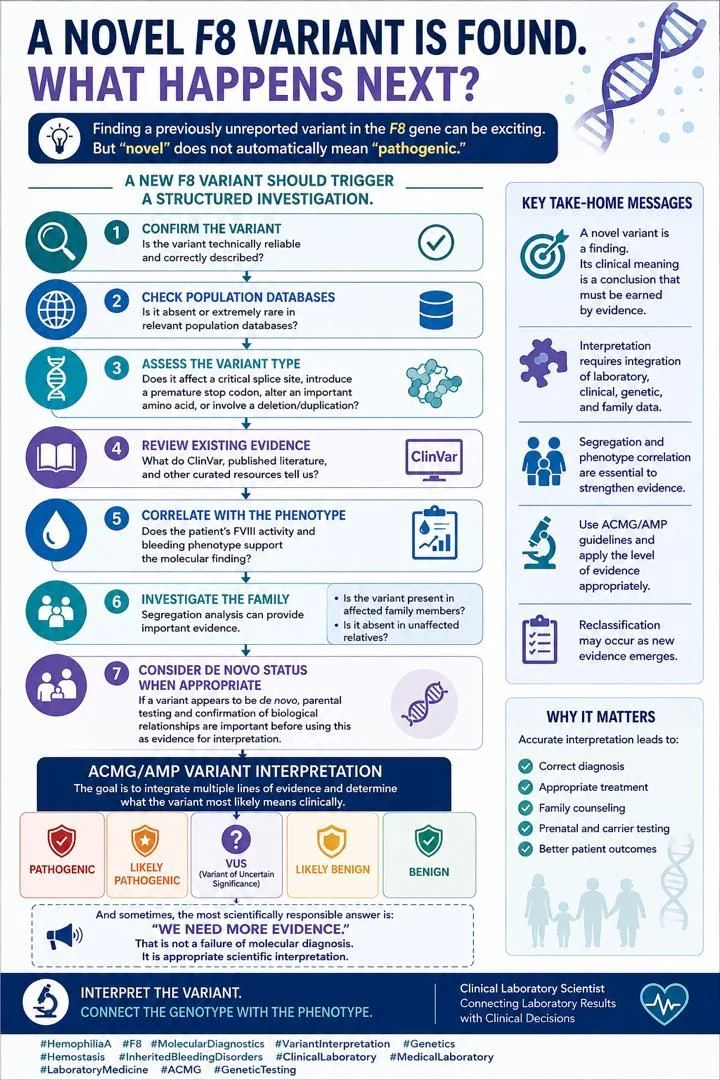
“A novel F8 variant is found. What happens next?
Finding a previously unreported variant in the F8 gene can be exciting.
But ‘novel’ does not automatically mean ‘pathogenic.’
A new F8 variant should trigger a structured investigation.
1. Confirm the variant
Is the variant technically reliable and correctly described?
2. Check population databases
Is it absent or extremely rare in relevant population databases?
3. Assess the variant type
Does it affect a critical splice site, introduce a premature stop codon, alter an important amino acid, or involve a deletion or duplication?
4. Review existing evidence
What do ClinVar, published literature, and other curated resources tell us?
5. Correlate with the phenotype
Does the patient’s FVIII activity and bleeding phenotype support the molecular finding?
6. Investigate the family
Segregation analysis can provide important evidence.
Is the variant present in affected family members?
Is it absent in unaffected relatives?
7. Consider de novo status when appropriate
If a variant appears to be de novo, parental testing and confirmation of biological relationships are important before using this as evidence for interpretation.
Then comes the critical step:
ACMG/AMP variant interpretation.
The goal is not simply to label a variant.
The goal is to integrate multiple lines of evidence and determine what the variant most likely means clinically.
A novel variant may ultimately be classified as:
Pathogenic | Likely Pathogenic | VUS | Likely Benign | Benign
And sometimes, the most scientifically responsible answer is:
‘We need more evidence.’
That is not a failure of molecular diagnosis.
It is appropriate scientific interpretation.
A novel variant is a finding.
Its clinical meaning is a conclusion that must be earned by evidence.”
Stay updated with Hemostasis Today.
-
Sep 9, 2026, 17:17When Is Thrombophilia Testing Appropriate and How Can the Evidence Guide Clinical Care? – ISTH
-
Sep 9, 2026, 16:00Maximo Agustin Schiavone: HDL Beyond Cholesterol – Linking Lipids and Immunity
-
Sep 9, 2026, 15:56Abdul Mannan: When Antiseizure Drugs Alter DOAC Risk
-
Sep 9, 2026, 15:39Alessandro Lucchesi: The Future of MPN Disease Modification
-
Sep 9, 2026, 15:10Pablo Corral: Is the Lp(a) Hypothesis Wrong?
-
Sep 9, 2026, 14:54Agnes Kisakye: Expanding Point-of-Care Ultrasound and Surgical Interventions for Hemophilia in Uganda
-
Sep 9, 2026, 14:52Jan Sloves: Addressing Diagnostic and Treatment Variability in Pelvic-Origin Varicose Veins
-
Sep 9, 2026, 14:48The French Care Pathway for Gene Therapy in Haemophilia B – CRH French Reference Center for Hemophilia Lyon
-
Sep 9, 2026, 14:43David McIntosh: The Ethics of Plasma Donation