


Abdul Mannan: When Antiseizure Drugs Alter DOAC Risk
Abdul Mannan, Consultant Haematologist at Betsi Cadwaladr University Health Board, shared a post on LinkedIn about a recent article by Kai Michael Schubert et al., published in JAMA Neurology, adding:
“DOAC plus epilepsy: The antiseizure medicine may alter more than seizure control.
The usual teaching is simple: avoid the obvious enzyme inducers.
This new study says the choice may be less tidy.
Schubert et al used a TriNetX target-trial emulation to compare adults taking a DOAC plus one antiseizure medicine with lamotrigine or lacosamide.
What stood out?
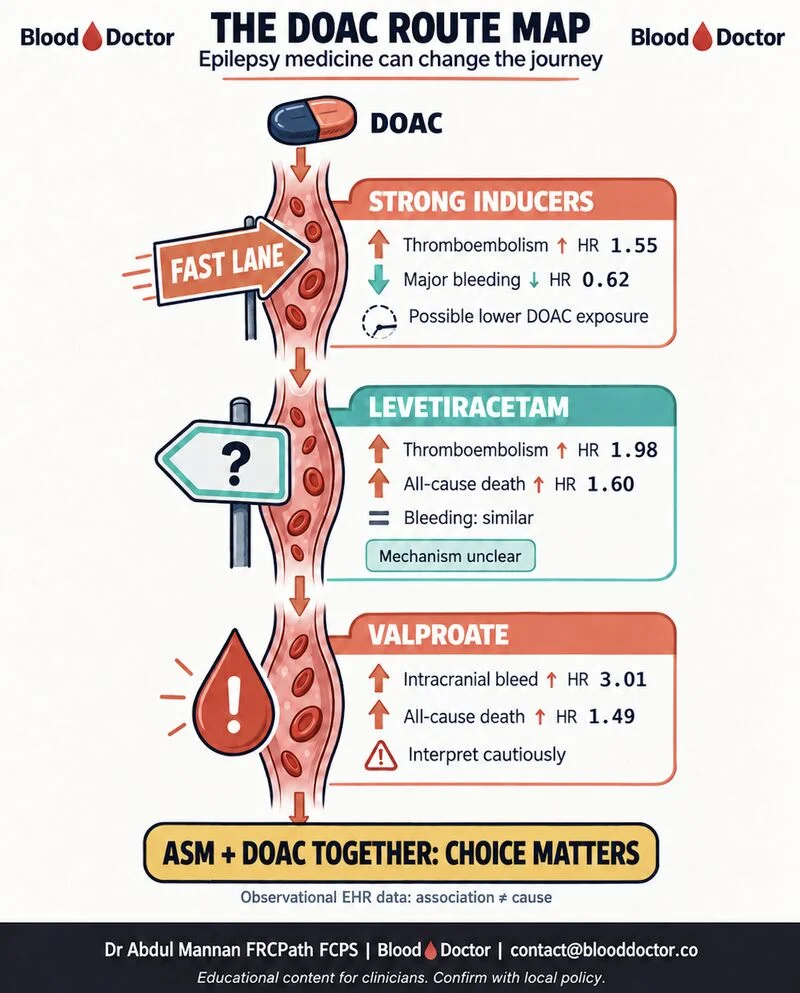
- Strong inducers, including carbamazepine and phenytoin: more thromboembolism (HR 1.55), but less major bleeding (HR 0.62).That pattern fits reduced DOAC exposure.
- Levetiracetam: more thromboembolism (HR 1.98) and death (HR 1.60), without less bleeding.This does not prove a drug interaction. It does mean ‘non-inducing’ is not the same as interaction-free.
- Valproate: more intracranial major bleeding (HR 3.01) and death (HR 1.49).Confounding remains a real concern.
The VKA analysis was calmer: thromboembolic estimates were close to 1.
My take? For someone needing a DOAC, antiseizure drug choice deserves a joint neurology, cardiology and haematology review.
These are observational data, with no DOAC levels, so they are not a reason for abrupt ASM changes.”
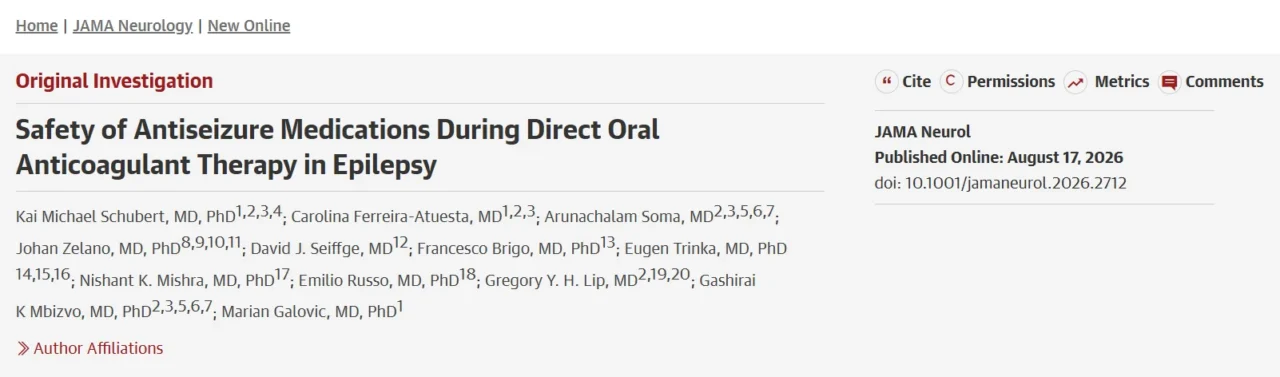
Title: Safety of Antiseizure Medications During Direct Oral Anticoagulant Therapy in Epilepsy
Authors: Kai Michael Schubert, Carolina Ferreira-Atuesta, Arunachalam Soma, Johan Zelano, David J. Seiffge, Francesco Brigo, Eugen Trinka, Nishant K. Mishra, Emilio Russo, Gregory Y. H. Lip, Gashirai K Mbizvo, Marian Galovic
Other posts featuring Abdul Mannan on Hemostasis Today.
-
Sep 9, 2026, 15:39Alessandro Lucchesi: The Future of MPN Disease Modification
-
Sep 9, 2026, 15:10Pablo Corral: Is the Lp(a) Hypothesis Wrong?
-
Sep 9, 2026, 14:54Agnes Kisakye: Expanding Point-of-Care Ultrasound and Surgical Interventions for Hemophilia in Uganda
-
Sep 9, 2026, 14:52Jan Sloves: Addressing Diagnostic and Treatment Variability in Pelvic-Origin Varicose Veins
-
Sep 9, 2026, 14:48The French Care Pathway for Gene Therapy in Haemophilia B – CRH French Reference Center for Hemophilia Lyon
-
Sep 9, 2026, 14:43David McIntosh: The Ethics of Plasma Donation
-
Sep 9, 2026, 14:42Thirunavukkarasu Angappan: Factor VIII and IX Didn’t Get Viral-Safety Rules Until the 1980s
-
Sep 9, 2026, 14:30Alejandro González Veliz: 2026 ESC Guidelines Expand Cardiac Rehabilitation Beyond Post-Event Recovery
-
Sep 9, 2026, 13:59Natalie Arnold: Biomarkers and the Hidden Burden of CHD