

CRISPR/Cas Gene Editing in β-Thalassemia: From Molecular Correction to Clinical Reality
The first regulatory approval of a CRISPR-based therapy for transfusion-dependent β-thalassemia (TDT) in 2024 marked a turning point in the care of this inherited blood disorder.
For decades, treatment relied on lifelong transfusions, iron chelation, and, for a minority, allogeneic hematopoietic cell transplantation (HCT).
CRISPR gene editing now offers a potentially curative, autologous option that addresses the underlying genetic defect without requiring a matched donor.
By 2026, the U.S. Food and Drug Administration (FDA) has expanded the indication for the first approved CRISPR therapy to children as young as 2 years, base-editing programs are advancing through clinical evaluation, and international guidelines are beginning to embed gene editing into standard care algorithms.
This article explains how CRISPR works in β-thalassemia, what the clinical and regulatory data show, how current guidelines position these therapies, and what this means for patients and clinicians in everyday practice.
Understanding β-Thalassemia: Why Gene Editing Matters
β-thalassemia is caused by pathogenic variants in the β-globin (HBB) gene that impair synthesis of β-globin chains, leading to ineffective erythropoiesis, microcytic hypochromic anemia, and a complex of systemic complications.
The clinical spectrum ranges from mild, non–transfusion-dependent phenotypes to severe transfusion-dependent β-thalassemia (TDT), which imposes a substantial burden on patients and healthcare systems.
Patients with TDT require regular red-cell transfusions to maintain adequate hemoglobin levels. Over time, this leads to iron overload that damages the liver, heart, and endocrine organs unless aggressively managed with chelation therapy.
Despite optimal supportive care, many patients experience growth retardation, skeletal deformities, cardiac dysfunction, fatigue, and reduced quality of life.
Allogeneic HCT remains the only established curative option in many settings, but it is constrained by the availability of HLA-identical donors, transplant-related morbidity and mortality, and age-dependent outcomes.
Younger patients with matched sibling donors and low iron burden achieve the best results, whereas older patients, those without suitable donors, or those with significant comorbidities face higher risks.
Gene editing offers a potentially autologous, one-time intervention that addresses the underlying molecular defect without requiring a matched donor, thereby expanding curative options to a broader population of TDT patients.
How CRISPR Gene Editing Works in β-Thalassemia
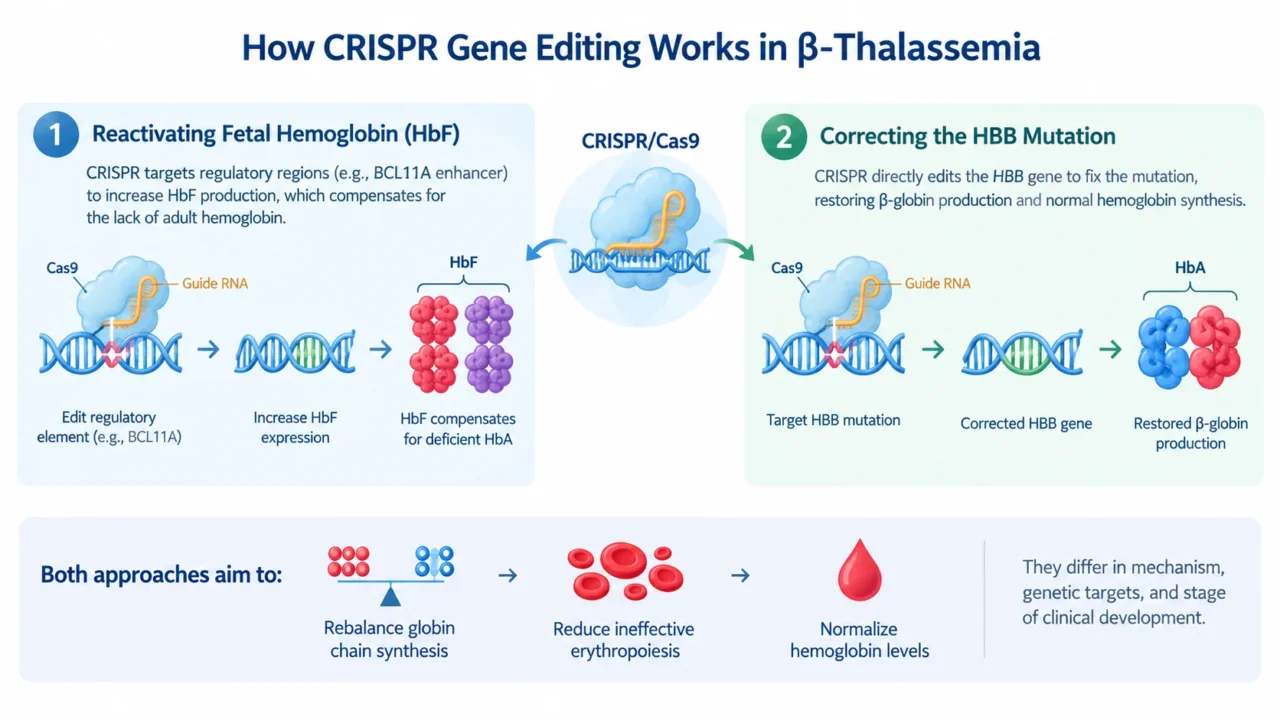
CRISPR-based therapies for β-thalassemia use two complementary strategies: reactivating fetal hemoglobin (HbF) to compensate for deficient adult hemoglobin, or directly correcting the HBB mutation to restore β-globin production.
Both approaches aim to rebalance globin chain synthesis, reduce ineffective erythropoiesis, and normalize hemoglobin levels, but they differ in mechanism, genetic targets, and stage of clinical development․
Reactivating Fetal Hemoglobin: Bypassing the Defect
The most clinically advanced approach disrupts erythroid-specific regulatory elements that silence γ-globin after birth, thereby reactivating HbF in adult erythroid cells.
Fetal hemoglobin (α2γ2) can functionally substitute for adult hemoglobin (α2β2), mitigating the consequences of β-globin deficiency.
Exagamglogene autotemcel (exa-cel; Casgevy) uses CRISPR/Cas9 to edit an erythroid enhancer of BCL11A, a master transcriptional repressor of γ-globin. Disruption of this enhancer reduces BCL11A expression in erythroid cells, leading to sustained, pancellular HbF expression that functionally compensates for absent or defective β-globin.
EDIT-301 (renizgamglogene autogedtemcel) employs Cas12a to disrupt BCL11A binding sites in the HBG1/HBG2 promoters, similarly boosting HbF through a slightly different genomic target. Both strategies aim not to repair HBB but to bypass its dysfunction by restoring total hemoglobin output via HbF.
This approach is conceptually analogous to the natural condition of hereditary persistence of fetal hemoglobin (HPFH), in which γ-globin expression persists into adulthood and ameliorates the severity of β-hemoglobinopathies.
Direct HBB Correction: Fixing the Root Cause
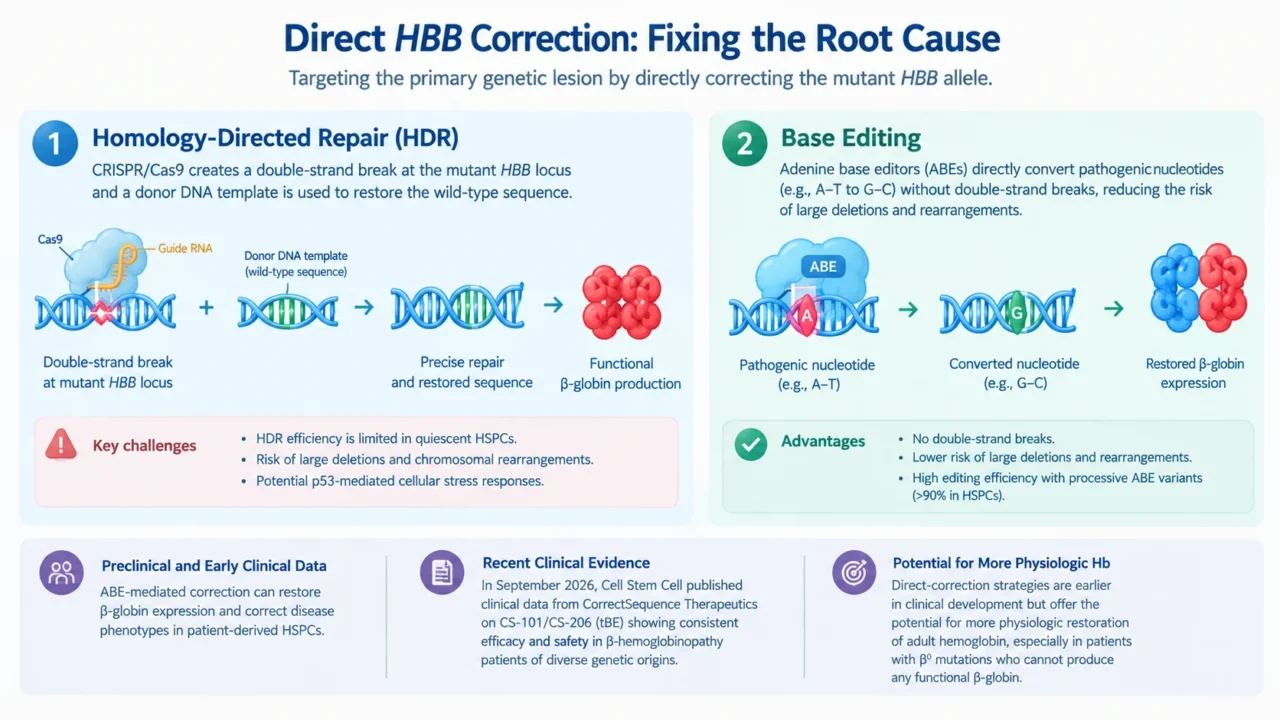
An alternative set of approaches targets the primary genetic lesion by directly correcting the mutant HBB allele.
Homology-directed repair (HDR) introduces a double-strand break at the mutant HBB locus using CRISPR/Cas9 and supplies a donor DNA template to restore the wild-type sequence.
While conceptually straightforward, HDR efficiency in quiescent hematopoietic stem and progenitor cells (HSPCs) is limited, and the process carries risks of large deletions, chromosomal rearrangements, and p53-mediated cellular stress responses.
Base editing, particularly adenine base editors (ABEs), directly converts pathogenic nucleotides (for example, A- T to G- C) without generating double-strand breaks, thereby reducing the risk of large deletions and chromosomal rearrangements.
Recent work has shown that highly processive ABE variants can achieve more than 90 percent editing of HSPCs, with improved β-globin expression and phenotypic correction in both β⁰-thalassemia and sickle cell–β-thalassemia models.
In September 2026, Cell Stem Cell published clinical data from CorrectSequence Therapeutics demonstrating that CS-101/CS-206—a transformer base editor (tBE)–based therapy—achieved consistent efficacy and safety in β-hemoglobinopathy patients of diverse genetic origins.
These results complement preclinical and early clinical data showing that ABE-mediated correction can restore β-globin expression and correct disease phenotypes in patient-derived HSPCs.
Direct-correction strategies are earlier in clinical development but offer the potential for more physiologic restoration of adult hemoglobin, particularly in patients with β⁰ mutations who cannot produce any functional β-globin.
What the Clinical Trials Show
Exa-cel (Casgevy): The First Approved CRISPR Therapy for TDT
Exa-cel’s approval was based on the CLIMB THAL-111 and related studies, which collectively demonstrated high rates of transfusion independence, robust HbF induction, and durable clinical benefit.
In these trials, the majority of evaluable TDT patients achieved durable transfusion-free status, with hemoglobin levels in or near the normal range. Pancellular HbF levels typically ranged from 30 percent to 65 percent and were maintained for years post-infusion, correlating with sustained clinical benefit.
Regulatory milestones reflect this evidence base. The U.S. Food and Drug Administration (FDA) approved exa-cel in January 2024 for patients aged 12 years and older with TDT.
In July 2026, a supplemental FDA approval extended the indication to children as young as 2 years, based on favorable safety and efficacy signals in younger cohorts.
At the European Haematology Association (EHA) 2026 congress, updated data supported exa-cel as a potential one-time functional cure for children aged 5–11 years with TDT, with suggestions of additional benefit when treatment is given before chronic iron-overload complications develop.
These findings align with the broader principle that earlier intervention—before cumulative organ damage accrues—may yield superior long-term outcomes.
EDIT-301 and Other HbF-Reactivation Programs
Early-phase trials of EDIT-301 (NCT04853576) and similar agents show robust HbF elevation and transfusion independence in subsets of TDT patients.
Adverse events are largely attributable to busulfan conditioning rather than the editing itself, and no therapy-related malignancies or confirmed harmful off-target edits have been reported to date.
Systematic reviews of gene-editing therapies in TDT report transfusion independence in approximately 89–100% of evaluable patients, with follow-up now extending beyond 4 years in some cohorts.
While these data are encouraging, longer-term surveillance remains essential to assess durability, clonal stability, and late adverse events.
Base Editing: Emerging Clinical Data
The September 2026 Cell Stem Cell report on CS-101/CS-206 provides some of the first clinical evidence for base editing in β-hemoglobinopathies.
Patients with diverse β-thalassemia mutations achieved clinically meaningful hemoglobin responses, and no unexpected safety findings were reported in the early follow-up period.
These results complement preclinical and early clinical data showing that ABE-mediated correction can restore β-globin expression and correct disease phenotypes in patient-derived HSPCs.
Base editors may mitigate some risks associated with double-strand breaks, but their long-term genomic stability in humans is still being defined.
Safety: What We Know and What We Are Still Learning
Safety discussions around CRISPR therapies often conflate conditioning toxicity with editing-specific risks.
Current evidence suggests that conditioning-related toxicity dominates early adverse events, while editing-specific risks remain theoretical but require vigilant long-term monitoring.
Myeloablative busulfan, used to clear space in the bone marrow for edited cells, is associated with grade 3 or higher events such as febrile neutropenia, infections, mucositis, and infertility.
These effects are well-characterized from decades of HCT experience and are not unique to gene editing.
Across β-thalassemia trials, no therapy-related malignancies or definitively harmful off-target edits have been reported, though follow-up remains limited.
Preclinical studies have identified potential off-target sites for commonly used guide RNAs (gRNAs), but clinical sequencing has not revealed consistent, pathogenic off-target mutations at these loci.
Monitoring for clonal hematopoiesis, large deletions, chromosomal rearrangements, and late adverse events is essential, particularly as younger patients receive editing earlier in life and live longer with edited cells.
Base editors may reduce some risks associated with double-strand breaks, but their long-term genomic stability in humans is still being defined.
How International Guidelines Position Gene Editing
International guidelines are increasingly explicit about the role of gene therapy—and by extension, gene editing—in the management of TDT.
While many recommendations were framed primarily around lentiviral gene addition, they are increasingly interpreted to include CRISPR-based editing as part of the ‘gene therapy’ category, especially for patients who meet trial eligibility criteria.
Thalassemia International Federation (TIF) 2025 Guidelines
The 2025 (5th edition) Thalassemia International Federation (TIF) guidelines recommend allogeneic HCT as the preferred curative option in children with TDT who have an HLA-identical donor, particularly when performed early in life before iron-overload complications develop (Grade B, Class I).
For patients aged 14 years or older, or those without an HLA-identical family donor, gene therapy is considered an optimal therapeutic option (Grade C, Class IIa).
Ideal gene therapy candidates are those with significant transfusion history (at least 100 mL/kg or at least 10 units per year), controlled iron overload (liver iron concentration [LIC] 7 mg/g dry liver weight or less, mT2* greater than 20 ms), normal cardiac and respiratory function, and high motivation.
Patients aged 35–45 years, those with moderate-to-severe iron overload (LIC greater than 7 and less than 15 mg/g, mT2* less than 20 and greater than 15 ms), rare erythrocyte phenotypes, alloimmunization concerns, or proven intolerance to iron chelation should be considered for HCT or gene therapy within 24 months (Grade C, Class IIb).
EHA 2026 Recommendations and Real-World Evidence
European Haematology Association (EHA) materials in 2026 emphasize durable clinical benefits in children, with updated exa-cel data supporting its use in patients aged 5–11 years, particularly when administered before chronic complications accrue.
Real-world confirmation from studies such as KL003-based gene therapy in Chinese TDT patients reinforces the translatability of trial findings to routine practice settings.
EHA also underscores the importance of preconceptual and antenatal screening for hemoglobinopathies, noting that early identification of at-risk couples can inform reproductive choices and, in the future, potentially earlier access to curative therapies.
Guideline Central and Other Summaries
2026 summaries highlight gene therapy as a standard option for TDT, particularly in patients 14 years or older or those lacking an HLA-identical donor.
They emphasize that gene therapy should be delivered in experienced institutions with robust supportive care and long-term follow-up capacity.
A Practical Framework for Clinicians
For hematologists and transplant physicians, several practical questions arise in integrating gene editing into clinical practice.
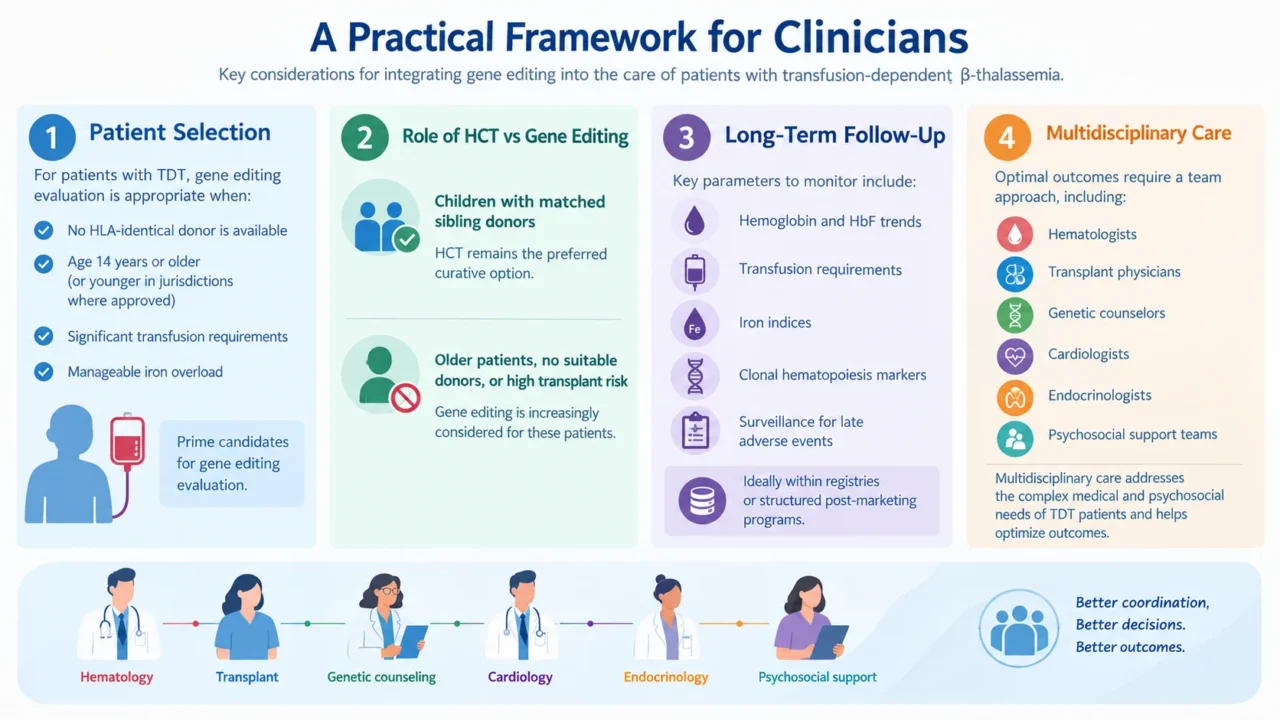
Patients with TDT who lack an HLA-identical donor, are 14 years or older (or younger in jurisdictions where approved), have significant transfusion requirements, and manageable iron overload are prime candidates for gene editing evaluation.provider.
In children with matched sibling donors, HCT remains the preferred curative option. Gene editing is increasingly considered for older patients, those without suitable donors, or those at high transplant risk.
Long-term follow-up should include hemoglobin and HbF trends, transfusion requirements, iron indices, clonal hematopoiesis markers, and surveillance for late adverse events, ideally within registries or structured post-marketing programs.
Multidisciplinary care involving hematologists, transplant physicians, genetic counselors, cardiologists, endocrinologists, and psychosocial support teams is essential to optimize outcomes and address the complex needs of TDT patients.
Looking Ahead: What the Next 3–5 Years May Bring
Several developments are likely to shape the field of CRISPR-based therapy for β-thalassemia over the next 3–5 years.
Earlier intervention is likely as safety data mature and regulatory indications expand, potentially shifting treatment toward younger patients before irreversible iron-overload damage occurs.
A broader molecular toolkit is emerging. Base editors, prime editors, and dual-target strategies may offer more precise, genotype-tailored solutions, particularly for common β⁰ mutations.
In vivo editing represents a transformative possibility. If delivery challenges are solved, in vivo approaches could eliminate the need for ex vivo cell processing and myeloablation, dramatically simplifying logistics and reducing toxicity.
Guideline evolution is expected. Future iterations of TIF, EHA, and national guidelines are likely to provide more granular recommendations on patient selection, timing, and long-term monitoring specific to CRISPR-based therapies.
Global access initiatives will be critical. Addressing the disparity between where these therapies are available and where the disease burden is greatest will require innovative financing models, technology transfer, and capacity-building initiatives.
Conclusion
CRISPR/Cas gene editing in β-thalassemia has moved from molecular research to clinical reality. Between 2024 and 2026, the approval of the first therapies, expansion of indications to children as young as 2 years, and inclusion of gene therapy in international guidelines reflect rapid progress in this field.
Despite high efficacy and durable clinical benefits, challenges remain: infrastructure requirements, high costs, long-term safety monitoring, and global access. The coming years are expected to bring next-generation editors (base/prime editors), in vivo approaches, and expanded indications.
For clinicians, the key priorities are appropriate patient selection, multidisciplinary care, and long-term follow-up to ensure that the promise of CRISPR translates into sustainable, equitable clinical outcomes.
Frequently Asked Questions (FAQ)
1. What is CRISPR/Cas gene editing?
A targeted gene-editing technique used in β-thalassemia to increase fetal hemoglobin (HbF).
2. Who is eligible for CRISPR therapy?
As of July 2026, Casgevy is FDA-approved for patients aged 2 years and older with transfusion-dependent β-thalassemia.
3. How is the treatment given?
The patient’s stem cells are collected, genetically edited, and reinfused after myeloablative conditioning.
4. What benefits have trials shown?
About 91 percent of treated patients achieved transfusion independence, with sustained HbF production.
5. How long does the effect last?
Responses have remained durable for at least 4 years, although lifelong durability is still being studied.
6. What are the main risks?
Risks are mainly related to conditioning, including infections, mucositis, and infertility. Long-term safety monitoring remains essential.
7. How does it compare with allogeneic HCT?
Unlike HCT, CRISPR therapy uses the patient’s own cells and avoids graft-versus-host disease, but still requires intensive conditioning.
8. Will patients still need transfusions or chelation?
Most patients become transfusion-independent. Iron chelation can be stopped once iron stores are adequately controlled.
9. Is it available worldwide?
It is approved in several regions but remains available only at specialized centers, with access limited by cost and infrastructure.
10. What follow-up is needed?
Long-term monitoring includes blood counts, HbF, transfusion needs, iron status, and surveillance for late effects.
Written by Anna Stepanyan, MD
Stay updated with Hemostasis Today.
-
Oct 25, 2026, 05:30Denis Oduor: Whole Blood and Component Therapy in Clinical Practice
-
Oct 25, 2026, 02:18Dai H. Chung: Delivering Lyfgenia to Pediatric Patients With Sickle Cell Disease
-
Oct 25, 2026, 02:17Marilyn Baffoe-Bonnie: What Does It Mean to Be Cured of Sickle Cell Disease?
-
Oct 25, 2026, 02:15Tamara Stipcevic: A Hand-Powered Device for Rapid Blood Typing and Hematocrit Estimation
-
Oct 25, 2026, 02:14Rhonda Patrick: Microplastics Generate Damaging Free Radicals Simply by Contacting Water
-
Oct 25, 2026, 02:12Chokri Ben Lamine: Rilzabrutinib – Oral BTK Inhibitor for ITP
-
Oct 25, 2026, 02:12Michael H. Tomasson: Self-Experimentation That Revealed the Immune Mechanism of ITP
-
Oct 25, 2026, 02:10Nabiha Huq Saifee: Do You Help Make Platelet Transfusion Decisions Before Lumbar Puncture?
-
Oct 25, 2026, 02:09Sebastian Szmit: Congratulations to Isabelle Mahé on Her New Cardio-Oncology Paper