


Alexsander Santiago: Tranexamic Acid – Why Timing Matters in Critical Bleeding
Alexsander Santiago, Health Education Coordinator at Terapia Intensiva em Foco, shared a post on LinkedIn:
“Tranexamic acid is not about ‘stopping bleeding.’
It is about buying time before physiology collapses.
And in critical care, that difference matters.
We often discuss TXA as if it were a universal hemostatic reflex:
- Patient bleeding – give tranexamic acid.
But that is not good enough.
Because the real question is not:
- ‘Is there blood loss?’
The real question is:
- ‘Is this a time-sensitive bleeding phenotype in which fibrinolysis is part of the problem and early treatment can still change the trajectory?’
That is where TXA becomes clinically meaningful.
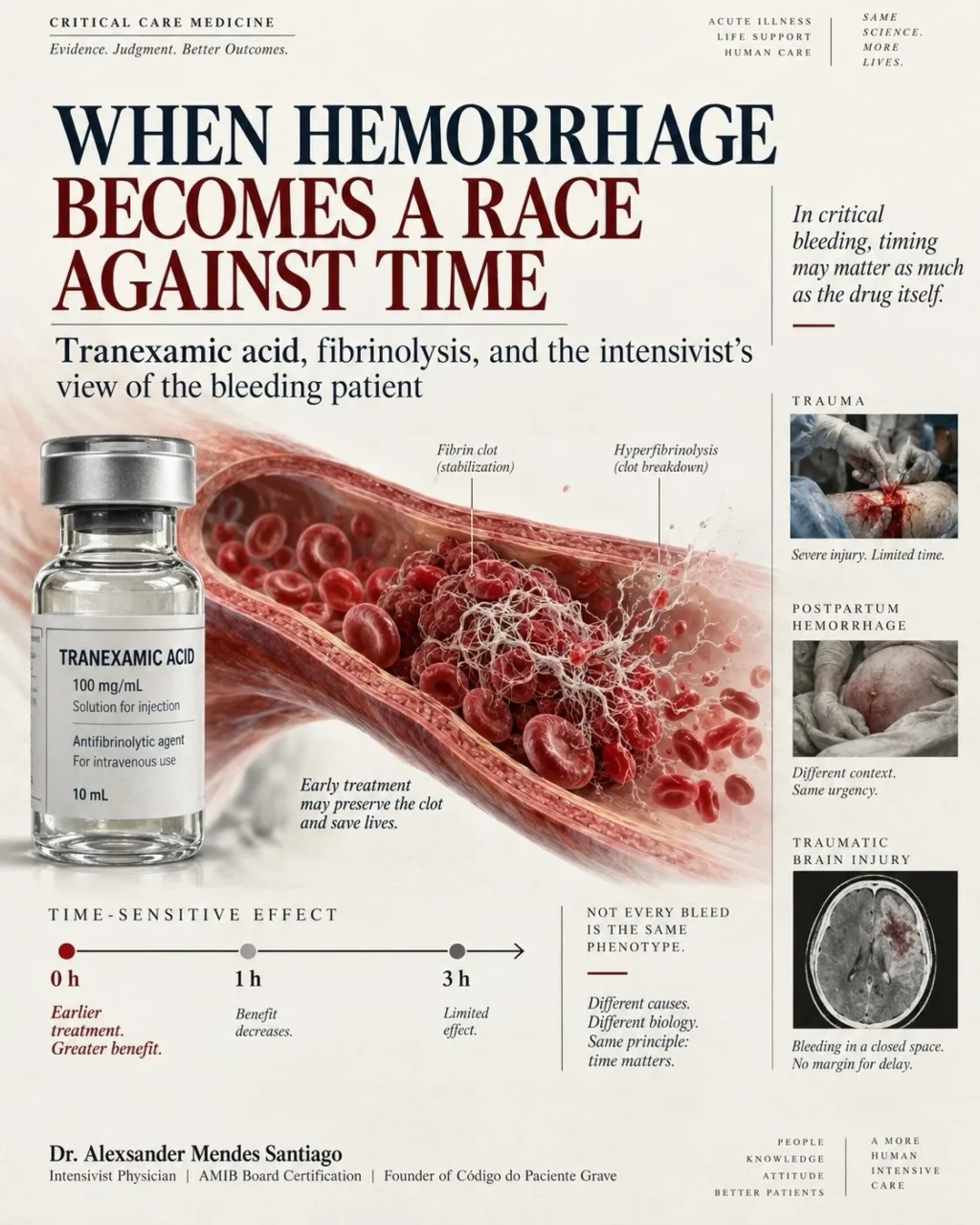
In trauma, timing changed the conversation.
In postpartum hemorrhage, timing changed the conversation.
In selected traumatic brain injury, timing still matters because bleeding in a closed space leaves little margin for delay.
The lesson is bigger than the drug itself:
- Critical bleeding is not only about volume loss.
- It is about tempo.
- A patient can still be bleeding before shock is fully declared.
- A clot can still be salvageable before hemodynamic collapse becomes obvious.
- A trajectory can still be reversible before organ failure becomes the dominant story.
That is why I think TXA should not be framed as a ‘bleeding drug.’
It is better understood as a time-sensitive antifibrinolytic tool.
And like every serious tool in the ICU, its value depends on context.
Not every hypotensive patient is bleeding.
Not every bleed is driven by hyperfibrinolysis.
Not every hemorrhagic situation benefits equally.
And not every late intervention deserves to be called a missed miracle.
Sometimes the mistake is not failing to give TXA.
Sometimes the mistake is failing to think early enough.
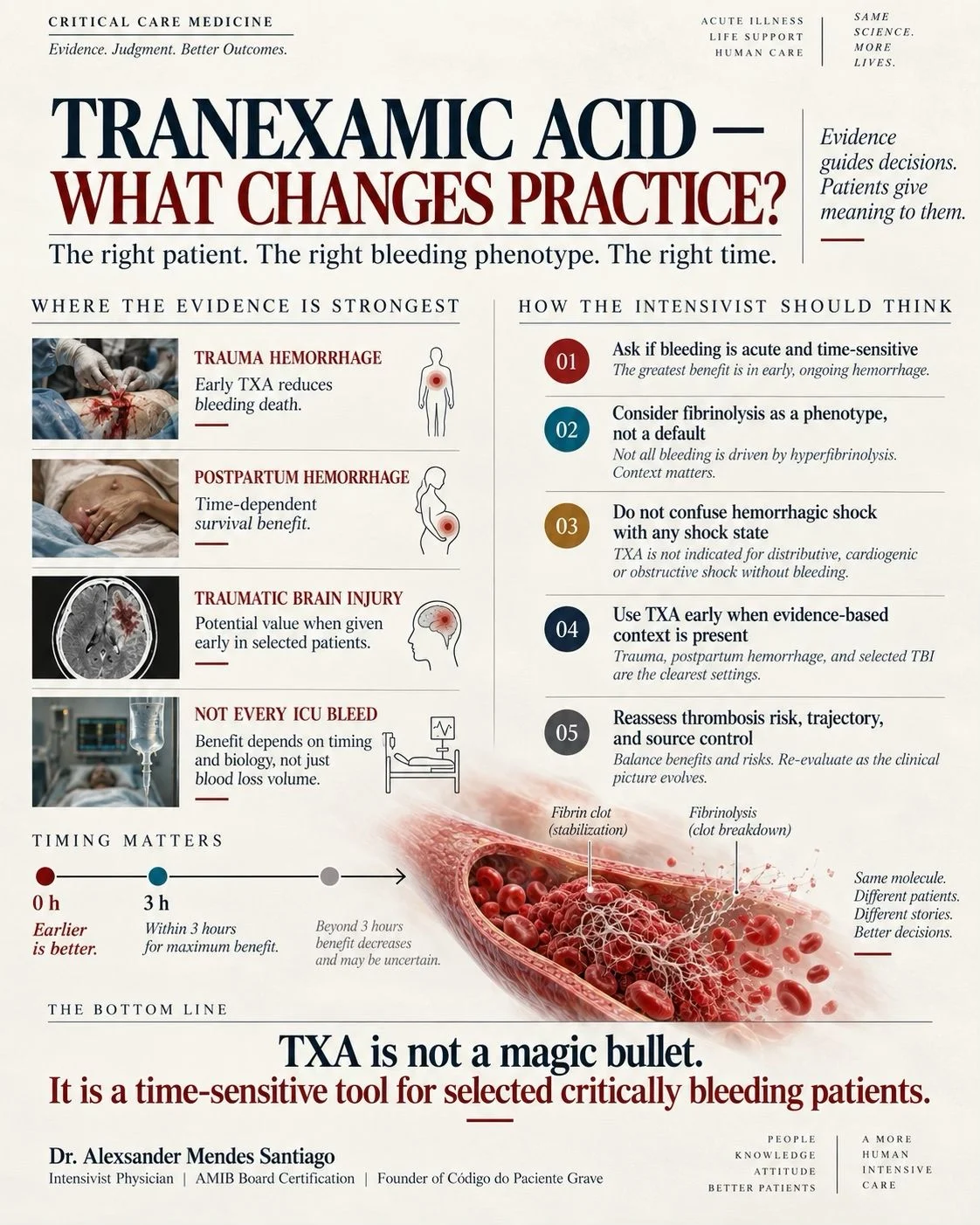
For the intensivist, the reasoning should be practical:
- Is this an acute, clinically significant hemorrhage?
- Is the patient still within a window where biology can be modified?
- Is fibrinolysis plausibly contributing to ongoing loss?
- Is this one of the settings where evidence is strongest?
- Have we remembered that TXA never replaces source control, resuscitation, and organ support?
Because TXA does not rescue bad reasoning.
It only helps when sound reasoning reaches the patient on time.
That may be the most important message:
- TXA is not magic.
- It is timing, phenotype, and judgment.
And in the critically bleeding patient, those three things can be the difference between stabilization and collapse.”
Stay updated with Hemostasis Today.
-
Sep 14, 2026, 15:53Leonard Valentino: Advancing a New Model of Patient-Led Research
-
Sep 14, 2026, 15:48Adishwar Rao: LAAC vs Oral Anticoagulation in Atrial Fibrillation
-
Sep 14, 2026, 15:36Lesley Van Wyk: Hemolytic Anemia Quick Revision – Tips and Tricks
-
Sep 14, 2026, 15:35Maha Othman: ISTH-BAT Reference Ranges Validated Across Five Continents in Children
-
Sep 14, 2026, 15:30Umberto Pensato։ Left Ventricular Dysfunction and DOAC Benefit in ESUS
-
Sep 14, 2026, 15:22Meral Kayikcioglu: Why Do Women and Men Differ in LDL-C Management?
-
Sep 14, 2026, 15:22James Crowley: The Complex Role of CRP in Cardiovascular Risk and Atherosclerosis
-
Sep 14, 2026, 15:16Factor XIII Deficiency An Often-Missed Bleeding Disorder
-
Sep 14, 2026, 15:07Raffaele Piccolo: Heparin Against Jellyfish Venom?