


Shamee Shastry: Chart Before You Chase – Diagnosing Drug-Induced Hemolytic Anemia
Shamee Shastry, Professor and Head of the Department of Immunohematology and Blood Transfusion at Kasturba Medical College, Manipal, shared a post on LinkedIn:
“Chart before you Chase!
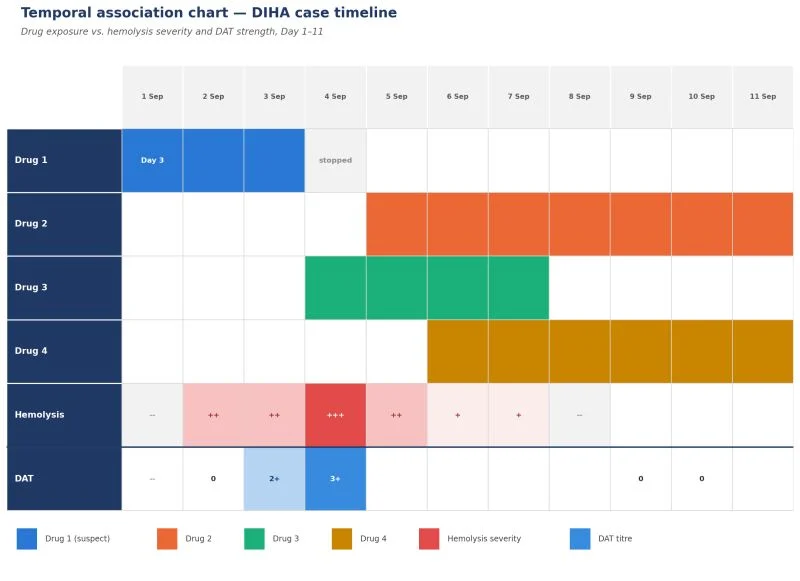
Why a simple timeline can be your most powerful diagnostic tool in Drug-Induced Hemolytic Anemia (DIHA).
When a patient on multiple medications develops sudden hemolysis, the real challenge isn’t recognising hemolysis, it’s identifying which drug caused it.
This is where a temporal association chart becomes indispensable.
By mapping every drug’s start and stop date against the day of hemolysis onset, hemolysis severity, and serial DAT results on a single timeline, patterns that are invisible in a case note become obvious at a glance:
Temporal plausibility: onset follows drug exposure within a biologically credible window, not before it.
A structured temporal chart doesn’t replace clinical judgement or serological workup (DAT, eluate, drug-dependent antibody testing), but it focuses that workup on the right suspect.”
Other posts featuring Shamee Shastry on Hemostasis Today.
-
Nov 9, 2026, 13:48PF4-ELISA–Negative HIT: Are We Missing a New Class of Anti-PF4 Immunothrombotic Disease?
-
Nov 9, 2026, 13:07Nandini Sadasivam: Gene Therapy for Sickle Cell Disease and Thalassaemia
-
Nov 9, 2026, 13:04Raising Awareness of Bleeding Disorders in Women and Girls – EHC
-
Nov 9, 2026, 12:59Rahul Bohra: Exploring the Complex Mechanisms of Sickle Cell Disease
-
Nov 9, 2026, 12:53Three Years of Movement and Thrombosis Awareness in the Czech Republic – World Thrombosis day
-
Nov 9, 2026, 12:51Octavio Marques Pontes-Neto: Intensive Blood-Pressure Control Reduces Cardiovascular Events After Ischemic Stroke
-
Nov 9, 2026, 12:49Irma Bagdoniene: What Really Makes Us Live Longer
-
Nov 9, 2026, 12:47Imo Akpan: Announcing the 2027 Women’s Hematology Summit
-
Nov 9, 2026, 12:45Shadi Yaghi: Rethinking Antithrombotic Therapy After Stroke