

HIT Reimagined: Can 12-Lipoxygenase Inhibition Stop Immune Thrombosis?
Heparin-induced thrombocytopenia (HIT) is a serious immune-mediated complication of heparin therapy and one of the clearest examples of immunothrombosis.
Unlike many thrombocytopenic conditions, HIT is characterized by a paradoxical combination of falling platelet counts and a markedly increased risk of thrombosis.
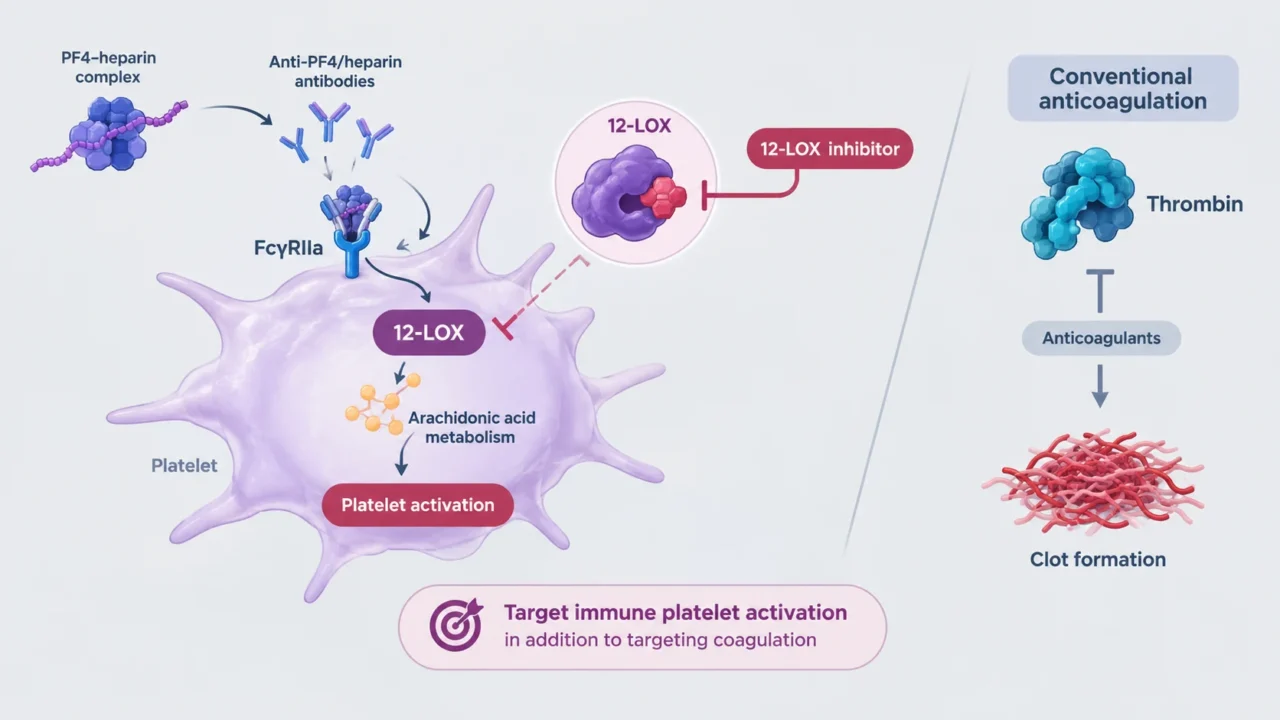
The condition develops when antibodies recognize complexes formed between platelet factor 4 (PF4) and heparin. These immune complexes bind to FcγRIIa receptors on platelets, triggering powerful platelet activation and amplification of the prothrombotic response.
The result is a disorder in which thrombocytopenia is not the main clinical threat. The major danger is the development of venous or arterial thrombosis, which can lead to serious and potentially life-threatening complications.
The Therapeutic Paradox of HIT
The immediate priority in suspected HIT is to stop heparin and initiate a non-heparin anticoagulant.
Current ASH recommendations include argatroban, bivalirudin, danaparoid, fondaparinux and, in appropriate patients, direct oral anticoagulants.
These therapies are essential because thrombosis, rather than bleeding, is the major clinical danger of HIT.
However, anticoagulants primarily target thrombin generation and clot propagation. They do not directly eliminate the antibody-mediated platelet activation that initiates HIT.
This has prompted interest in therapies that target the immune and cellular mechanisms upstream of coagulation.
Could interrupting FcγRIIa-dependent platelet activation provide an additional way to reduce thrombotic complications?
Why 12-Lipoxygenase?
One pathway attracting attention is platelet 12-lipoxygenase, or 12-LOX.
12-LOX is involved in arachidonic-acid metabolism and platelet signaling, and experimental evidence suggests that it participates in FcγRIIa-mediated platelet activation.
This makes 12-LOX particularly interesting in HIT.
Rather than targeting thrombin after coagulation has already been amplified, 12-LOX inhibition aims to interfere with a platelet signaling pathway involved in the immune response itself.
The concept is therefore different from conventional anticoagulation:
Target immune platelet activation — in addition to targeting coagulation.
From Experimental Inhibition to VLX-1005
The 12-LOX inhibitor VLX-1005 provided an opportunity to test this concept experimentally.
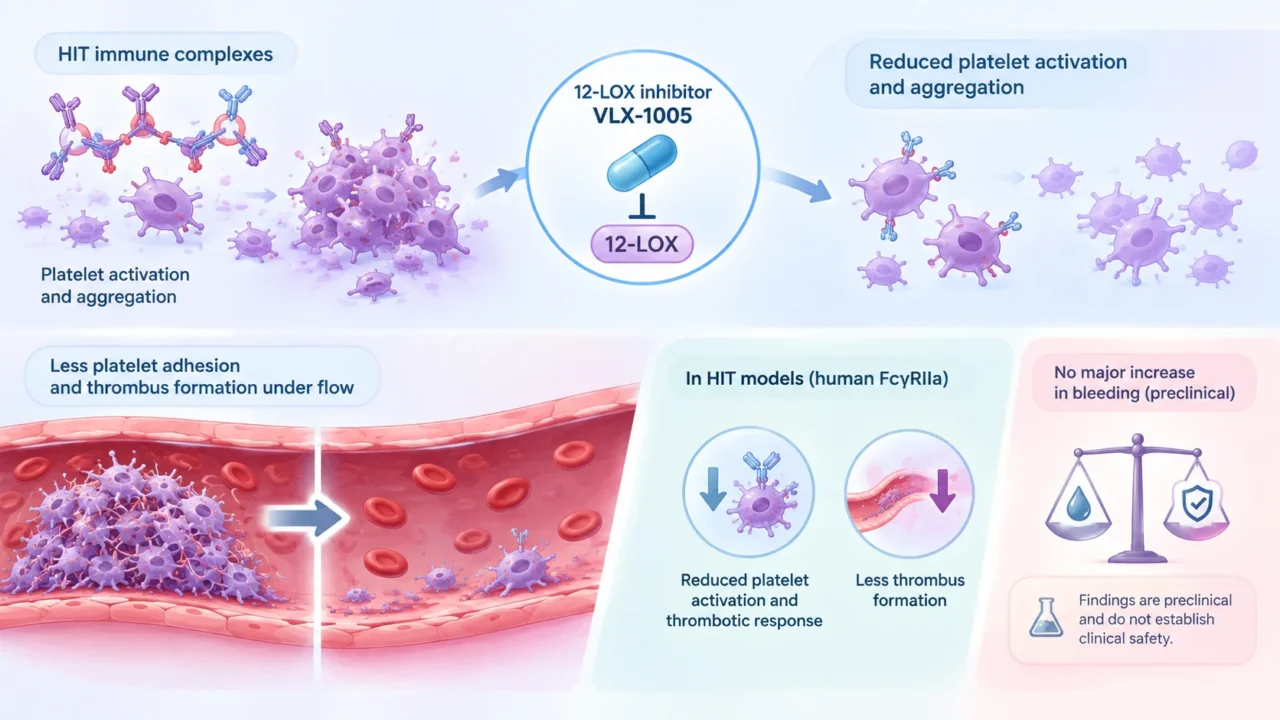
In a 2026 peer-reviewed study, VLX-1005 reduced platelet activation and aggregation induced by HIT immune complexes and inhibited ITAM-dependent platelet activation in whole blood.
The investigators also examined platelet adhesion and thrombus formation under flow conditions.
VLX-1005 reduced platelet adhesion and accumulation, supporting the possibility that 12-LOX inhibition may interfere with immune-mediated thrombus formation.
Animal experiments provided additional mechanistic support.
In experimental HIT models expressing human FcγRIIa, inhibition or absence of 12-LOX was associated with reduced HIT-related platelet activation and thrombotic responses.
Importantly, the preclinical work did not identify a major increase in bleeding with 12-LOX inhibition.
However, these findings remain preclinical and cannot establish clinical safety in patients.
From VLX-1005 to CAD-1005
The 12-LOX program subsequently moved toward clinical development with CAD-1005, an investigational 12-LOX inhibitor for HIT.
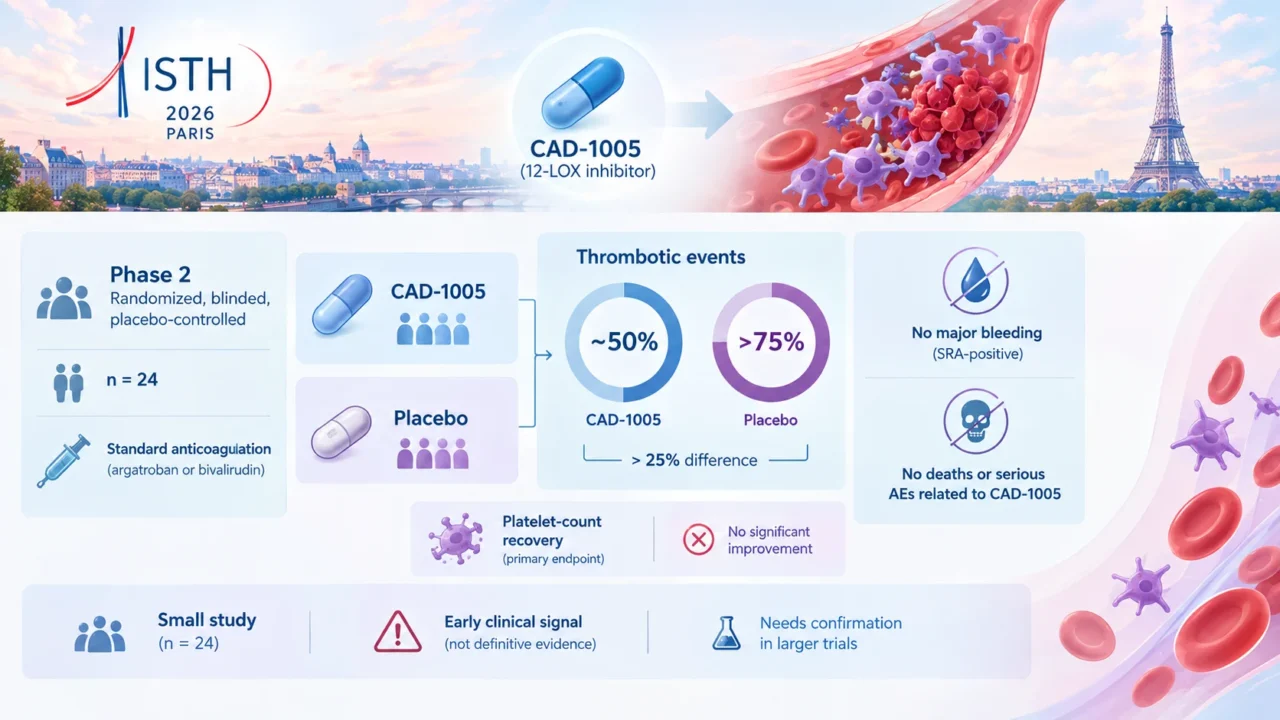
A randomized, blinded, placebo-controlled Phase 2 study evaluated CAD-1005 in patients with suspected HIT receiving standard anticoagulation with argatroban or bivalirudin.
The final reported dataset included 24 patients.
The study was designed with platelet-count recovery as its primary endpoint. That endpoint was not significantly improved with CAD-1005 compared with placebo. The thrombotic endpoint, however, generated a different signal.
New or worsening thrombotic events were reported in approximately 50% of patients receiving CAD-1005 compared with more than 75% in the placebo group.
This represents a difference of more than 25 percentage points․ The result should be interpreted cautiously.
The study was small, and the thrombotic endpoint was not powered to establish statistical significance. The finding therefore represents an early clinical signal rather than definitive evidence that CAD-1005 reduces thrombosis.
What Happened at ISTH 2026?
The latest clinical update came at the 34th Congress of the International Society on Thrombosis and Haemostasis in Paris in July 2026, where CAD-1005 Phase 2 data were presented as a late-breaking oral presentation.
The study reported new or worsening thrombotic events in approximately 50% of patients receiving CAD-1005 versus more than 75% with placebo, when added to standard anticoagulation.
The company also reported no major bleeding among SRA-positive patients and no deaths or serious adverse events attributed to CAD-1005.
However, the study included only 24 patients, and the primary endpoint of platelet-count recovery was not significantly improved. Therefore, these findings represent an early clinical signal that requires confirmation in larger trials.
Why Combine 12-LOX Inhibition With Anticoagulation?
The proposed strategy is not to replace anticoagulation.
Instead, it targets a different part of the HIT cascade.
Standard anticoagulation → limits thrombin generation and clot propagation.
12-LOX inhibition → aims to suppress immune-complex-mediated platelet activation.
The two approaches therefore act at different levels of the disease pathway.
This creates the possibility of a mechanism-based combination strategy: control coagulation while simultaneously limiting immune platelet activation.
The Platelet Count May Not Tell the Whole Story
One of the most interesting observations from the CAD-1005 program is that platelet recovery did not translate into an obvious difference in the primary endpoint.
At the same time, thrombotic events appeared to be lower in the CAD-1005 group. This raises an important methodological question for future HIT trials.
Should platelet-count recovery remain a major efficacy endpoint, or should trials focus more heavily on clinically meaningful thrombotic outcomes?
The question is particularly relevant because HIT is fundamentally a thromboinflammatory disorder.
The clinical burden comes from thrombosis and its complications, not thrombocytopenia alone.
What Comes Next?
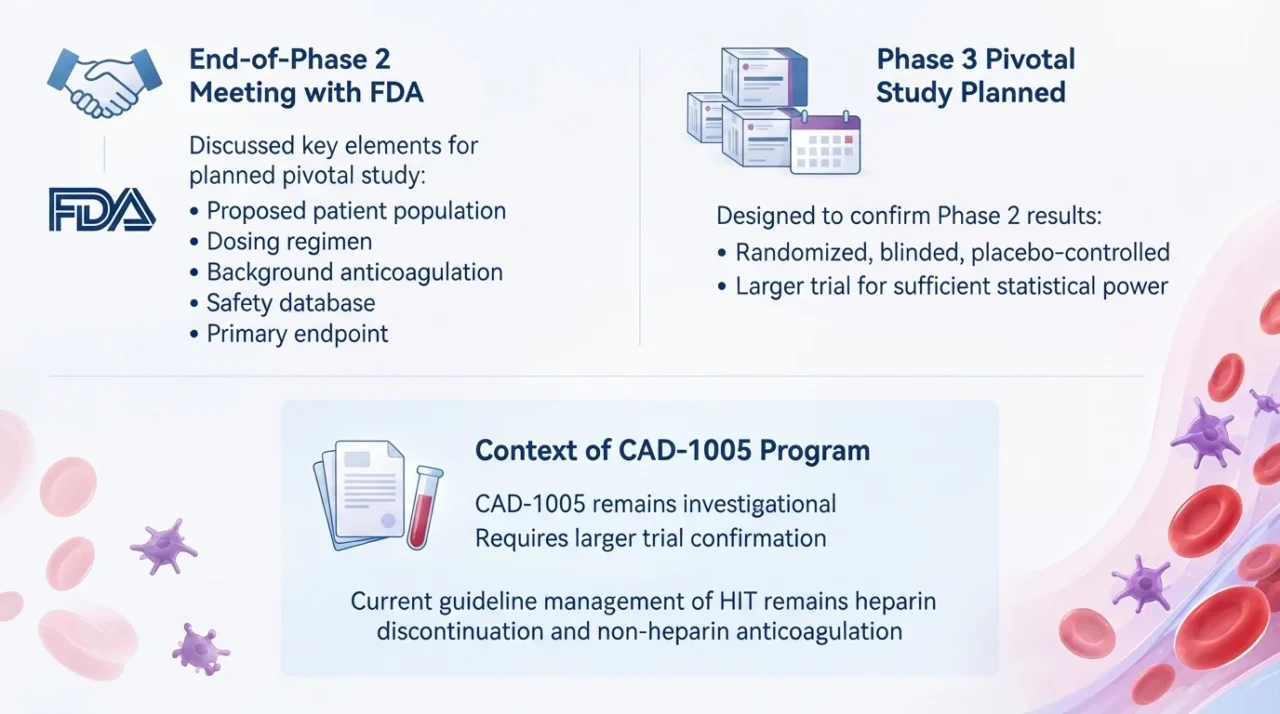
Following the Phase 2 program, Cadrenal reported an End-of-Phase 2 meeting with the U.S. Food and Drug Administration.
According to the company, discussions included the proposed patient population, dosing, background anticoagulation, safety database and the primary endpoint for the planned pivotal study.
The company has described plans for a randomized, blinded, placebo-controlled Phase 3 study.
A larger trial will be critical to determine whether the Phase 2 thrombotic signal can be reproduced in a sufficiently powered population.
Until those data are available, CAD-1005 remains investigational.
Current guideline-directed management of acute HIT remains heparin discontinuation and appropriate non-heparin anticoagulation.
A Broader Shift Toward Immunothrombosis
12-LOX inhibition is part of a wider effort to target the immune biology of HIT.
Recent reviews have discussed FcγRIIa-Syk-BTK signaling, complement activation and other pathways as potential therapeutic targets in autoimmune and spontaneous HIT.
The broader concept is a shift from treating HIT exclusively through downstream anticoagulation toward targeting the cellular mechanisms that generate the prothrombotic response.
12-LOX inhibition provides one of the first clinical tests of this concept.
What Still Needs to Be Proven?
Several questions remain before 12-LOX inhibition could change HIT management.
Can the reduction in thrombotic events be reproduced in a larger population?
Can it reduce clinically meaningful thrombosis without increasing bleeding?
And can the treatment provide additional benefit when used alongside standard anticoagulation?
Future studies will also need to clarify which patients are most likely to benefit and whether specific immunologic or platelet-activation markers can identify those patients.
These questions will become increasingly important as mechanism-based therapies move into larger clinical trials.
From Anticoagulation to Immune-Targeted Therapy
The current standard of care for HIT remains clear: stop heparin and initiate appropriate non-heparin anticoagulation.
12-LOX inhibition does not yet change that clinical approach.
What CAD-1005 adds is a different therapeutic concept: targeting the immune platelet-activation pathway while continuing to control coagulation.
Preclinical studies provide a mechanistic rationale, while the small Phase 2 study has generated an early signal that warrants further investigation.
The next phase of research will determine whether that signal translates into a clinically meaningful reduction in HIT-associated thrombosis.
For now, the key question remains open:
Can targeting 12-lipoxygenase help control immune thrombosis in HIT?
FAQ
1. What is HIT?
HIT is an immune-mediated adverse reaction to heparin in which PF4-heparin antibodies activate platelets and promote thrombosis.
2. Why is HIT associated with thrombosis?
HIT antibodies activate platelets through FcγRIIa and trigger a broader prothrombotic response involving multiple blood and vascular cells.
3. What is 12-LOX?
12-lipoxygenase is an enzyme involved in arachidonic-acid metabolism and platelet signaling that has been implicated in immune-complex-mediated platelet activation.
4. What is CAD-1005?
CAD-1005 is an investigational selective 12-LOX inhibitor being developed for HIT.
5. Is CAD-1005 a replacement for anticoagulation?
No. In the Phase 2 study, CAD-1005 was evaluated alongside standard anticoagulant therapy.
6. Did CAD-1005 improve platelet recovery?
The primary endpoint of platelet-count recovery was not significantly improved compared with placebo.
7. What happened with thrombotic events?
Approximately 50% of patients in the CAD-1005 group had new or worsening thrombotic events compared with more than 75% in the placebo group.
8. How strong is the Phase 2 evidence?
The study included only 24 patients, and the thrombotic endpoint was not powered for statistical significance. The result should therefore be considered an early clinical signal.
9. What was presented at ISTH 2026?
Late-breaking Phase 2 data for CAD-1005 were presented at the 34th ISTH Congress in Paris in July 2026.
10. Is CAD-1005 approved for HIT?
No. CAD-1005 remains investigational, and larger clinical trials are needed to establish its efficacy and safety.
Written by Hermine Sayiyan, MD
Stay updated with Hemostasis Today.
-
Sep 16, 2026, 16:06Katrina Louise Manalaysay: In Your 20s, You Might be Given the Opportunity to Donate Blood for the First Time
-
Sep 16, 2026, 15:45Matthew Hazell: A Brilliant Explanation of Phenotype vs Genotype Using a LEGO House
-
Sep 16, 2026, 15:23Ahmad Al-Ramahi: Presenting the Military Pharmacists Blood Training Course at the FIP World Congress
-
Sep 16, 2026, 14:42Ruchi Punamia: Beyond the Blood Bank and The Clinical Impact of Apheresis
-
Sep 16, 2026, 14:06Kalyan Roy: Celebrating Apheresis, Advancing Care, Saving Lives
-
Sep 16, 2026, 13:38Andrew Zapfel: Advancing Sickle Cell Disease Care and Research
-
Sep 16, 2026, 13:30Thirunavukkarasu Angappan: Why Plasma-Derived Factor VIII Still Matters for Inhibitor Patients
-
Sep 16, 2026, 13:22Matthew Hazell: New BSH Guidance for Fetal, Neonatal and Paediatric Transfusion
-
Sep 16, 2026, 13:21Sophia Delicou: Mediterranean Network for Haemoglobinopathies and Regional Collaboration