


Thirunavukkarasu Angappan: Why Plasma-Derived Factor VIII Still Matters for Inhibitor Patients
Thirunavukkarasu Angappan, Vice President – Operations and Manufacturing at PopVax, shared a post on LinkedIn:
“Factor VIII Has a Bodyguard. For Some Hemophilia A Patients, It’s the Only One That Works.
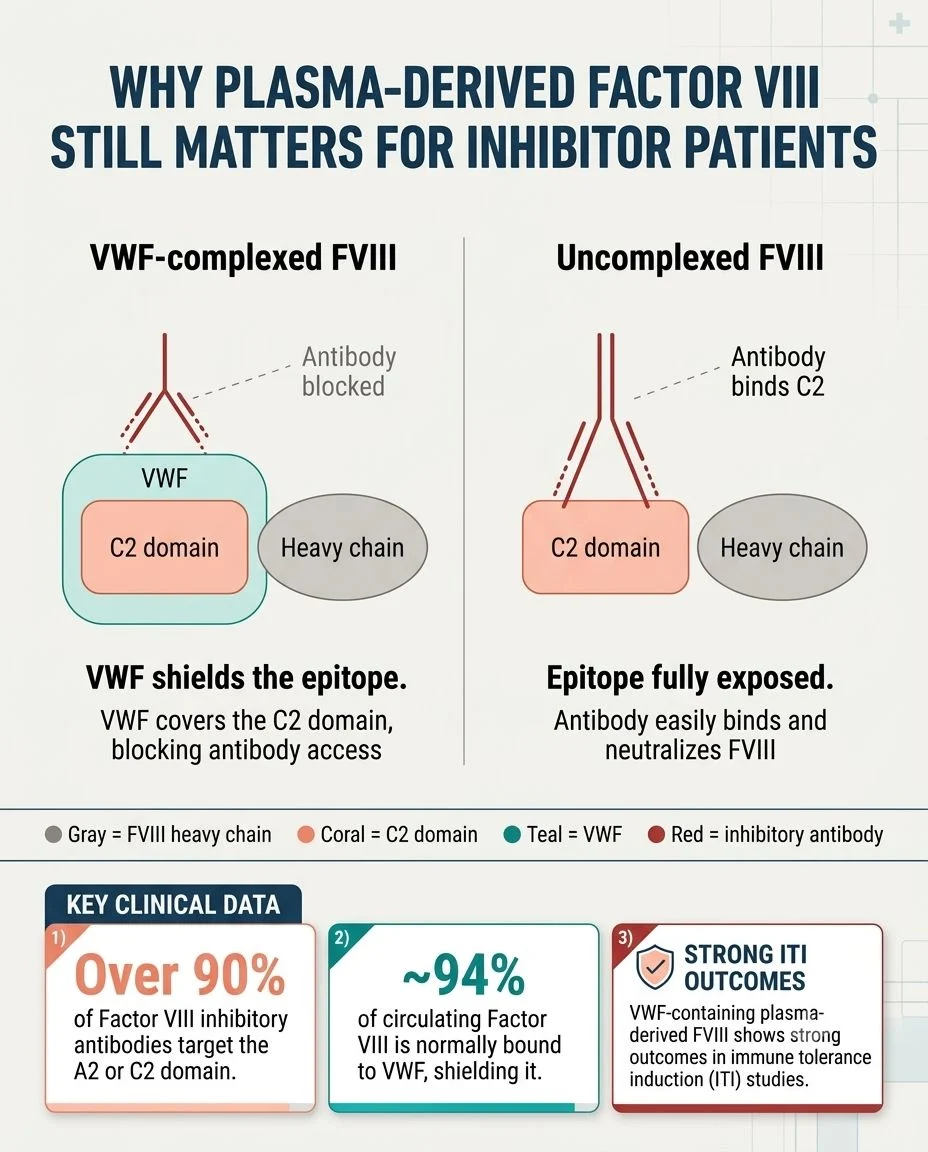
Most Factor VIII inhibitor antibodies don’t attack the whole protein. They attack one specific spot — and that spot happens to be where von Willebrand factor (VWF) sits.
Over 90% of inhibitory antibodies to Factor VIII bind to just two regions: the A2 domain or the C2 domain, disrupting the specific functions tied to each.
- Here’s the mechanical detail that matters clinically: under normal conditions, about 94% of circulating Factor VIII is bound to VWF, and VWF physically covers part of the Factor VIII light chain — including much of that same C2 domain where inhibitory antibodies attack.
- Multiple structural studies confirm this isn’t incidental — the same amino acid residues on Factor VIII’s C2 domain that bind VWF also overlap with where inhibitory antibodies bind and where Factor VIII binds to platelet phospholipid surfaces. When VWF occupies that site first, it can physically block or reduce the antibody’s ability to attach.
- This is why immune tolerance induction (ITI) outcomes differ by product type in a way that isn’t just statistical noise. As per Kreuz’s clinical review, VWF plays a documented role in the success of immune tolerance induction specifically because of this epitope-shielding effect, not simply because plasma-derived and recombinant products are chemically different.
- This mechanism has real clinical stakes. As per Oldenburg et al.’s multicentre international study, VWF-containing plasma-derived Factor VIII concentrate showed strong outcomes in both primary and rescue immune tolerance induction across a large, international patient cohort.
- The reason plasma-derived Factor VIII still matters for inhibitor patients isn’t habit, and it isn’t just because the studies say so — it’s a specific, structural interaction at the C2 domain that recombinant protein alone doesn’t replicate the same way.
If VWF’s epitope-shielding effect is central to why immune tolerance induction succeeds, should recombinant Factor VIII manufacturers be exploring VWF-fusion or VWF-co-formulated products specifically for inhibitor patients, rather than leaving that mechanism to plasma-derived concentrates alone?”
Stay updated with Hemostasis Today.
-
Nov 8, 2026, 11:56Why Genetic Predisposition Does Not Always Lead to Thrombosis – Stork Genetics
-
Nov 8, 2026, 11:45Sher-Lu Pai: Investigating Intracardiac Thrombosis and Its Management in Liver Transplantation
-
Nov 8, 2026, 11:25Mehmet Cilingiroglu: Navigating Anticoagulation Choices in Acute Coronary Syndrome PCI
-
Nov 8, 2026, 07:16Gilberto de lima Lopes Junior: The Cardiovascular Consequences of Cancer in Younger Patients
-
Nov 8, 2026, 06:51Haney Mallemat: Key Principles and Pitfalls of LVAD Emergencies
-
Nov 8, 2026, 06:31Maria Omer: Clinical Recognition and Management of Cavernous Sinus Thrombosis
-
Nov 8, 2026, 06:16Natasha Jolakoski: University of New Mexico Hospital Promotes PGY-2 Thrombosis and Hemostasis Management Pharmacy Residency
-
Nov 8, 2026, 05:47Safaa Hilal: POCUS in the Evaluation of Perioperative Troponin Elevation
-
Nov 8, 2026, 05:34Eugene Bolotin: Thrombosis and Survival in Pancreatic Cancer