


Bastu Odoka: How Much Does Blood Transfusion Raise Hemoglobin in Children?
Bastu Odoka, Transfusion Scientist at Effia-Nkwanta Regional Hospital, shared a post on LinkedIn:
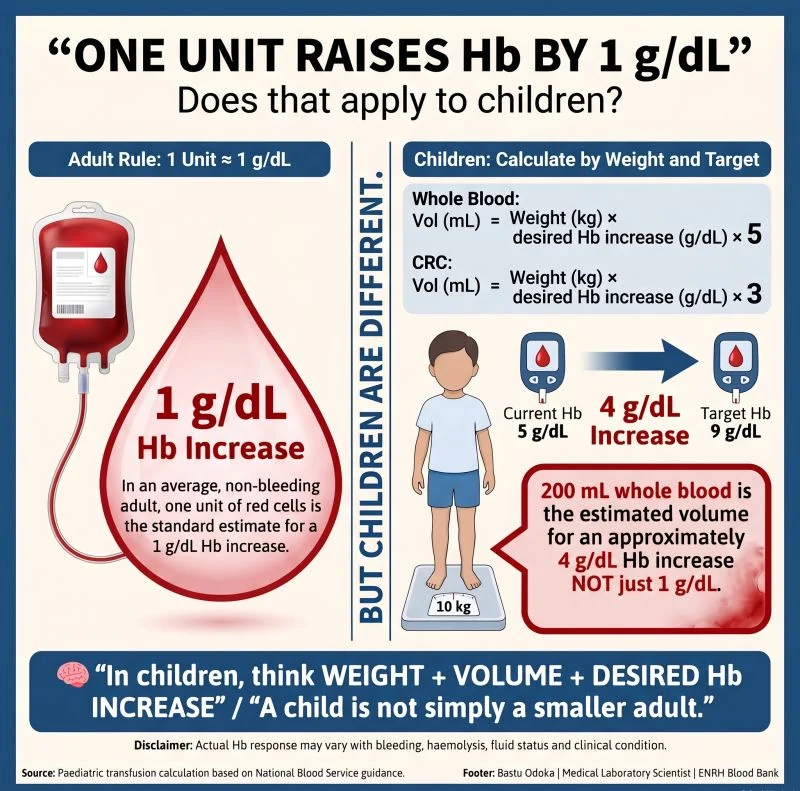
” ‘One unit of blood raises Hb by about 1 g/dL.’
But does that apply to children?
Last week, a clinician came to the blood bank to secure blood for a 10 kg child being prepared for surgery.
The request was: 200 mL whole blood multiplied by 2
The initial 200 mL wasn’t the problem.
In our setting, 20 mL/kg of whole blood is commonly used for children, which gives: 10 kg multiplied by 20 mL/kg equals 200 mL
The misunderstanding was about the expected rise in haemoglobin.
There was an assumption that the first 200 mL would raise the child’s Hb by about 1 g/dL, and another 200 mL would provide a further increase.
We discussed the calculation together, particularly the fact that the desired Hb rise is already factored into the calculated volume.
Based on the child’s weight and the desired Hb increase, we agreed that 200 mL of whole blood was appropriate.
According to the National Blood Service guidance we use:
Whole blood (mL):
Weight (kg) multiplied by desired Hb increase (g/dL) multiplied by 5
Concentrated red cells (mL):
Weight (kg) multiplied by desired Hb increase (g/dL) multiplied by 3
So, let’s take a 10 kg child with an Hb of 5 g/dL, and suppose the desired Hb is 9 g/dL.
Desired Hb increase equals 4 g/dL
For whole blood: 10 multiplied by 4 multiplied by 5 equals 200 mL
So that 200 mL is already the estimated volume required for an approximately 4 g/dL rise, not 1 g/dL.
This is where the familiar adult rule of thumb can cause confusion.
In an average, non-bleeding adult, one unit of red cells is commonly expected to raise Hb by approximately 1 g/dL.
In children, however, the volume and desired Hb increase are calculated together.
Of course, the actual Hb response may vary with ongoing bleeding, haemolysis, fluid status and the child’s clinical condition.
Key message:
The rule of thumb we use in adults does not apply the same way to children.
For children, think weight plus desired Hb increase plus volume.”
Other posts featuring Bastu Odoka on Hemostasis Today.
-
Nov 12, 2026, 14:35Mokhtar Tazik: Connecting Clinical Demand with Plasma Collection and Fractionation Capacity
-
Nov 12, 2026, 14:25Kim Phelan: Celebrating Dr. Marilyn Manco-Johnson as a Recipient of the 2026 Eternal Spirit Award
-
Nov 12, 2026, 14:20Shailesh Kucha: Ensuring Transfusion Safety Through Biochemical Assessment of Stored Red Cells
-
Nov 12, 2026, 14:20Akshat Jain: Wonderful Time Presenting at the ATHN 2026
-
Nov 12, 2026, 14:08Elisa Gabinaud: The Evolving Science of Megakaryocyte Development
-
Nov 12, 2026, 13:57Seyed Mohammad Sadegh Pezeshki: When Microcytosis Reveals a Complex Hemoglobinopathy
-
Nov 12, 2026, 13:45Danny Hsu: THANZ Highlights Antiphospholipid Syndrome in Upcoming Educational Webinar
-
Nov 12, 2026, 13:04Wuhan Thrombosis Congress 2026 – Bringing Global Experts Together – ISTH
-
Nov 12, 2026, 13:00Abdul Mannan: Factor IX Prophylaxis – Can Breakthrough Bleeding Still Occur?