


Chokri Ben Lamine։ Saudi Arabia Leads A New Milestone In Hemophilia A Care
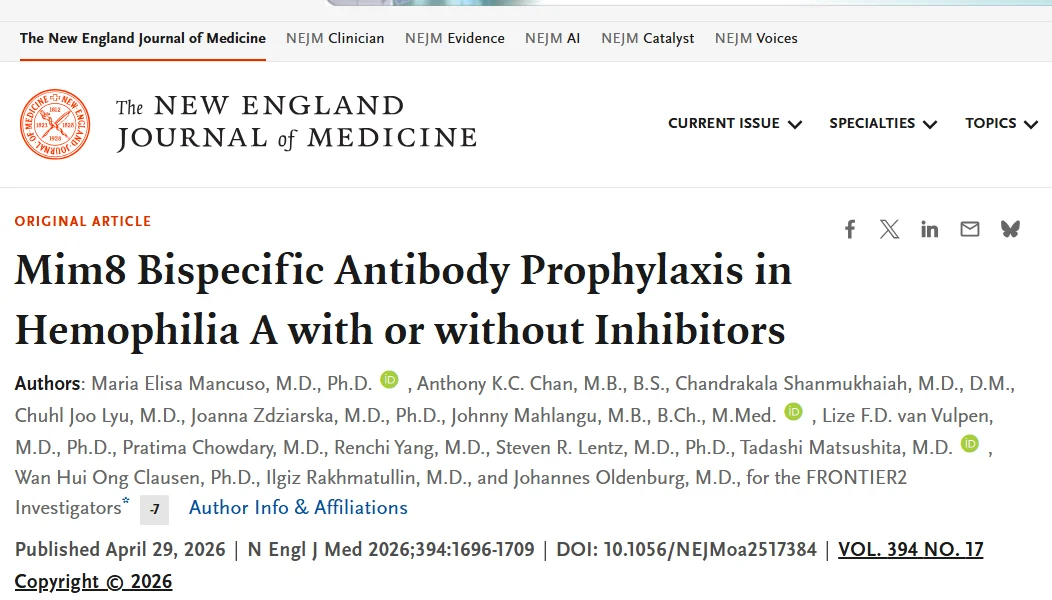
Chokri Ben Lamine, Hematologist at King Faisal Specialist Hospital and Research Center, shared a post on X about a recent article by Maria Elisa Mancuso et al., published in The New England Journal of Medicine, adding:
”Saudi Arabia leads a new milestone in hemophilia A care!
World-first approval
The Saudi Food and Drug Authority has announced the world’s first registration of denecimig (Mim8; Frehemgo) for routine prevention of bleeding episodes in hemophilia A.
Previously designated under the SFDA’s Promising Drugs program
Evaluated for efficacy, safety and quality
Adds another subcutaneous prophylaxis option
Credit: SFDA announcement and infographic.
How does denecimig work?
- Denecimig is a bispecific antibody that mimics activated factor VIII (FVIIIa).
- Brings FIXa and FX together
- Facilitates FX activation and downstream thrombin generation
- Supports clot formation despite FVIII deficiency
Its activity does not depend on replacing FVIII itself, allowing use in hemophilia A with or without FVIII inhibitors. FRONTIER2 publication
Administration
The SFDA announcement describes subcutaneous administration:
- Once weekly
- Every 2 weeks
- Once monthly
The regimen depends on body weight and the prescribed schedule.
Pivotal evidence: FRONTIER2
Phase 3, open-label, randomized study in adolescents and adults with hemophilia A, with or without inhibitors.
254 participants aged 12 years or older
26-week main treatment phase
Weekly or monthly subcutaneous denecimig
Primary endpoint: annualized rate of treated bleeding events
Comparisons included on-demand treatment and patients’ prospectively recorded prior clotting-factor prophylaxis. Mancuso et al., NEJM 2026
Bleeding outcomes
In the cohort previously receiving on-demand treatment, estimated treated annualized bleeding rates were:
- Weekly denecimig: 0.57
- Monthly denecimig: 0.20
- Continued on-demand treatment: 15.76
These correspond to approximately 96 percent and 99 percent fewer treated bleeds, respectively.
These are annualized rates estimated during trial follow-up; they do not mean every patient remained bleed-free. FRONTIER2 results
Safety
The pivotal publication reported:
No thromboembolic events
No clinical evidence of neutralizing anti-denecimig antibodies
However, absence of events in a trial does not establish zero long-term risk.
The SFDA infographic lists potential adverse effects:
- Injection-site redness
- Injection-site itching
- Fever
- Headache
- Upper respiratory tract infections
- Essential laboratory pearl
Denecimig can interfere with:
- aPTT-based tests
- One-stage FVIII activity assays
- Some chromogenic FVIII assays
A shortened or normal aPTT during treatment should not be interpreted as proof of normal endogenous FVIII activity.
Inform the coagulation laboratory and use assays validated for samples containing denecimig. Bowyer et al., Haemophilia
How should we interpret this advance?
- A significant regulatory milestone for Saudi Arabia
- More flexibility in prophylaxis schedules
- Strong evidence for reducing treated bleeding episodes
Comparisons across separate trials cannot establish superiority over emicizumab or other modern prophylactic therapies. Treatment selection still requires the approved label, bleeding history, patient preference and specialist assessment.
Key scientific references:
- Mancuso et al. — Mim8 prophylaxis in hemophilia A, NEJM 2026
- Bowyer et al. — Denecimig interference with coagulation assays.”
Title: Mim8 Bispecific Antibody Prophylaxis in Hemophilia A with or without Inhibitors
Authors: Maria Elisa Mancuso, Anthony K.C. Chan, Chandrakala Shanmukhaiah, Chuhl Joo Lyu, Joanna Zdziarska, Johnny Mahlangu, Lize F.D. van Vulpen, Pratima Chowdary, Renchi Yang, Steven R. Lentz, Tadashi Matsushita, Wan Hui Ong Clausen, Ilgiz Rakhmatullin, Johannes Oldenburg
Other posts featuring Chokri Ben Lamine on Hemostasis Today.

-
Nov 9, 2026, 09:29Veronica Sanchez: A Framework for Woman’s Health
-
Nov 8, 2026, 19:31Anna Kajaste-Rudnitski: Presenting AAV-Induced p53 Signalling in Human CNS Cells at ESGCT 26
-
Nov 8, 2026, 19:29David McIntosh: Cybersecurity Matters, but Blood Availability Remains the Bigger Challenge
-
Nov 8, 2026, 19:26Wenxue Ma: An Integrative Framework for Macrophage-Mediated Therapeutic Resistance in Cancer
-
Nov 8, 2026, 19:25Yildiz Yigit: Presenting a Polycythemia Vera Case at the MPN Subcommittee Session
-
Nov 8, 2026, 18:56Denis Oduor: Strengthening the Regulation and Delivery of Blood Transfusion and Transplantation Services
-
Nov 8, 2026, 18:28Raghavendra Rao: A Narrative Review on Chronic Venous Disease during Pregnancy
-
Nov 8, 2026, 17:57Dhiren Patel: PLD1-Derived Phospholipids Regulate NAD Kinase and ROS Production in Neutrophils
-
Nov 8, 2026, 17:48Andra T.: What Causes Antiphospholipid Syndrome? – Four Steps, not One Cause