

Mostafa Hammam: When aPTT Correction Is Not the End
Mostafa Hammam, Blood Bank Laboratory Technician at Specialized Medical Centers in Egypt, shared a post on LinkedIn:
”The clot corrected… then came back.
Was it magic? No — it was an inhibitor that just needed time to strike.
Coagulation mixing studies often look intimidating, but they boil down to one fundamental clinical question: Is a prolonged clotting time (like aPTT or PT) caused by a missing factor, or an active inhibitor?
Here is how standard interpretation works in the lab:
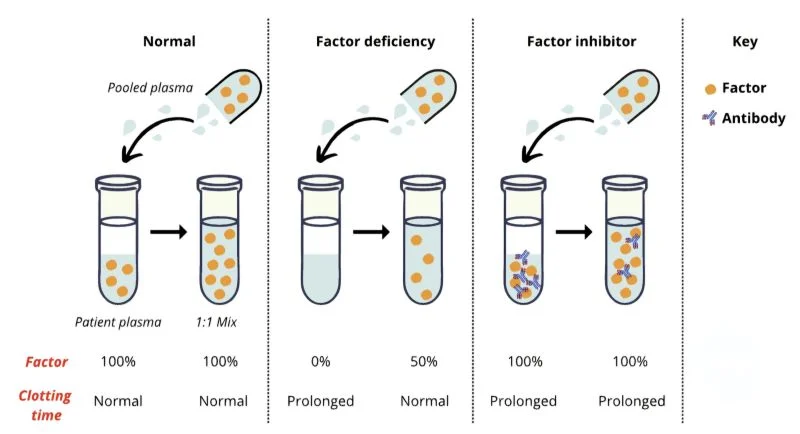
- The 1:1 Mix Principle: You mix patient plasma 50/50 with Normal Pooled Plasma (NPP) and retest the clotting time. NPP supplies at least 50% factor activity, which is plenty to correct any single factor deficiency.
- Immediate Correction equals Factor Deficiency: If the clotting time corrects into the normal range, the patient is simply missing one or more coagulation factors (e.g., Hemophilia A/B, or deficiencies in factors VIII, IX, XI).
- No Correction equals Circulating Inhibitor: If the result remains prolonged, something in the patient’s plasma is actively blocking the clotting cascade. Think of a Lupus Anticoagulant (LA) or a specific factor inhibitor (like acquired anti-Factor VIII antibodies). Note: LA often fails to correct right from the immediate mix, since it directly interferes with the phospholipid-dependent reagents — while factor-specific inhibitors may need time to show their effect.
Pro-Tip from Laboratory Literature (Henry’s Clinical Diagnosis and Management by Laboratory Methods):
Don’t rely solely on immediate mixes!
Reference guidelines emphasize that certain inhibitors (such as acquired factor inhibitors) exhibit time- and temperature-dependent kinetics.
A mix that appears to ‘correct’ initially might fail after incubation at 37°C for 1–2 hours because the inhibitor needs time to neutralize the factor. Always check if an incubation step is required by your hospital protocol!”
Stay updated with Hemostasis Today.
-
Sep 25, 2026, 17:13Sam Tsimikas: Lp(a) and Oxidized Phospholipids Link Lipoprotein Biology to Platelet Activation
-
Sep 25, 2026, 16:56Cindy Neunert: The Future of Personalized ITP Care
-
Sep 25, 2026, 16:26Gemma Postil: AI Tools in Modern Health Research
-
Sep 25, 2026, 15:50Adam Boruchov: Registration Is Open For The 2026 New England Hematologic Diseases Symposium
-
Sep 25, 2026, 15:23Bringing Hope and Treatment Access to Morocco’s Hemophilia Community – World Federation of Hemophilia
-
Sep 25, 2026, 15:22Alejandro González Veliz: Targeting Atherosclerosis Before the First Event
-
Sep 25, 2026, 15:00Sarah Richardson: Finding Strength Through Bleeding Disorders Advocacy
-
Sep 25, 2026, 14:54James Fildes: Modeling Device Related Thrombosis in Multi Organ Systems
-
Sep 25, 2026, 14:51Platelet Metabolic Reprogramming: How Cellular Energy Drives Thrombosis