

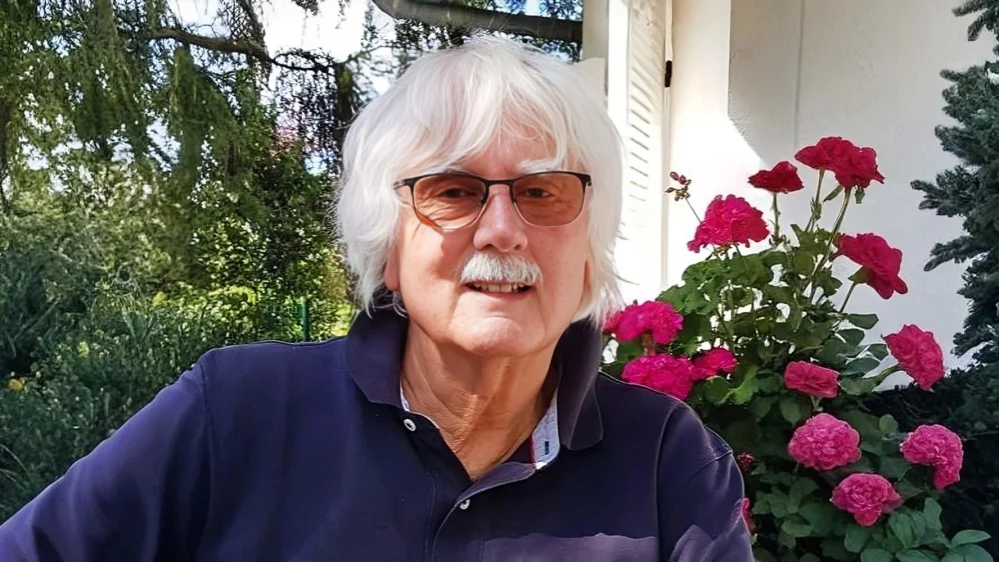
Alan Nurden: Could Mast Cell aIIb Integrin Play a Key Role in Septic Thrombus Stability?
Alan Nurden, Emeritus Research Director at CNRS, Co-Founder of the French National Reference Centre for Inherited Platelet Disorders (CRPP), shared a post on LinkedIn about a recent article by Julie Rayes et al., published in Blood Advances, adding:
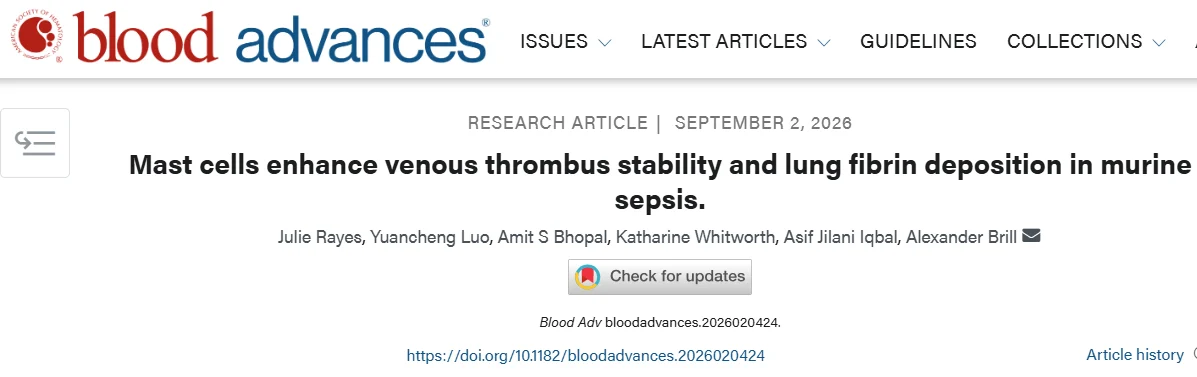
“Julie Rayes, Yuancheng Luo, Amit S Bhopal, Katharine Whitworth, Asif Jilani Iqbal, Alexander Brill; Mast cells enhance venous thrombus stability and lung fibrin deposition in murine sepsis.
This online manuscript from Birmingham, UK, provides much interesting data on how mast cells enhance venous thrombus stability and lung fibrin deposition in lipopolysaccharide-induced murine sepsis.
Enhanced neutrophil-induced trap formation was provoked by inflammatory mediators.
Ablation of mast cells resulted in thrombi comparable to those in control mice, furthermore their lysis was improved.
Lower angiopoietin levels suggested improved endothelial cell stability.
In the past, a Japanese group has shown that mast cells are able to synthesize appreciable quantities of alphaIIbbeta3 integrin (Oki T et al, J Immunol 2006; 176(1):52-60).
This historical finding has mostly stayed under the radar.
If it is indeed so, then maybe the integrin has a role to play in the processes described by Julie Rayes and her colleagues.
Going further, is it possible that patients with Glanzmann thrombasthenia are protected from the most severe effects of sepsis or indeed Covid-19. This could be worth investigating.”
Title: Mast cells enhance venous thrombus stability and lung fibrin deposition in murine sepsis
Authors: Julie Rayes, Yuancheng Luo, Amit S Bhopal, Katharine Whitworth, Asif Jilani Iqbal, Alexander Brill
Stay updated on all scientific advances with Hemostasis Today.
-
Sep 29, 2026, 17:13Nicholas Lang։ A Meaningful Case of Immune Thrombocytopenia
-
Sep 29, 2026, 16:55Ayatullah Gamal Wahab: When the CBC Lies
-
Sep 29, 2026, 16:35Jonathan Douxfils: Navigating the VTE Risk Continuum in Reproductive Medicine
-
Sep 29, 2026, 16:35Chaima Rajeh: Types of Anemia and Their Laboratory Features
-
Sep 29, 2026, 16:27Scott Isaacs: How GLP-1 RAs Target Systemic Inflammation to Drive Cardio, Autoimmune, and Gut Health
-
Sep 29, 2026, 16:21Yitshak Kreiss: From Treating Patients to Defining the Standard of Knowledge
-
Sep 29, 2026, 16:18Edward Lee Carter: Why Periprocedural DOAC Guidance Needs a Common Output Standard
-
Sep 29, 2026, 16:07Yasmine Laraba: Deep Vein Thrombosis Causes, Signs and Management
-
Sep 29, 2026, 16:01Stephen Cornelissen: How Joining the Stem Cell Registry Can Save Patients with Blood Cancers