


Edward Lee Carter: Why Periprocedural DOAC Guidance Needs a Common Output Standard
Edward Lee Carter, Clinical Pharmacist Practitioner at U.S. Department of Veterans Affairs, shared on LinkedIn about his recent article published in Annals of Pharmacotherapy, adding:
“Five tools. One patient. Same plan before surgery. Different answers after.
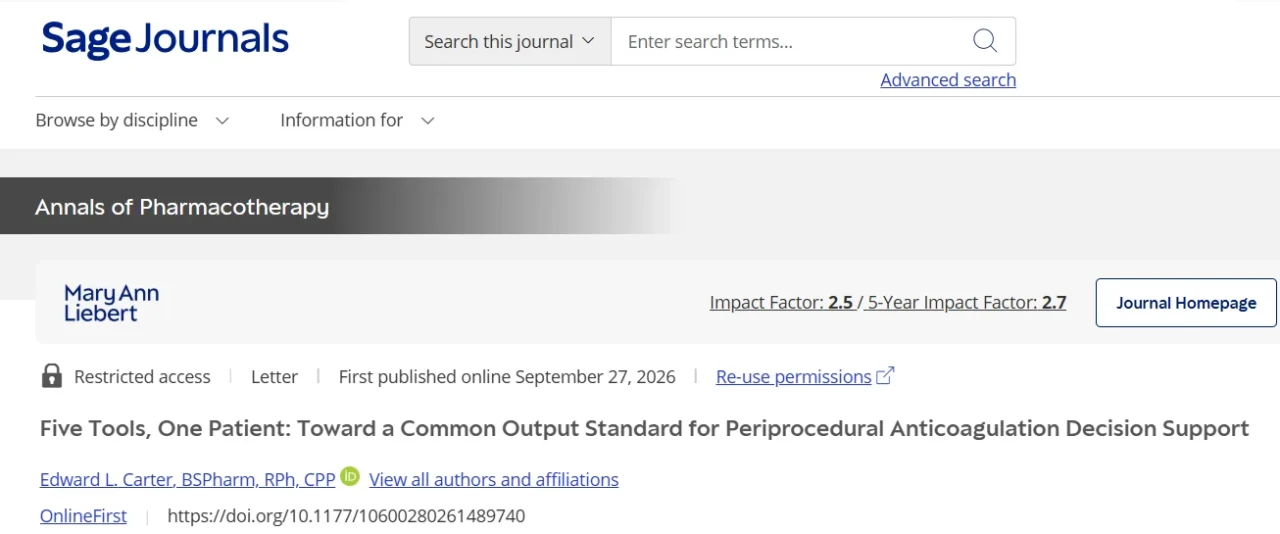
My Letter to the Editor is now published in Annals of Pharmacotherapy.
Periprocedural DOAC management is usually framed as a pharmacokinetic problem.
In practice, it’s also a translation problem. ‘Hold 2 days,’ ‘skip 4 doses,’ and ‘stop at least 48 hours’ all have to become one unambiguous medication calendar, at the exact moment when both clot and bleeding risk are elevated.
I ran one hypothetical patient through 5 publicly available resources: IPRO MAPPP, ACC ManageAnticoag, Thrombosis Canada, Anticoagulation Forum guidance, and the MAQI2 Toolkit.
The patient: 79 years old, nonvalvular AF, apixaban 5 mg twice daily, CrCl 55, CHA2DS2-VASc 7, scheduled for total knee arthroplasty.
Before surgery, all 5 tools agreed:
- Last dose on day -3
- Hold on days -2 and -1, and on the day of surgery
- No therapeutic heparin bridging
- Resume at 48 to 72 hours if hemostasis is adequate
After surgery, they diverged.
Some surfaced reduced-dose DOAC or prophylactic LMWH before therapeutic resumption.
Others went straight to therapeutic apixaban at 48 to 72 hours.
That matters because:
- VTE prophylaxis is not therapeutic AF anticoagulation.
- CHA2DS2-VASc does not estimate postoperative VTE risk.
The letter proposes a minimum common output standard.
It doesn’t require identical algorithms, only explicit outputs: the indication, the final dose with date and time, every omitted dose, whether parenteral therapy is bridging or prophylaxis, the conditional restart window, the hemostatic checkpoint, the accountable clinician, and the evidence source, version, and review date.
Decision support should standardize the workflow, not merely shorten the recommendation.”
Title: Five Tools, One Patient: Toward a Common Output Standard for Periprocedural Anticoagulation Decision Support
Authors: Edward L. Carter
Stay updated on all scientific advances with Hemostasis Today.
-
Nov 15, 2026, 23:44Pablo César Spada: Prevention of Venous Thromboembolism After Total Hip or Knee Replacement
-
Nov 15, 2026, 23:30Eshal Amir: Factor XI Inhibitors in AFib and Aortic Mortality Trends
-
Nov 15, 2026, 23:19Hamza Bashir: Adding Endovascular Therapy to Anticoagulation Cuts Moderate-to-Severe PTS in Half
-
Nov 15, 2026, 23:06Lanre Tunji-Ajayi: 2 Days of Deliberative Dialogue Hosted by the Network of Rare Blood Disorder Organizations
-
Nov 15, 2026, 23:00Fanny Delettre: Looking Back at Volunteer Blood Donor Friends Day
-
Nov 15, 2026, 20:56Victoria Adedoyin Adisa-Thomas: What I Learned About SCD During My Genetic Counselling Rotation
-
Nov 15, 2026, 20:55Martin Holst Lange: One Step Closer to a Potential New Treatment for Sickle Cell Disease
-
Nov 15, 2026, 20:53Bontha Babu: Health-Related Quality of Life Among Adults with Sickle Cell Disease in India
-
Nov 15, 2026, 20:52Miguel Ángel Herrera Rojas: A First-Line ITP Approach Presented at ASH in 2013 Now Reflected in the 2026 Guidelines