

Sudhir Kumar: Stroke is a Medical Emergency – and Every Minute Matters
Sudhir Kumar, Founder of Dr Sudhir’s Pain Relief, shared a post on LinkedIn:
“Stroke is a medical emergency—and every minute matters.
A stroke occurs when blood flow to part of the brain is interrupted or when a blood vessel ruptures and causes bleeding. Without adequate oxygen and nutrients, brain cells can become injured or die.
As a neurologist, one of the most important messages I want people to remember is this:
Sudden neurological symptoms should never be watched at home.
The major types of stroke
1.Ischemic stroke
This occurs when a blood vessel supplying the brain becomes blocked. Causes can include thrombosis, embolism, and small-vessel disease.
2.Hemorrhagic stroke
This occurs when a blood vessel ruptures and bleeding develops either within the brain tissue or around the brain.
3.Transient ischemic attack (TIA)
A TIA produces temporary neurological symptoms due to focal brain ischemia without permanent infarction. Importantly, it can be a warning sign of future stroke and requires urgent medical evaluation.
What should make you think of stroke?
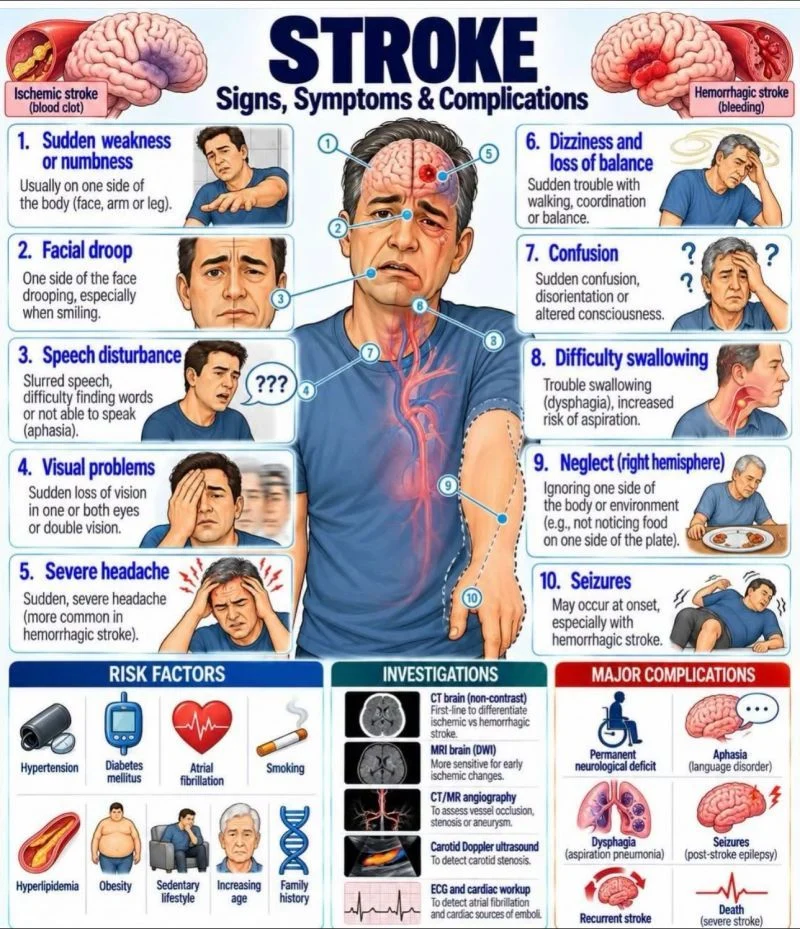
Stroke symptoms usually begin suddenly and may include:
- Facial drooping
- Weakness or numbness, particularly on one side
- Difficulty speaking or understanding speech
- Sudden vision problems
- Difficulty walking or loss of balance
- Sudden severe headache, particularly in some hemorrhagic strokes
- Difficulty swallowing or, in severe cases, loss of consciousness
Remember FAST
- F — Face: Is one side of the face drooping?
- A — Arms: Can both arms be raised equally?
- S — Speech: Is speech suddenly slurred or abnormal?
- T — Time: Seek emergency medical care immediately.
What happens in the hospital?
Rapid assessment helps determine the type and cause of stroke.
This may include neurological examination, blood glucose testing, urgent brain imaging such as a non-contrast CT, MRI when appropriate, ECG, blood tests, and vascular or cardiac investigations when indicated.
Treatment depends on the type of stroke and the individual clinical situation.
For eligible patients with ischemic stroke, intravenous thrombolysis and or mechanical thrombectomy may be considered within appropriate treatment windows. Other patients may require antiplatelet therapy and management of vascular risk factors.
Hemorrhagic stroke requires a different approach, which may include blood-pressure management, reversal of anticoagulation when appropriate, management of raised intracranial pressure, and neurosurgical or endovascular treatment in selected cases.
Prevention matters too
Several important stroke risk factors are modifiable:
- High blood pressure
- Diabetes
- Smoking
- Abnormal cholesterol
- Atrial fibrillation
- Physical inactivity
- Obesity
- Excessive alcohol consumption
- Carotid artery disease
If stroke is suspected, treat it as an emergency and seek immediate medical attention.”
Stay updated with Hemostasis Today.
-
Sep 30, 2026, 22:28Recent Mechanical Risk Factors and Young-Onset Cryptogenic Ischemic Stroke – American Heart Association International
-
Sep 30, 2026, 22:22Expert Consensus on Inferior Vena Cava Thrombosis – Thrombosis and Haemostasis Journal
-
Sep 30, 2026, 22:21Markus Abeln: How Platelets, Coagulation, Glycosylation, and Complement Regulate Placental Blood Flow
-
Sep 30, 2026, 22:19Fatma Al Arbawi: Studying Blood Clot Mechanics to Understand Aspirin Resistance and Thrombosis
-
Sep 30, 2026, 22:15Luisa Medeiros Visentini: Our Research on Cognitive Impairment After CVT Cited in the International Journal of Stroke
-
Sep 30, 2026, 21:50Jagat Narula: Connecting Cardiovascular Health and Sickle Cell Disease on World Heart Day 2026
-
Sep 30, 2026, 21:38John Kastelein: Exploring the Biology of Cardiovascular Disease at BioCentury Grand Rounds Europe
-
Sep 30, 2026, 21:36Mark Murphy: Irish Heart Foundation Meets With Senator Teresa Costello on World Heart Day
-
Sep 30, 2026, 21:34Sadashiva Pai: How Pancreatic Cancer Uses Blood Clotting to Evade Immune Attack