


Mohammed Alo: Your LDL Isn’t a Snapshot – It’s a Smoking Habit Measured in Years
Mohammed Alo, Fellow of the American College of Cardiology at American College of Cardiology, shared a post on LinkedIn:
“Your LDL is not a snapshot.
It is a smoking habit measured in cholesterol-years, and most people are already in the danger zone before their first symptom.
Most people think a cholesterol number is a single moment in time.
Check it once a year, see if it is ‘normal,’ move on.
But the data says otherwise.
And no, turning 60 with ‘normal’ cholesterol does not mean you dodged it.
I am a cardiologist.
I have thousands of patients who have gone through this exact conversation with me.
The number on your lab sheet today means far less than the number multiplied by the years you have carried it.
Here is what the science actually says.
Doctors have used pack-years to measure smoking damage for decades.
Two packs a day for five years equals 10 pack-years.
The formula captures cumulative exposure, not a single cigarette.
Cholesterol works the same way.
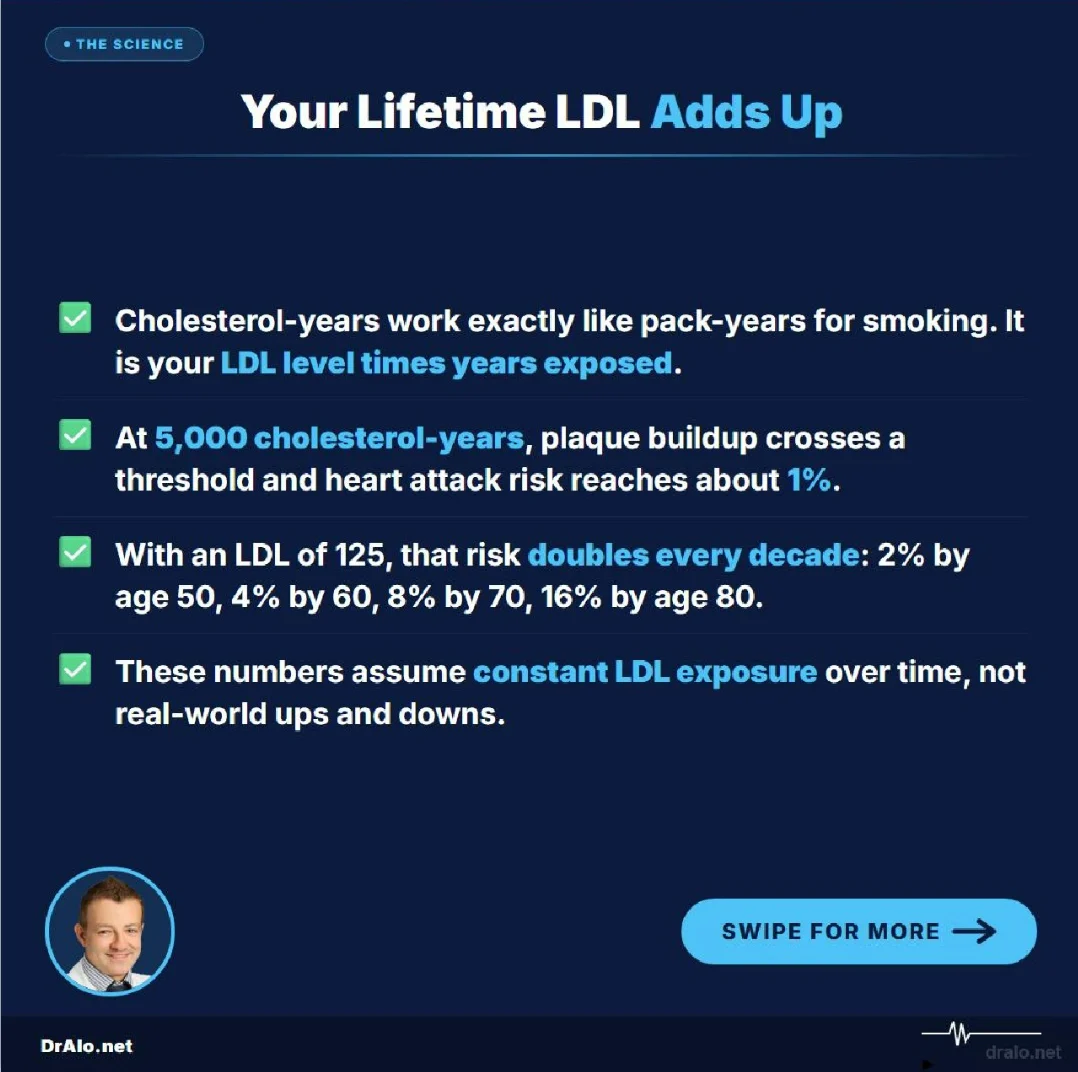
I calculate cholesterol-years by multiplying your LDL level by the number of years you carry it.
An LDL of 125 mg/dL for 40 years equals 5,000 cholesterol-years.
That is your smoking habit, except nobody warned you about it.
The threshold that changes everything.
5,000 cholesterol-years marks the point where plaque buildup becomes measurable. At that threshold, heart attack risk sits at about 1%. That is not the finish line. That is the starting gun.
From there, risk doubles with every additional decade of exposure.
- Age 40, 5,000 cholesterol-years: 1% risk.
- Age 50, 6,250 cholesterol-years: 2% risk.
- Age 60, 7,500 cholesterol-years: 4% risk.
- Age 70, 8,750 cholesterol-years: 8% risk.
- Age 80, 10,000 cholesterol-years: 16% risk.
That is a 16-fold increase in risk while your LDL number never changed. Only the years did.
The power of lower cholesterol.
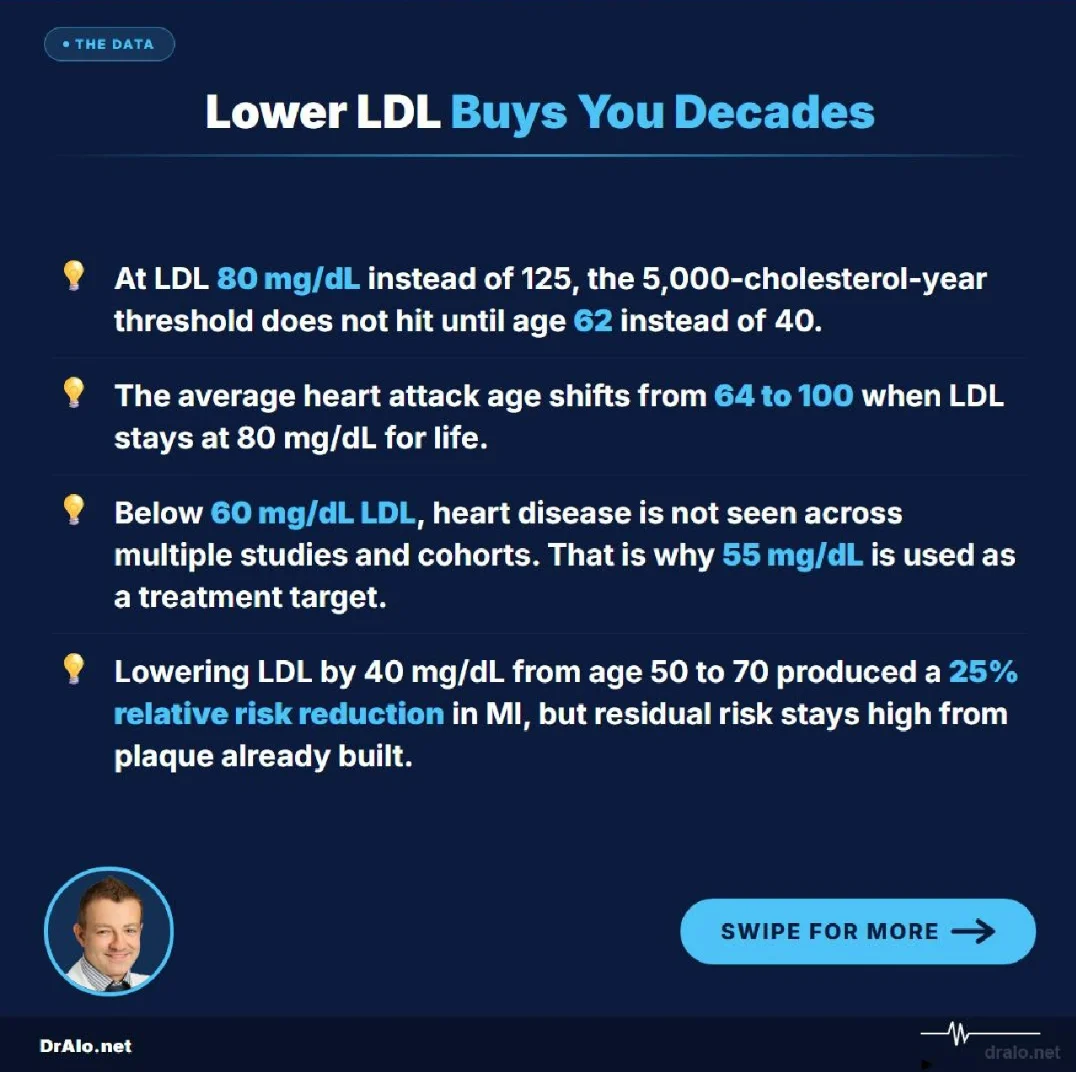
Now run the same math with an LDL of 80 mg/dL instead of 125.
You do not hit the 5,000 cholesterol-year threshold until age 62.
That is 22 extra years before plaque burden reaches the danger zone.”

More posts featuring Mohammed Alo on Hemostasis Today.
-
Oct 2, 2026, 06:00Susan Wickersham: Gradual Shift towards Autologous Blood Transfusion is a Current Trend
-
Oct 2, 2026, 05:54Shamee Shastry: When Every Cell Reacts – The Hunt for Rare Blood
-
Oct 2, 2026, 05:49David Mclntosh: Expanding Plasma Protein Therapies in Underserved Regions
-
Oct 2, 2026, 05:38Dianne E. van der Wal: C-Terminal Endings Impact PAR1/PAR4 Peptide Potency in In Vitro Platelet Assays
-
Oct 2, 2026, 00:33Marwa Mostafa: Hemoglobinopathies – When Globin Genes Go Wrong
-
Oct 1, 2026, 23:46Behnood Bikdeli: Global Burden of Venous Thromboembolism
-
Oct 1, 2026, 23:46Sthanu Subramanian: Clinical Presentation, Risk Factors, Diagnosis, and Neuroimaging Findings in CVT
-
Oct 1, 2026, 23:45Martha Gulati: Oral MHT Is Associated With Increased Thrombotic Risk
-
Oct 1, 2026, 23:44Priya Sriskandarajah: HEMA-MED Trial Exploring Roginolisib Plus JAK Inhibitors in Myelofibrosis