

Ana Cespedes: Maternal Anemia in Pregnancy Linked to Differences in Infant Brain Structure
Ana Cespedes, Chief Executive Officer at Vitamin Angels, Board Member at argenx, Member of Steering Committee at Instituto ProPatiens, shared a post on LinkedIn about a recent article by Jessica Ellen Ringshaw et al., published in Brain Communications, adding:
“4%.
That’s the difference in brain volume researchers found among infants born to mothers with anemia during pregnancy, according to new peer-reviewed research led by Jessica Ellen Ringshaw and published in Brain Communications.
The findings are striking, especially because most of the mothers with anemia in the study had only mild anemia.
As the children born to mothers with anemia grew, so did the gap in their brain development.
By 24 months, one key region of the brain was more than 6% smaller.
Anemia is not a new or highly localized condition we don’t know how to address.
It affects more than a third of pregnant women worldwide, with the highest rates in sub-Saharan Africa and South Asia.
Despite its prevalence and the existence of proven, affordable interventions to help prevent it, global progress has stalled for decades.
We know what works.
Multiple micronutrient supplementation (MMS) during pregnancy is a proven intervention that can reduce maternal anemia while improving birth outcomes.
Earlier this year, I joined health leaders in Makueni County, Kenya, where nearly 40% of pregnant women have anemia.
Vitamin Angels is supporting the county as it introduces MMS, beginning with 13 public health facilities and approximately 7,200 pregnant women expected to be reached by the end of this year.
By 2028, the goal is to expand MMS to all 242 county health facilities and reach every pregnant woman in Makueni County each year — approximately 21,000 women.
We’re seeing progress at the national level, too. In Indonesia, Vitamin Angels supported the Ministry of Health in integrating MMS into the national health system, putting the country on track to reach 9.6 million women and children annually with UNIMMAP MMS by 2030.
The evidence on MMS is clear.
Governments are demonstrating what is possible when it is integrated into health systems and delivered at scale.
The opportunity now is to build on this progress and expand access to MMS for pregnant women around the world, giving mothers and babies the opportunity to thrive.”
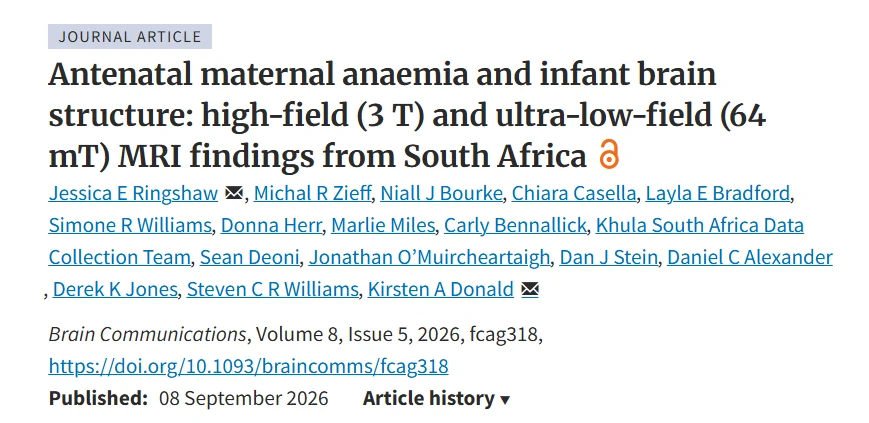
Title: Antenatal maternal anaemia and infant brain structure: high-field (3 T) and ultra-low-field (64 mT) MRI findings from South Africa
Authors: Jessica E Ringshaw, Michal R Zieff, Niall J Bourke, Chiara Casella, Layla E Bradford, Simone R Williams, Donna Herr, Marlie Miles, Carly Bennallick, Khula South Africa Data Collection Team, Sean Deoni, Jonathan O’Muircheartaigh, Dan J Stein, Daniel C Alexander, Derek K Jones, Steven C R Williams, Kirsten A Donald
Stay updated on all scientific advances with Hemostasis Today.
-
Oct 3, 2026, 07:43Janez Urevc: Modeling Compression Ultrasound for Internal Jugular Vein Thrombosis in Astronauts
-
Oct 3, 2026, 07:20Adam Wufsus: Novo Nordisk Seeks Medical Liaison for Sickle Cell Disease
-
Oct 3, 2026, 07:16Álvaro Dubois-Silva: Rethinking the Obesity Paradox in Cancer-Associated VTE
-
Oct 3, 2026, 07:09Lori Bryngelson Taylor: Expert Consensus Guidelines Flag Hypophosphatemia Risks With Injectafer
-
Oct 3, 2026, 06:40Aayush Bist: Study Reveals Distinct Social Patterns in Anemia, Excess Adiposity, and High Blood Pressure Among Women in Nepal
-
Oct 3, 2026, 06:39Ahmed Bennis: Understanding the Diagnosis, Risk, and Management of ARN
-
Oct 3, 2026, 05:52Kemal Karaagac: When Vitamin K Antagonists Remain Essential in Cardiac Care
-
Oct 3, 2026, 05:32Shiavax J. Rao: PERT 2026 Session Explores Long-Term Anticoagulation and DOAC Management
-
Oct 3, 2026, 05:13Parveen Yograj: Iron Deficiency and Anaemia – Diagnosis, Causes, and Treatment Guidelines