

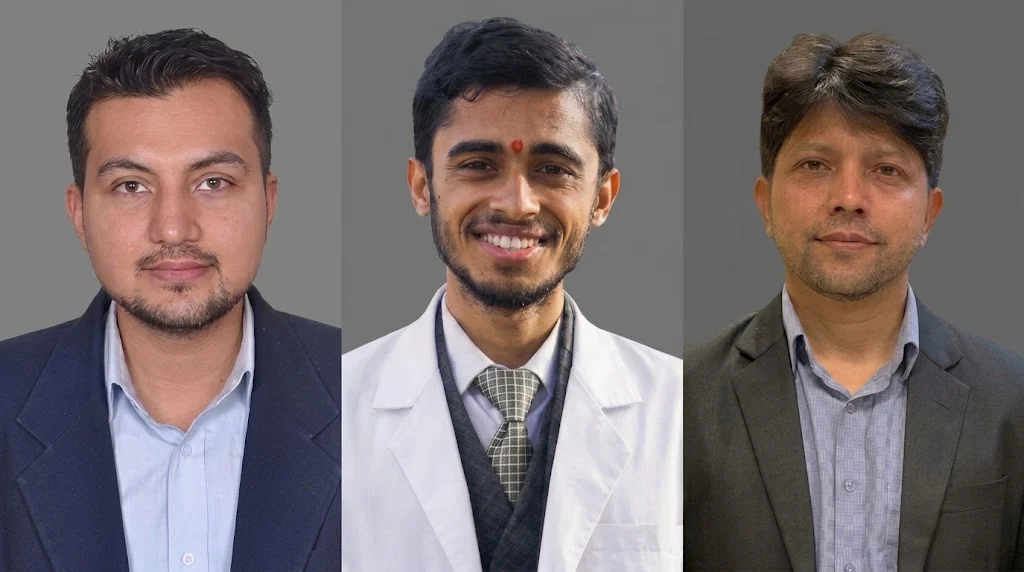
Aayush Bist: Study Reveals Distinct Social Patterns in Anemia, Excess Adiposity, and High Blood Pressure Among Women in Nepal
Aayush Bist, Reviewer at Frontiers in Medicine, Case Reports in Surgery, Asian Journal of Pregnancy and Childbirth, Sage, shared a post on LinkedIn about a recent article he and his colleagues co-authored, published in BMC Public Health, adding:
“Nearly 6 in 10 women in Nepal are living with at least one of the following: Anemia, Excess Adiposity, or High blood pressure.
Today, I’m excited to share our new publication in BMC Public Health.
Much of the global health discussion around low- and middle-income countries focuses on the double burden of disease, where undernutrition and non-communicable diseases coexist within the same populations.
However, an important question remains: Are the same women experiencing these risks, and can the same public health strategies effectively address them?
Using nationally representative data from the 2022 Nepal Demographic and Health Survey, we found that the burden of these conditions is substantial.
Nearly one in three women (32.7%) were anemic, 34.5% had excess adiposity, and 11.2% had high blood pressure.
Furthermore, more than 60% of women were affected by at least one of these conditions, highlighting the scale of the challenge facing women’s health in Nepal.
What makes these findings particularly important is that the three conditions did not follow the same social pattern.
Excess adiposity and high blood pressure increased markedly with age and household wealth, reflecting Nepal’s ongoing epidemiological and nutritional transition.
In contrast, anemia showed stronger variation across ethnic groups and provinces, suggesting that its drivers differ substantially from those of obesity and hypertension.
The central message of our study is straightforward but significant: the women most vulnerable to one condition are not necessarily those most vulnerable to another.
As a result, policies and programs designed around a single risk profile may fail to identify and reach large segments of the population in need.
Our findings highlights the importance of moving beyond one-size-fits-all approaches and toward more targeted, context-specific public health interventions.
As countries across South Asia continue to navigate demographic, economic, and nutritional transitions, understanding how different health risks are socially patterned will be critical for designing effective and equitable health policies.
We hope this work contributes to that evidence base and supports more nuanced approaches to improving women’s health in Nepal and similar settings.
I would like to Congratulate our team, Mukunda Prasad Poudel, and especially Rupak Thapa dai whose guidance and support made this work possible.”
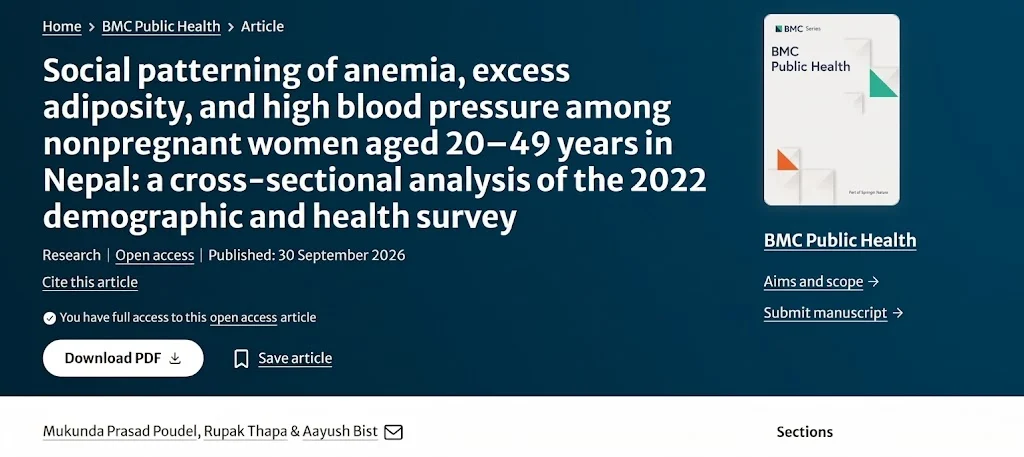
Title: Social patterning of anemia, excess adiposity, and high blood pressure among nonpregnant women aged 20–49 years in Nepal: a cross-sectional analysis of the 2022 demographic and health survey
Authors: Mukunda Prasad Poudel, Rupak Thapa, Aayush Bist
Stay updated on all scientific advances with Hemostasis Today.
-
Oct 3, 2026, 07:43Janez Urevc: Modeling Compression Ultrasound for Internal Jugular Vein Thrombosis in Astronauts
-
Oct 3, 2026, 07:20Adam Wufsus: Novo Nordisk Seeks Medical Liaison for Sickle Cell Disease
-
Oct 3, 2026, 07:16Álvaro Dubois-Silva: Rethinking the Obesity Paradox in Cancer-Associated VTE
-
Oct 3, 2026, 07:09Lori Bryngelson Taylor: Expert Consensus Guidelines Flag Hypophosphatemia Risks With Injectafer
-
Oct 3, 2026, 06:39Ahmed Bennis: Understanding the Diagnosis, Risk, and Management of ARN
-
Oct 3, 2026, 06:11Ana Cespedes: Maternal Anemia in Pregnancy Linked to Differences in Infant Brain Structure
-
Oct 3, 2026, 05:52Kemal Karaagac: When Vitamin K Antagonists Remain Essential in Cardiac Care
-
Oct 3, 2026, 05:32Shiavax J. Rao: PERT 2026 Session Explores Long-Term Anticoagulation and DOAC Management
-
Oct 3, 2026, 05:13Parveen Yograj: Iron Deficiency and Anaemia – Diagnosis, Causes, and Treatment Guidelines