


Francois Roubille: Biomarkers and Long-Term Prognosis After Revascularised STEMI
Francois Roubille, Head of the Intensive Care Unit at University Hospital of Montpellier, shared a post on LinkedIn about a recent article he and his colleagues co-authored, published in European Journal of Internal Medicine, adding:
“Inflammation and myocardial infarction: cause or consequence?
A DANAMI-3 substudy has just been published in the European Heart Journal: Acute Cardiovascular Care (Kunkel et al., 2026).
What the study found
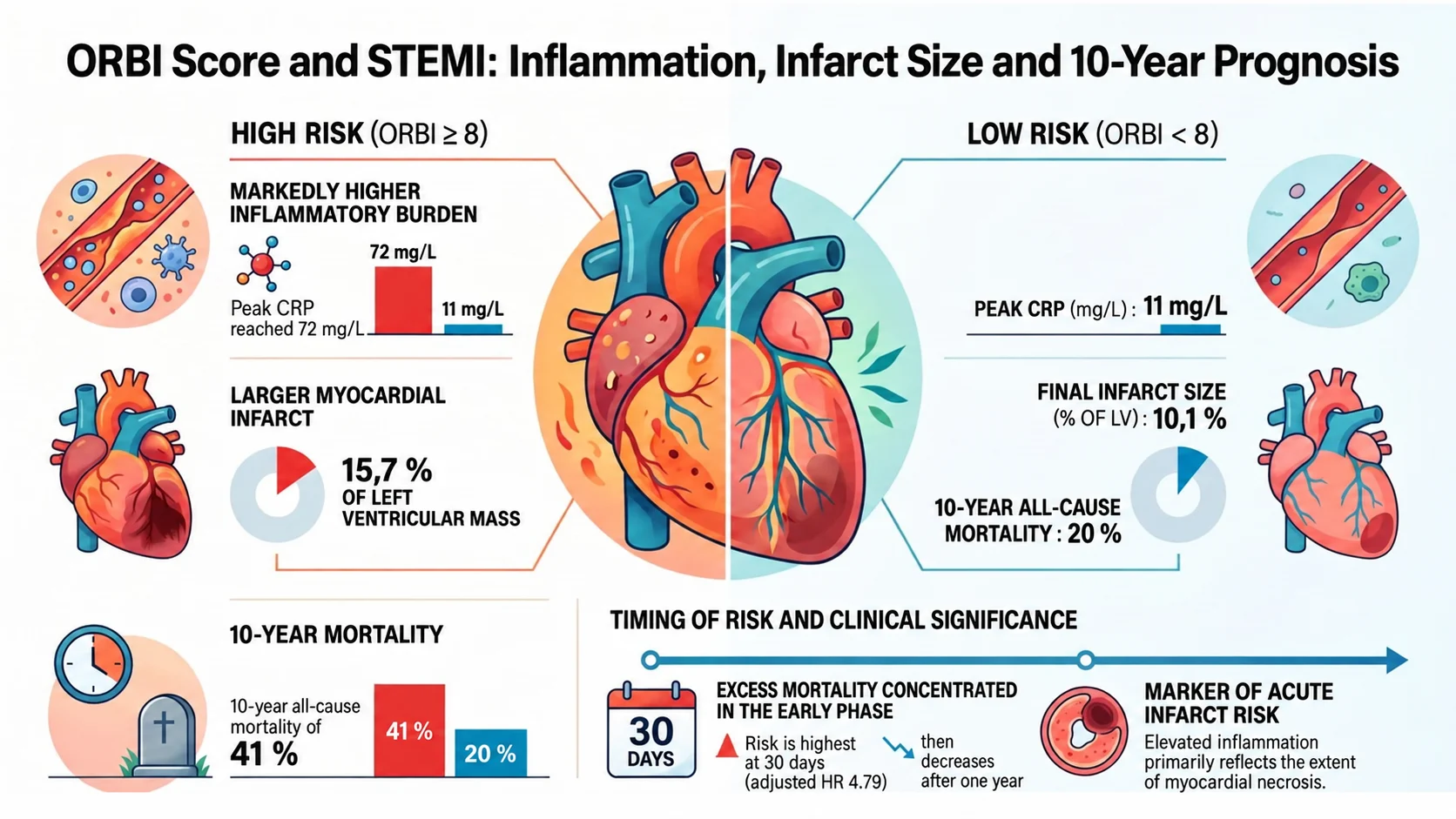
The study included 1,574 patients with STEMI and no cardiogenic shock, grouped according to their ORBI score (risk of shock after primary angioplasty).
Among patients at high risk (ORBI greater than or equal to 8):
- Peak CRP was 72 mg/L, compared with 11 mg/L.
- White blood cell and neutrophil-to-lymphocyte counts were higher.
- Cardiac MRI showed larger infarcts: 15.7% versus 10.1% of left ventricular mass.
- Ten-year mortality was 41% versus 20% (adjusted HR 1.47).
The association was strongest during the first month (HR 4.79). Beyond one year, it was largely explained by age.
Our interpretation
A heart attack triggers an intense inflammatory response: the more extensive the tissue damage, the higher the CRP. It is therefore very difficult to distinguish cause from consequence.
This is not new.
We previously showed in the European Journal of Internal Medicine (Roubille et al., 2010) that CRP measured three days after a revascularised STEMI was associated with prognosis.
The principle is well established: a large heart attack causes a strong inflammatory response.
Does inflammation remain a therapeutic target?
Yes.
The ACVC and ESC clinical consensus on inflammation in acute coronary syndromes reiterates that the causal link between inflammation and atherosclerosis is well established.
However, treatment results have been disappointing:
- Anti-IL-1: Canakinumab reduced cardiovascular risk, but increased infections and is not indicated for this purpose.
- Anti-IL-6: No clinical benefit has been demonstrated to date.
- Low-dose colchicine (0.5 mg/day) remains an option, although results have varied between trials:
- ESC 2023, acute coronary syndromes: “May be considered” (Class IIb, Level A).
- ESC 2024, chronic coronary syndromes: “Should be considered” (Class IIa, Level A).
Key message: Elevated CRP after a heart attack primarily reflects the extent of tissue damage.
It is a risk marker, not currently a treatment target.
Targeted randomised trials are needed to determine which patients might benefit from anti-inflammatory treatment.”
Title: Routinely-feasible multiple biomarkers score to predict prognosis after revascularized STEMI
Authors: F. Roubille, A. Samri, L. Cornillet, C. Sportouch-Dukhan, J.M. Davy, F. Raczka, R. Gervasoni, J.L. Pasquie, T.T. Cung, C. Piot, J.C. Macia, F. Cransac, F. Leclercq

Stay updated on all scientific advances with Hemostasis Today.
-
Nov 20, 2026, 17:27Adam Bryant: Great Science, Valuable Connections and a Wonderful Haematology Community at Blood 2026
-
Nov 20, 2026, 17:25Gurpreet Kaurr: Scientific Discussions, New Perspectives and Inspiration at HAEMATOCON 2026
-
Nov 20, 2026, 17:24Bispecific FVIIIa-Mimetic Antibodies in Haemophilia A – CRH French Reference Center for Hemophilia Lyon
-
Nov 20, 2026, 17:23Khalid Rehman: Psychosocial Burden Among Caregivers of Patients with Beta-Thalassemia Major in Pakistan
-
Nov 20, 2026, 17:20Dhinesh Selvaraju: Caplacizumab Becomes the First FDA-Approved Treatment for Pediatric aTTP
-
Nov 20, 2026, 17:19Paris Margaritis: Presenting Preclinical Data on GENV-HEM at the WFH Workshop
-
Nov 20, 2026, 17:18WFH Opens Public Comment on Draft Guidelines for Hemostatic Agents and Prophylaxis
-
Nov 20, 2026, 17:18Ketan Asawale: Consensus on the Management of Cancer-Associated Thrombosis in India
-
Nov 20, 2026, 17:16Ajay Samkaria: The Evolution of Hemostasis Diagnostics with the ACL TOP 70 Series