


Thirunavukkarasu Angappan: Immunoglobulin Decides How Much Plasma Gets Collected
Thirunavukkarasu Angappan, Vice President – Operations and Manufacturing at PopVax, shared a post on LinkedIn:
”Immunoglobulin Decides How Much Plasma Gets Collected.
Hemophilia Patients Just Hope Enough Falls Out Along the Way.
Plasma-derived Factor VIII (FVIII) isn’t planned for anymore. It’s a leftover.
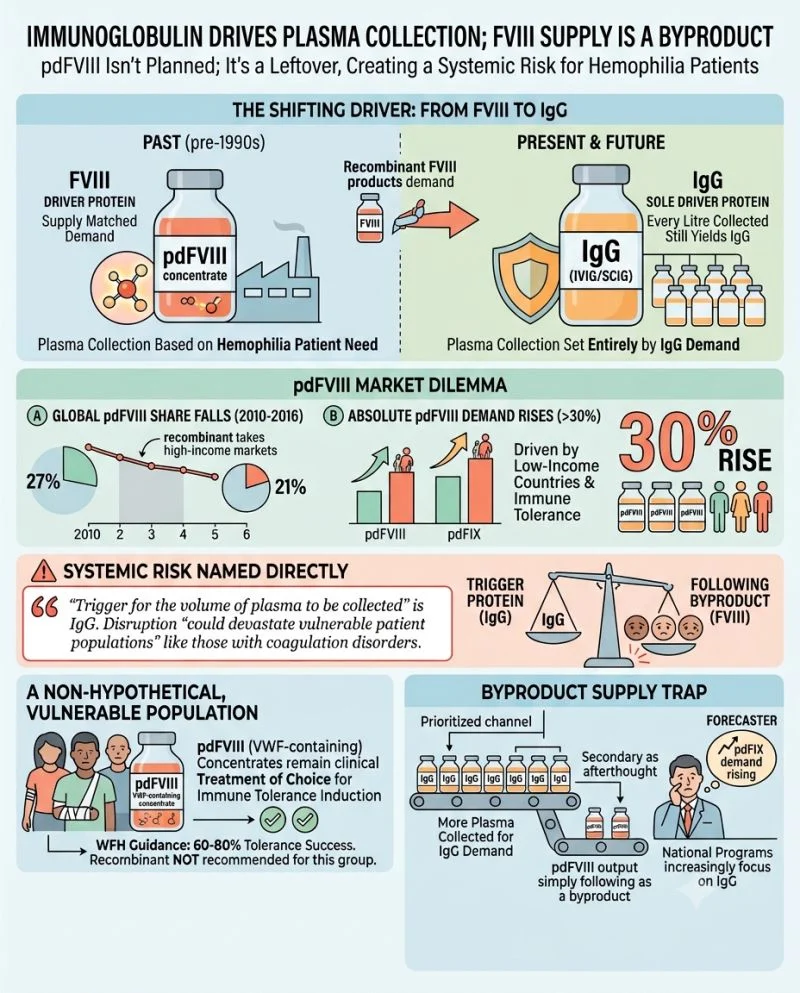
- Immunoglobulin G (IgG) is now the plasma industry’s sole ‘driver protein’ — the one product that determines total collection volume, with every litre collected still yielding IgG long after other proteins have been fully supplied. FVIII held that role until recombinant products arrived in the early 1990s and began displacing plasma-derived demand.
- The numbers show how that displacement played out, and why it didn’t eliminate need. Global plasma-derived FVIII market share fell from 27 percent in 2010 to 21 percent in 2016 as recombinant took over higher-income markets. Yet absolute unit demand for plasma-derived FVIII and Factor IX (FIX) each rose over 30 percent in the same six years — driven by growing low-income-country demand and immune tolerance induction use in inhibitor patients.
- That’s a shrinking share of the market feeding a growing, clinically vulnerable population — precisely the group a 2025 review warns about: supply of plasma-derived FVIII and FIX ‘relies on the amount of plasma collected from donors,’ a volume now set entirely by IgG demand, not by how many hemophilia patients need it that year.
- A separate 2024 peer-reviewed analysis names the systemic risk directly: because IV/subcutaneous IgG is ‘the trigger for the volume of plasma to be collected,’ any disruption to that IgG-plasma balance ‘could devastate vulnerable patient populations such as those with coagulation or immune deficiency disorders’.
- This isn’t a hypothetical population. Plasma-derived, von Willebrand factor (VWF)-containing FVIII concentrates remain the clinical treatment of choice for immune tolerance induction in hemophilia A inhibitor patients — the World Federation of Hemophilia’s own guidance confirms 60–80 percent tolerance success, and WFH does not recommend recombinant over plasma-derived product for this group.
- Industry forecasters flagged this structural risk nearly two decades ago: at the WFH’s own Global Forum, one speaker noted that more plasma collected for IgG ‘will not necessarily lead to more supply of factor VIII,’ since national programmes increasingly collect plasma to serve IgG-dependent patients, with pdFVIII output simply following as a byproduct.
So the hemophilia patients who still depend on plasma-derived FVIII — a growing population by unit demand, even as their share of a bigger market shrinks — depend on a drug whose collection volume was never set with them in mind.
Should national plasma plans carry an explicit minimum pdFVIII volume target, separate from IgG-driven collection, to protect a patient population whose demand is rising even as its market share falls?”
Stay updated with Hemostasis Today.
-
Oct 6, 2026, 16:43Beth Shirley: Xylitol Consumption Increases Platelet Reactivity and Cardiovascular Risk
-
Oct 6, 2026, 16:37Jared Rice: What Sets the Transfusion Threshold in Anemia of Prematurity?
-
Oct 6, 2026, 16:18Gemma Davies: New CMML Research Selected for Presentation at the 68th ASH Annual Meeting
-
Oct 6, 2026, 16:03Professor Csongor Kiss Receives the Kálmán Laki Prize – Hungarian Society of Thrombosis and Haemostasis
-
Oct 6, 2026, 15:52Mark Kheifets: A Massive Stent Thrombosis Requiring Aspiration Thrombectomy
-
Oct 6, 2026, 15:40Joseph Aslan։ Targeting Mitochondrial Permeability Transition To Reduce Platelet Thrombogenicity
-
Oct 6, 2026, 15:36Nominations Open for ISTH Outstanding Mentor Awards – ISTH
-
Oct 6, 2026, 15:17Walaa Obaid: How Warfarin Went From Poison To Medicine
-
Oct 6, 2026, 15:16Nathan Hutchinson-Jones: Pharmacist-Led Care Optimises Cancer-Associated Thrombosis