


Paris Margaritis: Assays vs Outcomes – Connecting FVIII Expression to Bleeding Phenotype in Hemophilia A
Paris Margaritis, Chief Scientific Officer at GeneVentiv Therapeutics, Inc, shared on LinkedIn about a recent article by Anna R Sternberg et al, published in Blood, adding:
“A recent paper in Blood by Sternberg and colleagues caught my attention.
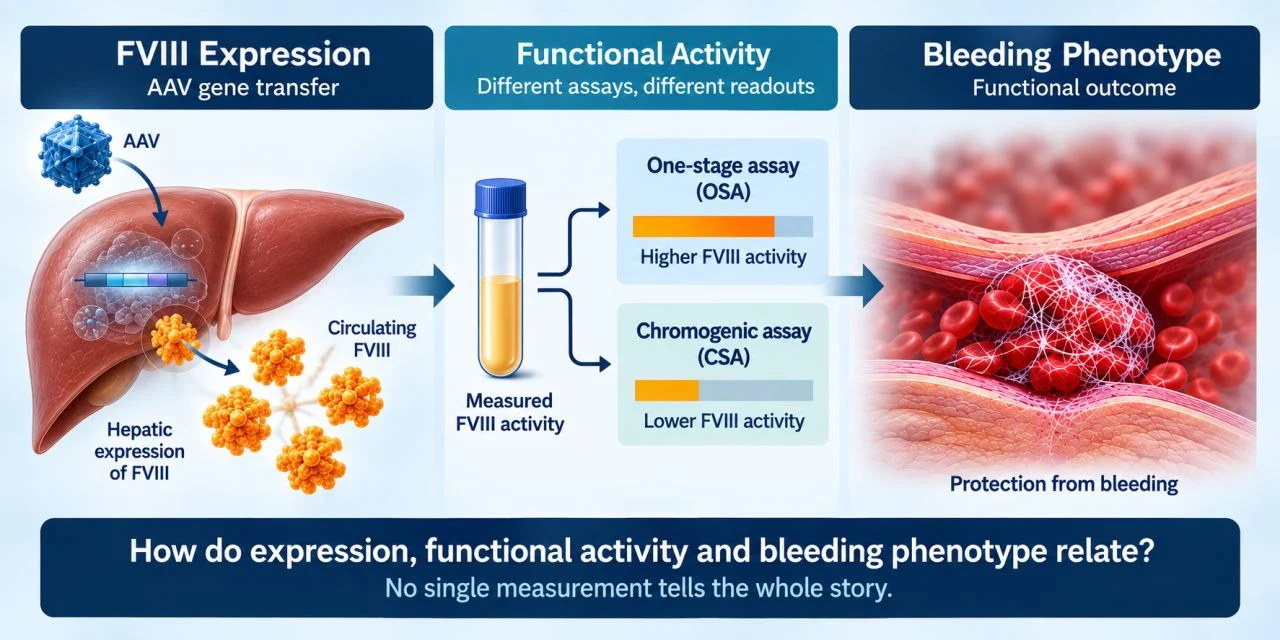
The authors examined the longstanding discrepancy between one-stage and chromogenic FVIII assays following AAV gene transfer and provide evidence that the higher one-stage activity reflects a biological property of AAV-derived FVIII-SQ (enhanced activation by thrombin) rather than simply an assay artifact.
This is significant work that begins to provide a biological explanation for a longstanding observation in clinical FVIII gene therapy.
The question is:
What does measured FVIII activity tell us about actual protection from bleeding?
Years ago, we approached the activity-versus-phenotype question in hemophilia A rats using both AAV-mediated FVIII gene transfer and FVIII protein infusion.
Because these animals develop spontaneous bleeds, we could relate circulating FVIII activity to actual bleeding risk across both approaches.
Increasing FVIII activity was associated with progressively greater protection from bleeding.
Looking back at those experiments now, the new study adds a very interesting dimension: how does the way we measure FVIII activity influence our interpretation of the relationship between factor activity and bleeding phenotype?
But there is also a broader principle here:
For hemostatic gene therapy, no single measurement tells the whole story.
Expression, functional activity and bleeding phenotype need to be understood together.
That principle is very relevant to how we think about GENV-HEM at GeneVentiv Therapeutics, Inc.
With liver-directed expression of activated Factor V, we are interested not only in transgene expression, but in how that expression translates into measurable hemostatic activity and the resulting bleeding phenotype.
Taken together, these different measures give us a more complete picture of what a gene therapy is actually doing.
A very interesting study and another reminder that the biology behind the number matters.
Congratulations to the team, led by my former CHOP/Penn colleague Lindsey George”
Title: One-stage Assay Factor VIII Activity Reflects AAV-Derived Factor VIII–Enhanced Thrombin Activation and Predicts Phenotype
Authors: Anna R Sternberg, Connor T Watson, Robert J Davidson, Marianne Uguen, Anna Kiialainen, Lindsey A George
Stay updated on all scientific advances with Hemostasis Today.
-
Nov 24, 2026, 01:12Cynthia Dalveren: John Hay Students Partner with American Red Cross to Support Sickle Cell Patients
-
Nov 24, 2026, 00:59Htar Wai Shan: How the Reticulocyte Count Measures Bone Marrow Red Blood Cell Production
-
Nov 24, 2026, 00:49Sadik Kükrer: New ASH Thresholds and a Critical Look at the Latest IV Iron Meta-Analysis
-
Nov 23, 2026, 19:11Svetislav Matic: Optimizing Perioperative Patient Outcomes Through PBM and Sample Volume Management
-
Nov 23, 2026, 19:10Subhadip Misra: TRANSMEDCON 2026 – Where Science Met Conversations, Collaboration and Purpose
-
Nov 23, 2026, 18:51Anirban Sen Gupta: Platelet-Inspired Nanoparticles for Targeted Drug Delivery at Vascular Disease Sites
-
Nov 23, 2026, 18:50Jan Sloves: Honored to Serve as Faculty at VEITH Symposium 2026
-
Nov 23, 2026, 18:50Edward Lee Carter: AI vs FDA Anticoagulant Education – The Most Important Finding Wasn’t Who Scored Highest
-
Nov 23, 2026, 16:04Gamunu Wijetunge: Stop Leaving TRICARE Transfusion Reimbursement on the Table