


Dino Mehic: Managing Heavy Menstrual Bleeding in Patients with BDUC
Dino Mehic, Physician Scientist at Medical University of Vienna, shared a post on LinkedIn about a recent article he and his colleagues co-authored, published in Blood, adding:
“Heavy menstrual bleeding in women with bleeding disorders of unknown cause (BDUC): What should clinicians know?
Excited to share our recently published How I Treat article in Blood, together with Johanna Gebhart and Ingrid Pabinger!
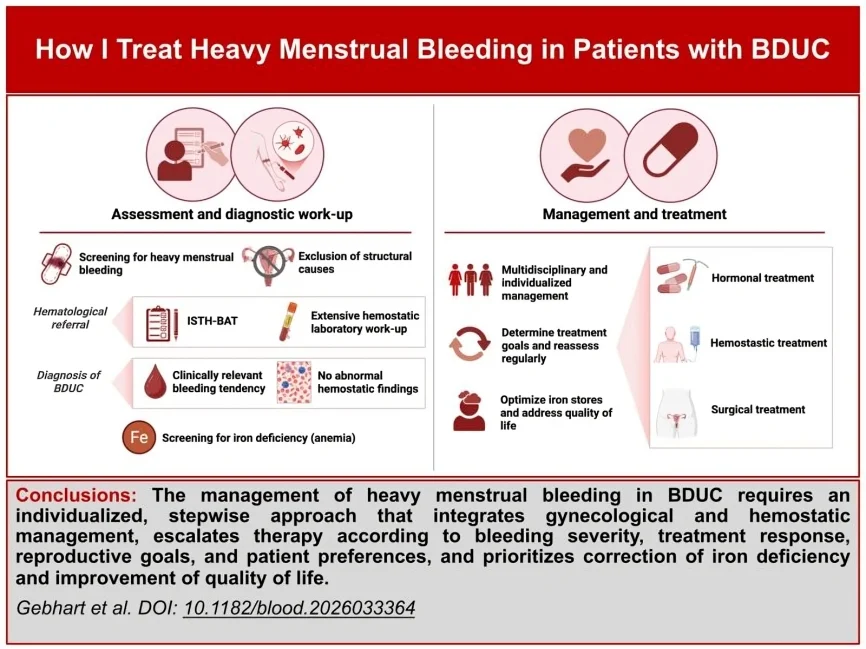
How I Treat Heavy Menstrual Bleeding in Patients with Bleeding Disorder of Unknown Cause
Heavy menstrual bleeding (HMB) is one of the most common and burdensome manifestations of BDUC, yet it frequently remains underrecognized and undertreated. Through three clinical cases across different stages of reproductive life, we discuss diagnostic challenges and practical management strategies.
Key takeaways:
- Normal hemostatic tests do not exclude a bleeding disorder. A convincing bleeding phenotype warrants further investigation, even with a normal ISTH-BAT score.
- Think beyond gynecological causes. Structural abnormalities such as adenomyosis may coexist with an underlying bleeding disorder and may contribute to diagnostic delays.
- Repeat testing matters. VWF levels may be transiently elevated during acute bleeding or stress, potentially masking VWD.
- Don’t overlook iron deficiency. Iron deficiency, even without anemia, contributes substantially to fatigue and impaired quality of life. Routine screening and appropriate treatment are essential.
- Treatment requires an individualized approach. Hormonal therapies, particularly LNG-IUDs, and tranexamic acid remain the mainstays of treatment. Selected patients may require surgical interventions with appropriate hemostatic planning.
- Important unmet need: Despite the considerable clinical burden, targeted therapies for BDUC are lacking, highlighting the need for mechanistic research and prospective clinical trials.”
Title: How I Treat Heavy Menstrual Bleeding in Patients with Bleeding Disorder of Unknown Cause
Authors: Johanna Gebhart, Dino Mehic, Ingrid Pabinger

Stay updated on all scientific advances with Hemostasis Today.
-
Oct 10, 2026, 02:38Brianne D.: Sex Differences in RIPK1 Signaling Following Intracerebral Hemorrhage
-
Oct 10, 2026, 00:34Raphaëlle Dodart: Discussing the Mechanisms of Menstrual Hemostasis
-
Oct 10, 2026, 00:26Barbara Adams Krolak: Discussing the Growing Need for Blood Clot Prevention in Asia
-
Oct 9, 2026, 23:59Ana Pedrero Gil: Is Coagulopathy with Fibrinolysis Present in All Obstetric Hemorrhages?
-
Oct 9, 2026, 23:57Exploring the Psychosocial Needs of People with Bleeding Disorders in Kyrgyzstan – EAHAD
-
Oct 9, 2026, 23:53Bernard Slater Jr.: Serving on the Advisory Council for the NBDF West Virginia Chapter
-
Oct 9, 2026, 23:53Aurelio Maggio: Thalassemia Reports Real-Time Impact Factor Rises to 1.760
-
Oct 9, 2026, 23:52Stronger Connections, Stronger Organizations – World Federation of Hemophilia
-
Oct 9, 2026, 23:46Samuel Misiani Mbunya: Advancing Sickle Cell Care Through Collaboration at the 21st ASCAT Conference