

Abdul Rahman: Reticulocyte Count and Bone Marrow Activity
Abdul Rahman, Medical Laboratory Technologist at Modawah Clinical Laboratory, shared a post on LinkedIn:
”Hematology Lab Series | Day 1
Reticulocyte Count: A Window into Bone Marrow Activity
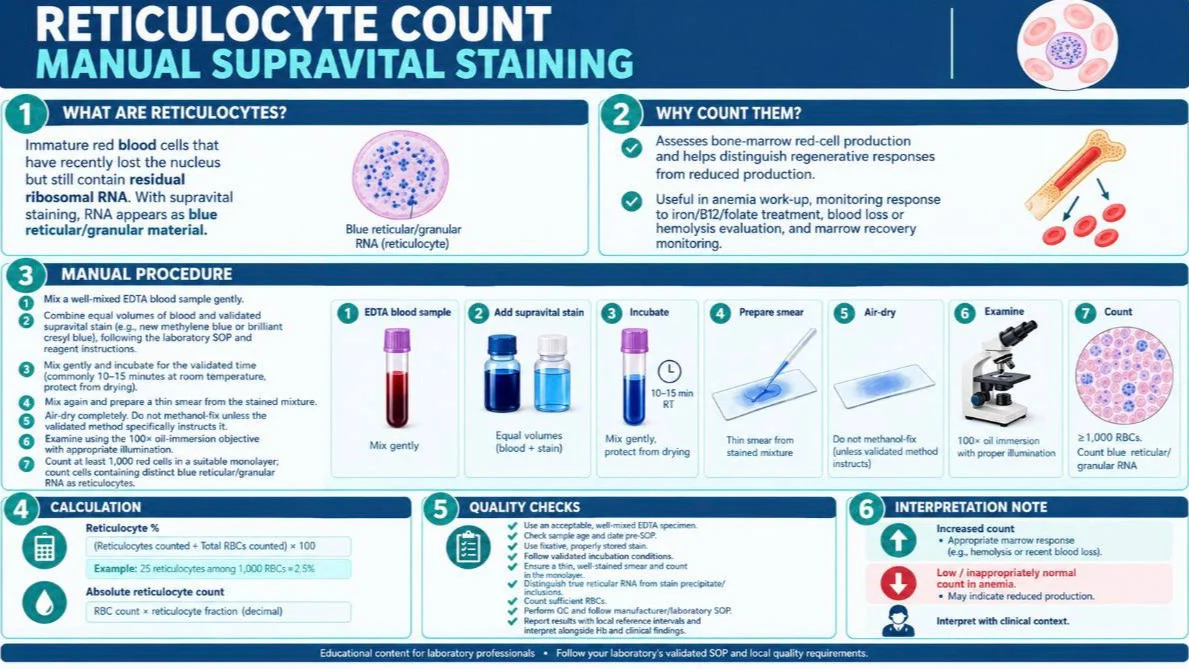
Reticulocytes are immature red blood cells that have lost their nucleus but retain residual ribosomal RNA. Using supravital staining, this RNA appears as blue reticular or granular material under the microscope.
Why is the reticulocyte count important?
- Evaluates bone marrow red blood cell production.
- Helps assess the response to anemia treatment.
- Supports the investigation of hemolysis and blood loss.
- Monitors bone marrow recovery.
Manual method — key steps
- Collect a well-mixed EDTA blood sample.
- Mix equal volumes of blood and validated supravital stain, following your laboratory SOP.
- Incubate for the validated time, commonly 10–15 minutes at room temperature.
- Prepare a thin smear and allow it to air-dry.
- Examine under the 100× oil-immersion objective.
- Count at least 1,000 red blood cells and identify cells containing distinct blue reticular RNA.
- Calculate the percentage of reticulocytes.
Formula
Reticulocyte (percent) equals (Number of reticulocytes counted divided by Total RBCs counted) multiplied by 100
Example: 25 reticulocytes among 1,000 RBCs equals 2.5 percent.
Quality matters: Correct specimen handling, validated staining conditions, adequate cell counts, recognition of stain precipitates, and adherence to laboratory SOPs are essential for reliable results.
Remember: Always interpret the reticulocyte count alongside the hemoglobin level, RBC count, clinical findings, and other relevant laboratory results.
Educational content for medical laboratory professionals. Follow your laboratory’s validated procedure and quality requirements.”
Stay updated with Hemostasis Today.
-
Oct 16, 2026, 17:22Wolfgang Miesbach։ What a Near-Perfect FISH Score Fails to See
-
Oct 16, 2026, 17:06Troels Wienecke: Connecting Myeloproliferative Disease and Ischemic Stroke
-
Oct 16, 2026, 17:03Only 5 Days Left to Submit Your Research for EAHAD 2027
-
Oct 16, 2026, 16:44DOAC Adherence in Stroke Patients With Atrial Fibrillation – International Journal of Stroke
-
Oct 16, 2026, 16:22Shannon Farmer: Driving Patient Blood Management Forward in Australia and New Zealand
-
Oct 16, 2026, 16:01Obi Light Ogbonnia: The Greatest Reward Is Changing Lives, Not Winning Awards
-
Oct 16, 2026, 15:18Carmine Liberatore: Limited Accuracy of VTE Risk Scores in Multiple Myeloma
-
Oct 16, 2026, 14:55Alex Borstein and the Bleeding Phenotype of Hemophilia A Carriers
-
Oct 16, 2026, 13:59Aya Akmal Amin: Antiphospholipid Syndrome Management and Risk Stratification