

Alex Borstein and the Bleeding Phenotype of Hemophilia A Carriers
Actress and comedian Alex Borstein brings a personal perspective to an important issue in hematology: the recognition of women who experience bleeding symptoms associated with hemophilia.
She has publicly discussed her family’s experience with hemophilia across generations, including its impact on her brother and uncle, as well as her own experience as a carrier with low clotting-factor levels.
Her story highlights a question that remains important in modern hemostasis:
Can a woman with a pathogenic variant in the F8 gene experience clinically significant bleeding?
The answer is yes. Women with a pathogenic variant in the F8 gene can experience bleeding ranging from mild symptoms to clinically significant hemorrhage.
Yet, for many years, the term carrier has contributed to the perception that these women are unaffected by the disorder.
Understanding the distinction between genetic carrier status, factor VIII activity, and the clinical bleeding phenotype is essential for accurate diagnosis and individualized care.
In an interview, Borstein discusses her experience as a carrier and explains that her daughter was categorized as having mild hemophilia. Her account illustrates why genetic carrier status alone may not adequately reflect an individual’s bleeding phenotype.
Hemophilia A In Women Is More Than A Genetic Condition
Hemophilia A results from deficient or dysfunctional coagulation factor VIII (FVIII), a protein essential for effective thrombin generation and fibrin clot formation.
The F8 gene is located on the X chromosome, which explains why hemophilia A has historically been diagnosed predominantly in males.
However, females carrying a pathogenic F8 variant can also develop reduced FVIII activity and clinically important bleeding.
One mechanism contributing to this variability is X-chromosome inactivation, also known as lyonization. During early development, one X chromosome is inactivated in each cell.
When inactivation disproportionately affects the X chromosome carrying the functional F8 allele, FVIII production may be reduced.
However, X-chromosome inactivation does not explain every case. Genetic background, factor activity, other hemostatic influences, and individual clinical circumstances can also contribute to the observed bleeding phenotype.
As a result, some women with a pathogenic F8 variant have FVIII levels within the conventional reference range, while others have reduced levels consistent with mild, moderate, or severe hemophilia. Some may experience clinically significant bleeding even when their factor activity does not meet the laboratory threshold traditionally used to classify hemophilia.
The Bleeding Phenotype Can Be More Informative Than Carrier Status Alone
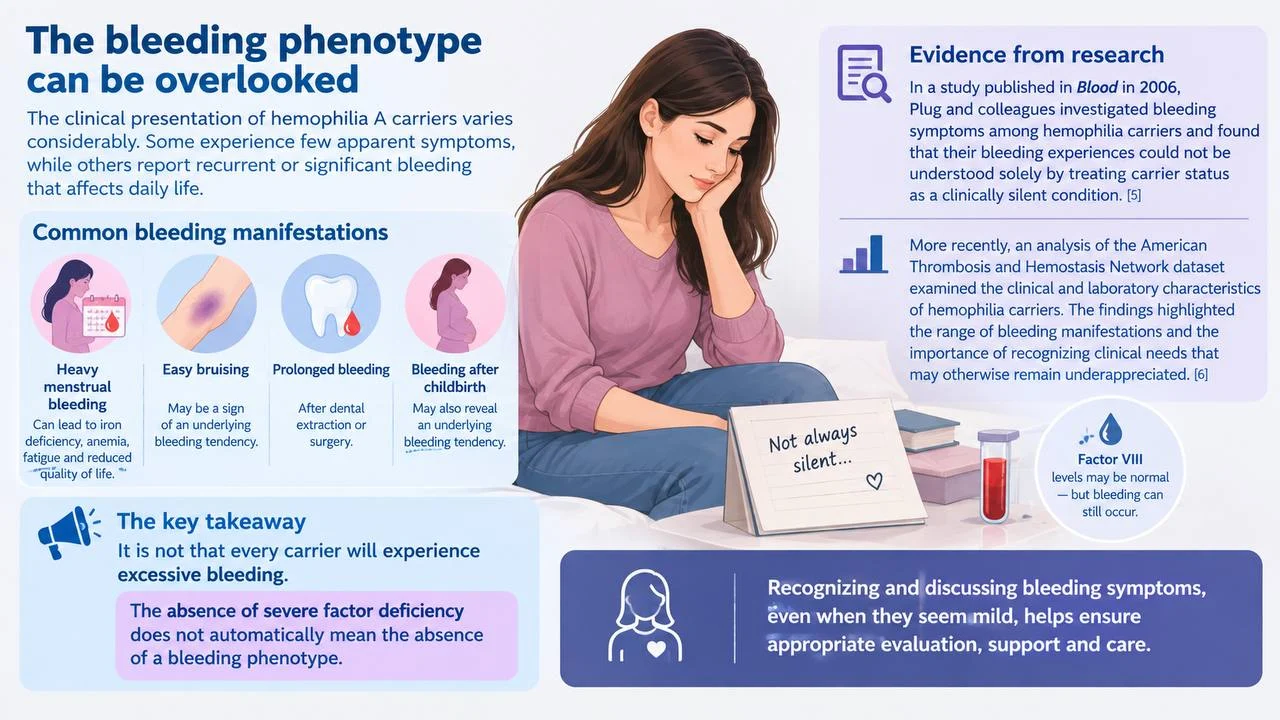
The clinical presentation of hemophilia A carriers varies considerably. Some experience few bleeding symptoms, while others have recurrent bleeding that affects daily life and requires medical attention.
Heavy menstrual bleeding is a particularly important manifestation.
Persistent menstrual blood loss can cause iron deficiency, iron-deficiency anemia, fatigue, and reduced quality of life. Other manifestations include easy bruising, prolonged bleeding after dental extraction or surgery, and excessive bleeding following childbirth.
Evidence supporting the clinical significance of bleeding in hemophilia carriers has been available for decades. In a study published in Blood in 2006, Plug and colleagues investigated bleeding symptoms among hemophilia carriers, demonstrating the importance of evaluating their bleeding experiences rather than assuming that carrier status is clinically silent.
The central issue is not that every carrier experiences excessive bleeding. Rather, the absence of severe factor VIII deficiency does not automatically exclude a clinically significant bleeding phenotype.
Recognizing this distinction can help prevent symptoms from being dismissed or attributed to unrelated causes without an appropriate hemostatic evaluation.
Why Factor VIII Levels Do Not Tell The Whole Story
Factor VIII (FVIII) activity is a central laboratory parameter in the diagnosis of hemophilia A, but it does not fully capture the complexity of hemostasis or reliably predict every individual’s bleeding tendency.
FVIII functions as a cofactor for activated factor IX (FIXa) in the intrinsic tenase complex on activated platelet surfaces.
This complex accelerates the conversion of factor X to activated factor X (FXa), promoting thrombin generation and subsequent fibrin formation. Reduced FVIII activity impairs this amplification phase of coagulation, compromising the formation of a stable hemostatic clot.
In women carrying a pathogenic F8 variant, FVIII activity can vary substantially because of differences in X-chromosome inactivation, the nature of the genetic variant, and other biological influences.
Consequently, women with the same variant—or even similar measured FVIII levels—may have different clinical bleeding phenotypes.
A further diagnostic challenge is assay discrepancy. FVIII activity can be measured using a one-stage clotting assay (OSA) or a chromogenic substrate assay (CSA).
These methods assess FVIII function through different analytical systems and may yield discordant results in certain patients. A result that appears normal with one method may underestimate the degree of deficiency identified by the other, potentially affecting diagnosis and severity classification.
The 2026 ISTH guidance recommends measuring FVIII with both methods at least once in women and girls with relevant family history, an F8 variant, or bleeding symptoms, when both assays are readily available. If results differ, the lower result that best correlates with the clinical bleeding phenotype should guide diagnostic classification and follow-up.
Physiological conditions can also affect interpretation.
Pregnancy, inflammation, stress, and estrogen exposure may increase FVIII activity, potentially obscuring a person’s baseline level. The ISTH guidance therefore recommends testing under steady-state conditions, confirming abnormal results with repeat testing, and considering the lowest reliable factor level for diagnostic classification.
These considerations explain why a single FVIII result should not be interpreted in isolation. A comprehensive assessment integrates laboratory findings with genetic information, personal and family bleeding history, and standardized bleeding assessment, such as the ISTH Bleeding Assessment Tool.
The objective is to determine not only whether FVIII activity is reduced, but also whether the laboratory findings adequately explain the patient’s clinical presentation. This distinction is particularly important in women whose bleeding symptoms may otherwise remain unrecognized despite apparently reassuring factor levels.
Pregnancy And Childbirth Require Particular Attention
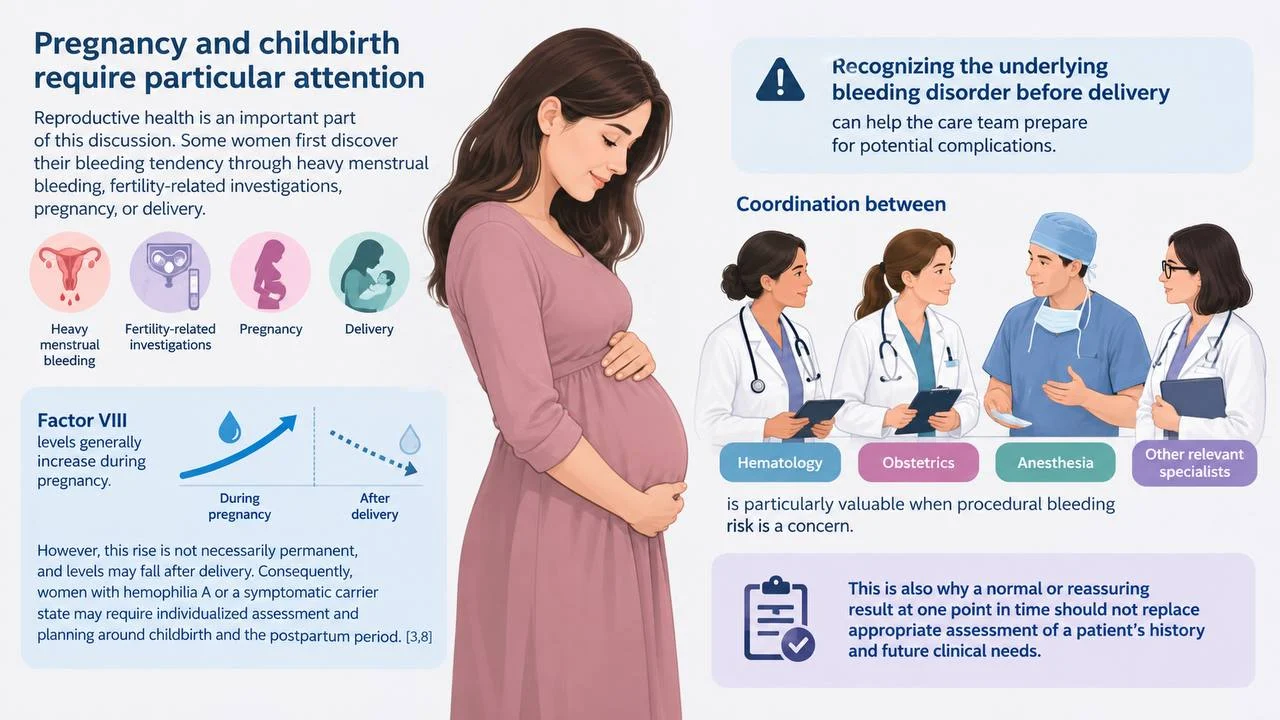
Factor VIII (FVIII) activity typically increases during pregnancy because of physiological changes in coagulation. However, levels may decline rapidly after delivery, increasing the risk of postpartum hemorrhage in women with hemophilia A or a clinically significant bleeding phenotype.
A normal FVIII level during pregnancy does not necessarily reflect baseline coagulation status. Assessment should consider bleeding history, factor activity, and delivery-related risks.
Preconception counseling, individualized delivery planning, and postpartum monitoring are important, with coordination between hematology and obstetric teams when indicated.
 From The Carrier Label To Individualized Care
The distinction between genetic carrier status and clinically significant hemophilia matters because it can influence diagnosis, treatment, and procedural planning.
Women with bleeding symptoms should not be assumed to be asymptomatic solely because they are classified as carriers.
Clinical assessment should integrate personal and family bleeding history, a standardized bleeding assessment, FVIII activity, and F8 genetic testing when indicated.
Management should be guided by the individual’s bleeding phenotype, laboratory findings, and clinical needs.
The goal is not to treat every carrier, but to identify and appropriately manage those whose bleeding warrants clinical attention.
Recognizing The Bleeding Phenotype Beyond The Carrier Label
Alex Borstein’s experience highlights a broader challenge in modern hemostasis: genetic carrier status does not fully define an individual’s bleeding risk.
In women with hemophilia A, factor VIII activity, genetic findings, and clinical symptoms must be interpreted together to establish an accurate diagnosis and guide care.
Recognizing heavy menstrual bleeding, excessive procedural bleeding, and postpartum hemorrhage as potential manifestations of an underlying bleeding disorder can help prevent delayed diagnosis and unnecessary suffering.
Current clinical guidance supports a structured, individualized approach that considers both laboratory findings and bleeding history.
The clinical priority is not simply to identify who carries an F8 variant, but to recognize who bleeds, understand why, and ensure that those symptoms receive appropriate evaluation and care.
FAQ
1. Can a woman who carries hemophilia A have bleeding symptoms?
Yes. Some women and girls with a pathogenic F8 variant experience clinically significant bleeding. Symptoms can include heavy menstrual bleeding, easy bruising, and excessive bleeding after surgery or childbirth.
2. Does being a hemophilia A carrier mean having hemophilia?
Not necessarily. The ISTH distinguishes women and girls with hemophilia from symptomatic and asymptomatic carriers. Classification depends on factor activity, genetic findings, and the clinical bleeding phenotype.
3. Can hemophilia A carriers have normal factor VIII levels?
Yes. Factor VIII activity can fall within the normal laboratory range despite the presence of a pathogenic F8 variant and a clinically significant bleeding history. Normal factor activity does not always explain or exclude bleeding symptoms.
4. What is the role of X-chromosome inactivation?
X-chromosome inactivation is the process by which one X chromosome is largely silenced in each cell. Skewed inactivation can contribute to differences in factor VIII production, but it does not explain every variation in bleeding severity.
5. What are the most common bleeding symptoms in hemophilia A carriers?
Important manifestations include heavy menstrual bleeding, easy bruising, prolonged bleeding following dental procedures or surgery, and bleeding complications during or after childbirth.
6. Can hemophilia A carriers develop iron deficiency?
Yes. Recurrent or heavy menstrual bleeding can lead to iron depletion and eventually iron-deficiency anemia. Iron status should be assessed when symptoms or the bleeding history warrant it.
7. How is the bleeding phenotype assessed?
Assessment includes a detailed personal and family bleeding history, a standardized tool such as the ISTH Bleeding Assessment Tool, factor VIII activity testing, and genetic evaluation when indicated. Other bleeding disorders may need to be investigated as well.
8. Does pregnancy increase bleeding risk in hemophilia A carriers?
The situation varies. Factor VIII levels generally rise during pregnancy and can subsequently fall after delivery. Postpartum bleeding risk therefore requires individualized assessment, particularly in women with reduced factor activity or a significant bleeding history.
9. Do all hemophilia A carriers require treatment?
No. Management depends on the person’s bleeding symptoms, factor levels, and clinical circumstances. Some require no hemostatic treatment, while others need an individualized plan for menstruation, surgery, or childbirth.
10. Why is early recognition important?
Early recognition allows bleeding symptoms to be evaluated, reproductive and procedural risks to be addressed, and appropriate treatment or prevention strategies to be planned. It can also help identify relatives who may benefit from genetic counselling and assessment.
Written by Samvel Avetisyan
Stay updated with Hemostasis Today.
-
Oct 16, 2026, 13:59Aya Akmal Amin: Antiphospholipid Syndrome Management and Risk Stratification
-
Oct 16, 2026, 13:10Emanuel Sueldo: CAHT 2026 Celebrates Scientific Progress and Team Achievements
-
Oct 16, 2026, 13:05Maha Othman: Queen’s Health Sciences Advances CAT Risk Models and Pediatric ISTH-BAT Cut-Offs
-
Oct 16, 2026, 13:03Thrombosis Awareness Must Lead to Timely Action – Roche
-
Oct 16, 2026, 12:49Wolfgang Miesbach: 5-Year CBDR Data Confirms Emicizumab Safety and Efficacy in Hemophilia A
-
Oct 16, 2026, 12:40Edward Lee Carter: How Factor XI Inhibition Could Transform Anticoagulation Therapy
-
Oct 16, 2026, 12:40Marc Carrier: Looking Ahead to ISTH 2027 in Vancouver
-
Oct 16, 2026, 12:30Bob Lempke: How One Blood Donation Can Save Up to Three Lives
-
Oct 16, 2026, 12:30Why VWF Therapies Belong on the EU Critical Medicines List – EHC