


Edward Lee Carter: A 15-Minute Blood Test for Brain Hemorrhage?
Edward Lee Carter, Clinical Pharmacist Practitioner at U.S. Department of Veterans Affairs, stared a post on LinkedIn:
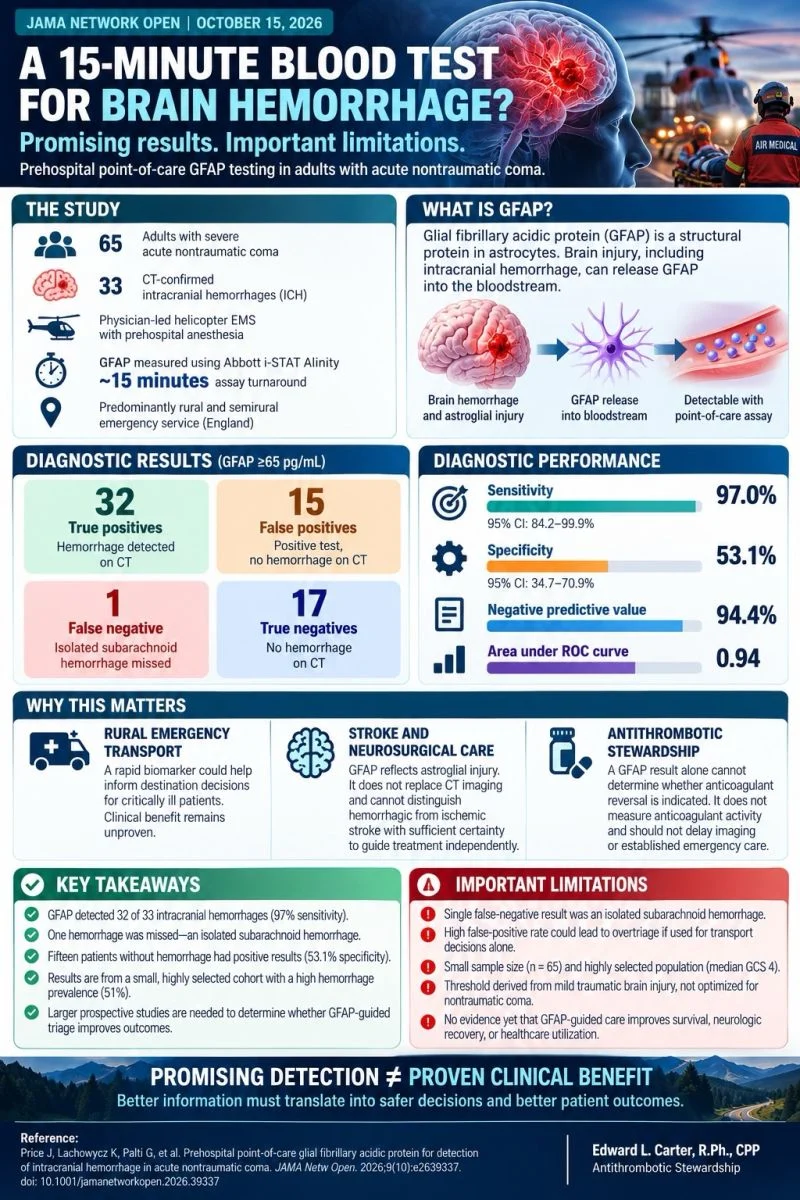
”A 15-Minute Blood Test for Brain Hemorrhage?
Promising Science, Important Limitations.
Could a simple blood test eventually help emergency teams identify intracranial hemorrhage before a patient reaches the hospital?
A study published October 15 in JAMA Network Open evaluated prehospital point-of-care testing for glial fibrillary acidic protein (GFAP), a biomarker released following astroglial injury.
Researchers studied 65 adults with severe acute nontraumatic coma.
CT imaging confirmed intracranial hemorrhage in 33 patients.
The findings were impressive:
- 97.0 percent sensitivity — 32 of 33 hemorrhages detected
- 53.1 percent specificity
- 94.4 percent negative predictive value
- Approximately 15-minute assay turnaround
But the numbers deserve closer examination.
One hemorrhage was missed—and it was an isolated subarachnoid hemorrhage.
Additionally, 15 patients without intracranial hemorrhage had positive GFAP results.
That distinction matters. A highly sensitive test is not necessarily a reliable standalone rule-out test, particularly when a missed diagnosis could have devastating consequences.
Why is this important for rural healthcare?
In communities where advanced stroke and neurosurgical services may be hours away, decisions about transporting critically ill patients to the nearest hospital versus a specialized center can significantly influence care.
A rapid blood biomarker could eventually help inform those decisions.
But this study did not demonstrate improved transport decisions, survival, or neurologic outcomes.
There are also implications for antithrombotic stewardship.
For patients receiving warfarin or direct oral anticoagulants, early recognition of intracranial hemorrhage is essential to timely imaging, specialist evaluation, and appropriate reversal when indicated.
However, GFAP does not measure anticoagulant activity, cannot replace CT imaging, and should not independently determine whether reversal therapy is administered.
Limitations remain.
This was a small, highly selected population of severely ill patients managed by a specialized prehospital critical care service.
The reported negative predictive value also reflects a population in which approximately half the patients had intracranial hemorrhage. These results should not be generalized to routine stroke presentations.
Larger prospective studies must determine whether GFAP-guided care improves triage, reduces delays, and ultimately improves patient outcomes.
Takeaway:
Promising detection does not automatically translate into proven clinical benefit.
A test with 97 percent sensitivity deserves attention.
But even one missed hemorrhage matters when the stakes are this high.
The goal is not simply earlier diagnostic information.
It is earlier, safer decisions that lead to better patient outcomes.
The views expressed are my own and do not represent the official positions of the Department of Veterans Affairs or the U.S. government.”
Stay updated with Hemostasis Today.
-
Oct 18, 2026, 17:11Owen McCarty: Understanding Prekallikrein and Its Role in Inflammation and Thrombosis
-
Oct 18, 2026, 17:04Emna Gouider Belhadjali: Don’t Miss GPAS 2026 on Bleeding Disorders
-
Oct 18, 2026, 16:53Mehran Ghasemzadeh: Microparticle-Associated Mitochondrial DNA in Stored Platelet Products
-
Oct 18, 2026, 16:29Patrick Taylor: Oral vs Transdermal Estrogen and Cardiovascular Risk in Menopausal Women
-
Oct 18, 2026, 16:19Artangela Henry: A Meaningful Week at the SCDAA National Convention
-
Oct 18, 2026, 16:04Emília Araújo։ New Insights Into the Genetics of Hemophilia B Leyden
-
Oct 18, 2026, 15:43André Marcel Harris: Award-Winning Research on Texas Sickle Cell Data Collection
-
Oct 18, 2026, 15:21Eleonora Gambineri: First Results of the IEI-Haem Consortium at ESID 2026
-
Oct 18, 2026, 15:17Alexey Kulikov: Could Platelets Reveal Frailty Before Physical Signs Appear?