

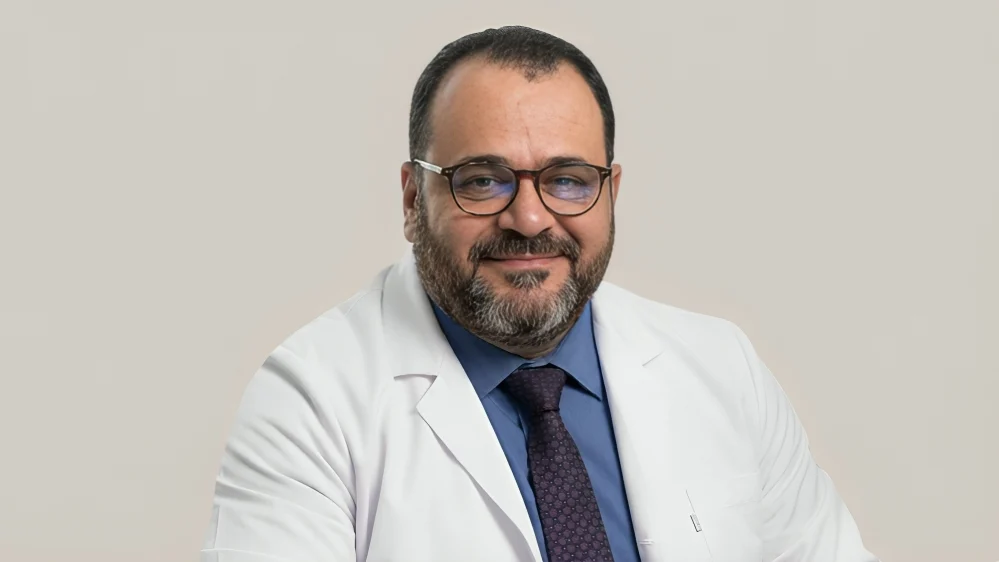
Hisham Fahmi: SCD – Should Gene Editing Begin Before Organ Damage?
Hisham Fahmi, Lecturer at Pediatric Hematology and Oncology, shared a post on LinkedIn about a recent article by Haydar Frangoul et al., published in NEJM, adding:
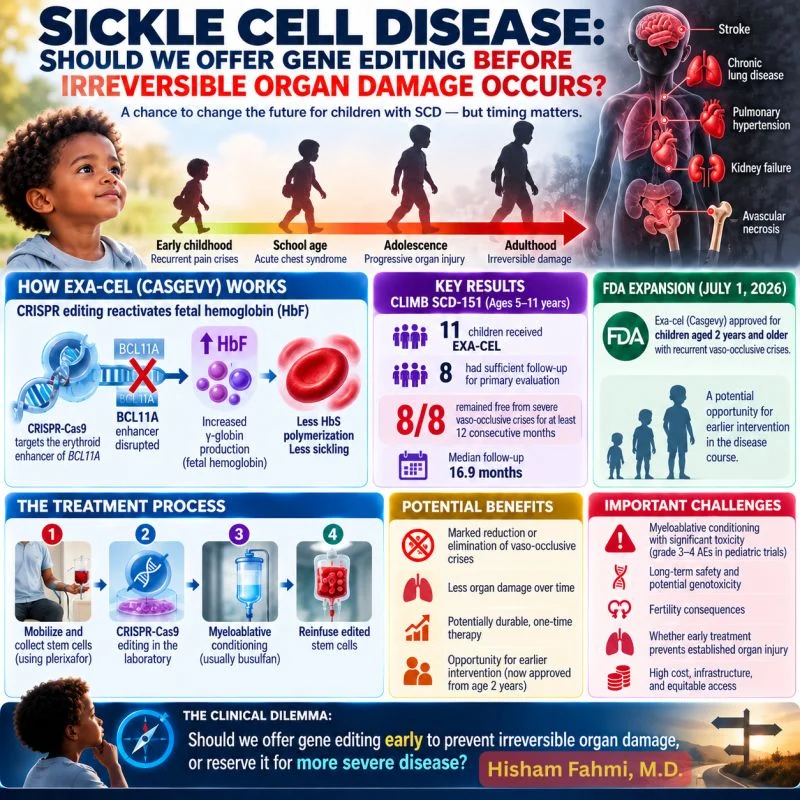
“Sickle Cell Disease: Should we offer gene editing before irreversible organ damage occurs?
For decades, pediatric SCD management focused on symptom prevention. In 2026, the paradigm is shifting toward early curative intervention. Recent clinical and regulatory breakthroughs have brought this debate to the forefront.
The Phase 3 CLIMB trial evaluated exa-cel (CRISPR-Cas9 gene-edited autologous stem-cell therapy) in children aged 5–11 with severe SCD. By disrupting the erythroid-specific enhancer of BCL11A, it restores fetal hemoglobin (HbF) production. 100% of evaluable children remained free from severe vaso-occlusive crises for 12 consecutive months (median follow-up: 16.9 months).
A Regulatory Shift took place in July 2026. The FDA expanded exa-cel (Casgevy) approval to children aged 2 and older with recurrent VOCs—opening the door to intervention much earlier in life.
While this is biologically compelling, significant hurdles remain:
- Conditioning risks due to myeloablative busulfan conditioning
- All trial participants experienced grade 3–4 adverse events
- Long-term safety: Genotoxicity, fertility loss, organ preservation
- Equity access: High costs, complex manufacturing, infrastructure constraints
The Clinical Dilemma: Do we intervene early to prevent irreversible organ damage or reserve gene editing for severe manifestations to avoid upfront conditioning risks?
Would you offer gene-edited therapy to a young child with recurrent VOCs before evidence of organ damage appears?”
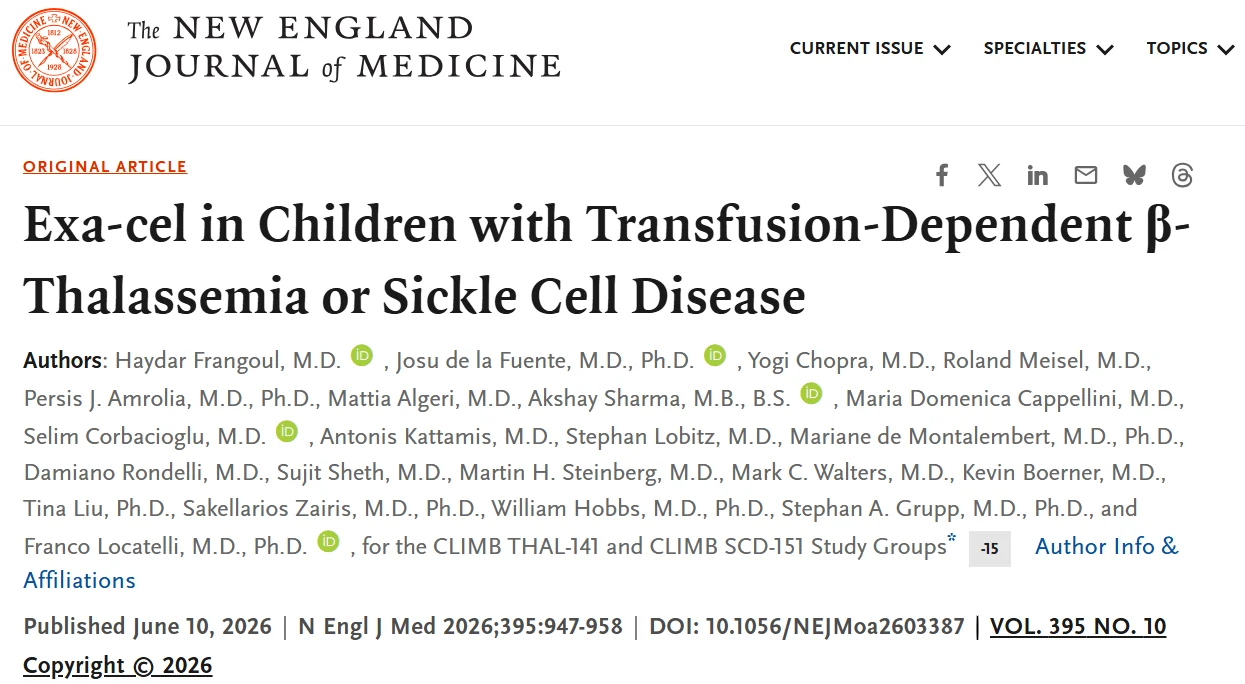
Title: Exa-cel in Children with Transfusion-Dependent β-Thalassemia or Sickle Cell Disease
Authors: Haydar Frangoul, Josu de la Fuente, Yogi Chopra, Roland Meisel, Persis J. Amrolia, Mattia Algeri, Akshay Sharma, Maria Domenica Cappellini, Selim Corbacioglu, Antonis Kattamis, Stephan Lobitz, Mariane de Montalembert, Damiano Rondelli, Sujit Sheth, Martin H. Steinberg, Mark C. Walters, Kevin Boerner, Tina Liu, Sakellarios Zairis, William Hobbs, Stephan A. Grupp, Franco Locatelli
Stay updated with Hemostasis Today.
-
Oct 19, 2026, 12:46Andrew Choong: Recognizing Thrombosis Before It Becomes Life-Threatening
-
Oct 19, 2026, 11:37Beth Faiman: APSHO Fellows Celebrated for Advancing Hematology and Oncology Practice
-
Oct 19, 2026, 11:26Emanuele Pacini: Myelodysplastic Syndromes Research Featured at JSH Annual Meeting in Kyoto
-
Oct 19, 2026, 10:57Jesmond Dalli: How Erythroblasts Shape Neutrophil Development and Function
-
Oct 19, 2026, 10:33Pallavi Madhiraju: YARTEMLEA Faces Another European Rejection Despite FDA Approval
-
Oct 19, 2026, 10:28Brig Tathagata Chatterjee: Acute Leukemias in AYAs at the Japanese Society of Hematology Conference
-
Oct 19, 2026, 10:27Heather M. Johnson: Join the Discussion on Optimizing the CTEPH Diagnostic Pathway
-
Oct 19, 2026, 10:18Flora Peyvandi: Unravelling the Complexity of VWF Through Genetics
-
Oct 19, 2026, 09:55High DOAC Adherence in Patients With Ischemic Stroke and AF – International Journal of Stroke