


Joseph R. Shaw: Thrombin Generation as a Tool for Coagulation Phenotyping in Critically Ill Patients
Joseph R. Shaw, Director of Research Plus Program at Ottawa Department of Medicine, EHJ-CVP Associate Editor at European Heart Journal, shared a post on LinkedIn about a recent article he and his colleagues co-authored, published in Journal of Thrombosis and Haemostasis, adding:
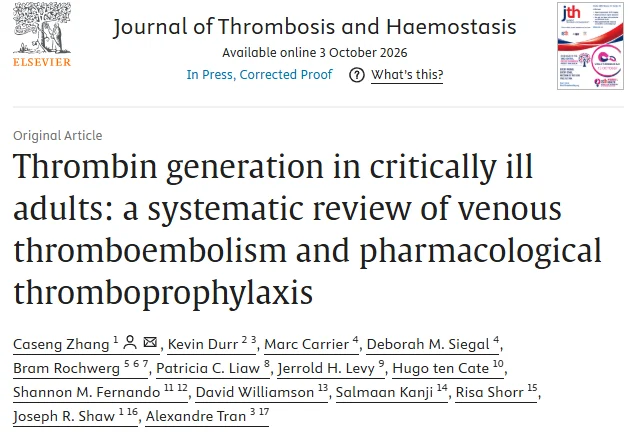
“I’m happy to share our new systematic review, ‘Thrombin generation in critically ill adults: a systematic review of venous thromboembolism and pharmacological thromboprophylaxis,’ published in the Journal of Thrombosis and Haemostasis.
Critically ill patients remain at risk of venous thromboembolism (VTE) despite standard thromboprophylaxis. Understanding how anticoagulant exposure interacts with each patient’s underlying coagulation state may help explain why.
Thrombin generation assays (TGAs) capture the timing and magnitude of thrombin formation: lag time reflects when generation begins; time-to-peak, when maximal thrombin concentration is reached; peak thrombin, that maximal concentration; and endogenous thrombin potential (ETP), the area under the curve representing overall thrombin generation.
We reviewed 15 prospective studies involving 2,250 patients across surgical or trauma, medical ICU, and mixed ICU settings.
The most consistent finding was pharmacodynamic: higher anti-Xa activity generally accompanied lower peak thrombin and ETP. Thrombin generation may complement anti-Xa by capturing the downstream coagulation response to low-molecular-weight heparin.
Some trauma cohorts linked shorter lag time or time-to-peak with subsequent VTE. Across studies, however, differences in assay methods, sampling relative to anticoagulant dosing, patient populations, VTE definitions, ascertainment methods, and follow-up periods created substantial heterogeneity.
This variability may have obscured clinically meaningful associations and limits firm conclusions about TGA’s predictive value.
A promising future role is as a coagulation-phenotyping tool: characterizing each patient’s evolving capacity to generate thrombin and their response to thromboprophylaxis.
Prospective studies combining standardized, serial TGA measurements with anti-Xa and antithrombin levels—and consistent VTE assessment—could help connect anticoagulant exposure, residual thrombin generation, and clinical outcomes, laying the groundwork for individualized thromboprophylaxis.”
Title: Thrombin generation in critically ill adults: a systematic review of venous thromboembolism and pharmacological thromboprophylaxis
Authors: Caseng Zhang, Kevin Durr, Marc Carrier, Deborah M. Siegal, Bram Rochwerg, Patricia C. Liaw, Jerrold H. Levy, Hugo ten Cate, Shannon M. Fernando, David Williamson, Salmaan Kanji, Risa Shorr, Joseph R. Shaw, Alexandre Tran
Find more posts featuring Joseph R. Shaw on Hemostasis Today.
-
Oct 24, 2026, 05:46James Posada: Demonstrating the Benefits of Nuclease Therapy in Ischemic Stroke
-
Oct 24, 2026, 05:44Juan Luis Fernández Masip: Reconnecting With the Australia and New Zealand Hematology Community at Blood 2026
-
Oct 24, 2026, 05:43No One Should Navigate Von Willebrand Disease Alone – EHC
-
Oct 24, 2026, 05:39Ani Mebalds: Advancing the Availability of Cryopreserved Blood Products at AABB
-
Oct 23, 2026, 17:45Lucy Brook: Had the Privilege of Attending the Blood 2026 Conference with New Zealand Blood Service
-
Oct 23, 2026, 16:05Platelet Secretion Defects and Their Role in the Diagnosis of Bleeding Disorders
-
Oct 23, 2026, 16:00Hemophilia Alliance team in New Orleans at the ATHN Data Summit
-
Oct 23, 2026, 15:49Brian Sapp: Why Exact Calf Vein Naming Is Critical for DVT Diagnosis?
-
Oct 23, 2026, 15:33Smitirupa Mishra: A Systematic Approach to Bone Marrow Examination