


Edward Lee Carter: Anticoagulation After Intracranial Hemorrhage – Encouraging Data, but an Unresolved Tradeoff
Edward Lee Carter, Clinical Pharmacist Practitioner at U.S. Department of Veterans Affairs, stared a post on LinkedIn:
“Anticoagulation After Intracranial Hemorrhage: Encouraging Data, but an Unresolved Tradeoff
For patients with atrial fibrillation (AF) and previous intracranial hemorrhage (ICH), few treatment decisions involve greater uncertainty.
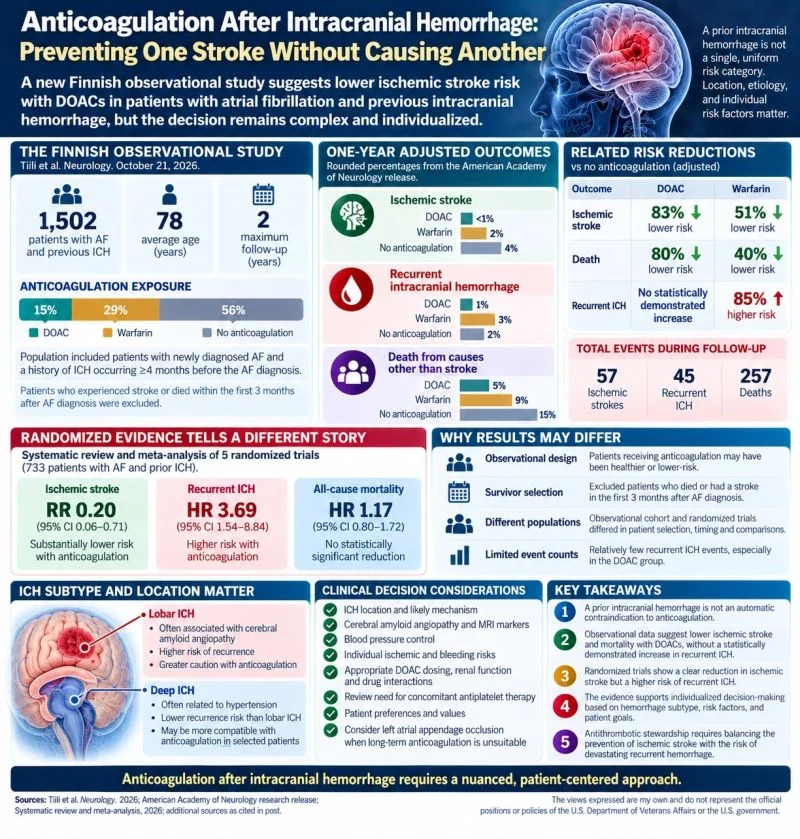
A new Finnish observational study published in American Academy of Neurology examined 1,502 patients with newly diagnosed AF and previous intracranial bleeding.
Mean age: 78 years.
Approximately 15% received DOACs, 29% warfarin, and 56% no anticoagulation.
At one year, adjusted ischemic stroke risks were:
- DOACs: less than 1%
- Warfarin: 2%
- No anticoagulation: 4%
Recurrent ICH risks were approximately 1%, 3%, and 2%, respectively.
DOAC use was associated with lower ischemic stroke risk and mortality, without a statistically demonstrated increase in recurrent ICH.
Encouraging-but not definitive.
A meta-analysis of five randomized trials involving 733 patients found that anticoagulation reduced ischemic stroke (RR 0.20; 95% CI 0.06–0.71) but increased recurrent ICH (HR 3.69; 95% CI 1.54–8.84).
No statistically significant mortality benefit was established.
These findings are not necessarily contradictory.
The observational cohort and randomized trials differed in patient selection, timing, and treatment comparisons.
Importantly, the Finnish study excluded patients who experienced stroke or died during the first three months after AF diagnosis.
Its findings should not be extrapolated to immediate anticoagulation decisions following acute ICH.
A previous brain hemorrhage is not a single, uniform risk category.
Clinical assessment should consider:
- Lobar versus deep hemorrhage and underlying mechanism
- Cerebral amyloid angiopathy and MRI markers
- Blood-pressure control
- Individual ischemic and recurrent bleeding risks
- Appropriate DOAC dosing, renal function, and interactions
- Patient preferences and alternatives when anticoagulation is unsuitable
For selected patients, left atrial appendage occlusion may also merit consideration.
The emerging evidence supports meaningful ischemic stroke prevention with anticoagulation in appropriately selected patients.
But reducing ischemic stroke does not eliminate the possibility of devastating recurrent hemorrhage.
The challenge is not simply deciding whether to anticoagulate.
It is identifying which patients are most likely to benefit-and which may face unacceptable harm.
The views expressed are my own and do not represent the official positions or policies of the U.S.
Department of Veterans Affairs or the U.S. government.”
Find more posts featuring Edward Lee Carter on Hemostasis Today.
-
Oct 24, 2026, 11:16Aram Hovhannisyan: New Evidence on CAT from the THEO Study
-
Oct 24, 2026, 10:49Shahram Kordasti: Investigating Novel Immune Targets in MPN
-
Oct 24, 2026, 10:32Amber Yates: A Major Milestone for the RISE UP Phase 3 Study
-
Oct 24, 2026, 10:22Emmanuel J Favaloro: Laboratory Diagnostics in Hemostasis – The Final 2026 Issue
-
Oct 24, 2026, 10:13Rana Al-Hrout: Vitamin B12 Deficiency – Neurological Symptoms Without Anemia
-
Oct 24, 2026, 09:56Celebrating 30 Years of Collaboration in Haemophilia Care – WFH
-
Oct 24, 2026, 09:08Imre Berger: Decoding Echis Viper Venom Proteins in the Lab
-
Oct 24, 2026, 07:42Hina Wajid: Venae Comitantes and DVT Ultrasound Assessment
-
Oct 24, 2026, 07:27The Importance of Emotional and Social Support in VWD – EHC