


Nathalie Conrad: Uncovering 30-Year Sex Differences Across 55 ESC Nations
Nathalie Conrad, Associate Professor, Health data science and epidemiology at University of Oxford, shared a post on LinkedIn about a recent article she and her colleagues, published in EHJ, adding:
“Few opportunities in cardiovascular medicine offer as much potential to improve outcomes as reducing inequalities in care.
Addressing sex-related inequalities is one of them.
To understand where inequalities arise and how to address these, we undertook a dedicated study examining cardiovascular disease incidence, mortality, disease composition and risk factor exposures across 55 European Society of Cardiology (ESC) member countries from 1990 to 2023, and how these patterns differ between women and men and have evolved over time.
Overall, we found the cardiovascular disease burden to be broadly similar in women and men: 1.6 million deaths in women (39% of all deaths) and 1.5 million in men (34%) (2023 data).
Yet important differences emerged:
- Different disease profiles: Women had a more heterogenous burden with greater contributions from multiple conditions (including peripheral arterial disease, arrhythmias, and pregnancy-related disorders), ischaemic heart disease represented 21% of new diagnoses. In men the burden was dominated by ischaemic heart disease (38% of new CV diagnoses) and stroke (17%).
- Distinct risk exposure profiles: The largest sex differences is risk exposure were observed for behavioural risk factors, with higher tobacco, alcohol and dietary risks in men (often by 10–20 percentage points, particularly in Eastern Europe and Central Asia), and physical inactivity consistently higher in women across all 55 countries.
- Greater geographic inequalities among women: Cardiovascular disease incidence varied 3-fold between countries in women (2-fold in men). Inequalities in mortality were even more striking, with an 11-fold difference between countries in women (8-fold in men). Cross-country inequalities were particularly pronounced for rheumatic heart disease and maternal hypertensive disorders, 2 conditions for which effective prevention strategies are available but remain unevenly implemented.
These findings challenge conventional prevention paradigms that treat CVD as a homogeneous condition and highlight opportunities for more precise prevention.
To help translate findings into practice, we developed two dedicated panels outlining priorities for sex-specific cardiovascular prevention, policy and surveillance.
Thank you to all our co-authors and colleagues at the European Society of Cardiology for this collaboration.”
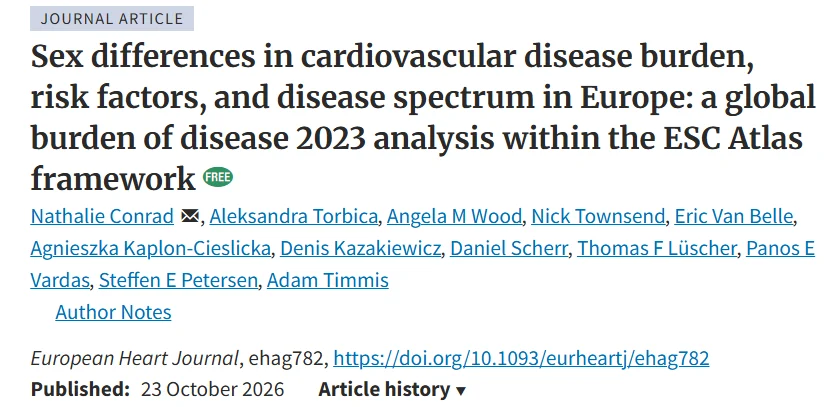
Title: Sex differences in cardiovascular disease burden, risk factors, and disease spectrum in Europe: a global burden of disease 2023 analysis within the ESC Atlas framework
Authors: Nathalie Conrad, Aleksandra Torbica, Angela M Wood, Nick Townsend, Eric Van Belle, Agnieszka Kaplon-Cieslicka, Denis Kazakiewicz, Daniel Scherr, Thomas F Lüscher, Panos E Vardas, Steffen E Petersen, Adam Timmis
Stay updated on all scientific advances with Hemostasis Today.
-
Oct 27, 2026, 03:45Melissa Barlow: Cancer Risk After Platelet Count and CRP Testing
-
Oct 27, 2026, 03:38Nnadozie Gabriel C.: What Everyone Needs to Know about BE FAST
-
Oct 27, 2026, 03:30Pouya Tahsili-Fahadan: Evolving Boundaries in Acute Stroke Care – Key Takeaways from WSC 2026
-
Oct 27, 2026, 03:27Kristin N.: Could Elritercept Change How We Manage Anemia in Lower-Risk MDS?
-
Oct 27, 2026, 03:22David J McCormack: Hybrid LAA Closure Prevents Recurrent Stroke Without Blood Thinners
-
Oct 26, 2026, 20:09Augustina Isioma Ikusemoro: Advancing PBM Through Evidence-Based, Patient-Centred Transfusion Care
-
Oct 26, 2026, 20:03David McIntosh: Outdated Plasma Collection Methods and the Global Shortage of Plasma-Derived Medicines
-
Oct 26, 2026, 20:00José Antonio García Erce: Recognizing Professor Marcela Contreras’ Contributions to Spanish Hematology
-
Oct 26, 2026, 19:47Ahmed Boukaraa: Transfusion Safety – Have You Checked Calcium Levels before Transfusing?