


Ifeanyichukwu Ifechidere: When Normal Results Don’t Explain the Bleeding
Ifeanyichukwu Ifechidere, Specialist Biomedical Scientist at Sheffield Teaching Hospitals, shared a post on LinkedIn:
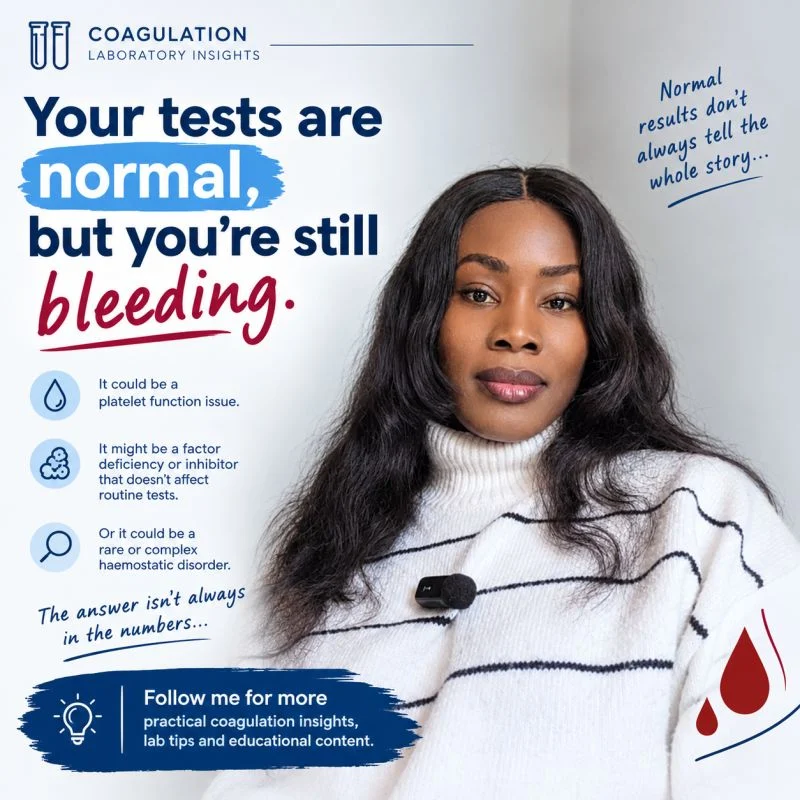
” ‘Your tests are normal, but you’re still bleeding.’
Imagine hearing that as a patient. Heavy periods that soak through in an hour. Nosebleeds that won’t stop. Bruising that appears from nowhere.
Bleeding after dental work that needed a second visit. Yet PT, APTT, fibrinogen, and platelet count all come back normal.
This is the reality of Bleeding Disorder of Unknown Cause (BDUC), and it’s one of the most frustrating diagnostic puzzles in haemostasis.
What BDUC means
A patient has a clear bleeding phenotype, usually shown by an elevated bleeding assessment tool score (like the ISTH-BAT), but comprehensive testing doesn’t identify a defined cause.
Why it’s so hard to diagnose
- Screening tests have blind spots. A normal PT/APTT doesn’t exclude mild factor deficiencies, VWD, platelet function defects, or fibrinolytic disorders. PFA-100 sensitivity is limited too.
- VWF is a moving target. Levels fluctuate with stress, exercise, pregnancy, oestrogen, inflammation, and ABO blood group. A level of 45 IU/dL on a bad sampling day may be 70 a month later. Repeat testing matters.
- Platelet function testing is demanding. Light transmission aggregometry is sample-sensitive, time-critical, and affected by medications, diet, and pre-analytical handling. Variability between labs is real.
- Fibrinolytic and rare defects are rarely tested. Conditions like PAI-1 deficiency or α2-antiplasmin deficiency sit outside routine panels.
- Non-haemostatic causes overlap. Connective tissue disorders, gynaecological pathology, and vascular fragility can all produce bleeding that coagulation tests will never explain.
- Genetic panels create new questions. Variants of uncertain significance can leave patients and clinicians with data but no answer.
Why it matters
Without a label, patients may be dismissed, undertreated, or told it’s ‘just heavy periods.’ Yet their bleeding risk around surgery, childbirth, and trauma is real.
Many are managed successfully with tranexamic acid, hormonal therapy, or a desmopressin trial, so lack of a diagnosis shouldn’t mean lack of care.
The lab’s role: Rigorous pre-analytical practice, repeat testing when results are borderline, and clear communication with clinicians about what a ‘normal’ screen can and can’t exclude.
Let’s make this interactive.
- Where does your lab hit the biggest wall: VWF variability, platelet function testing, or access to specialist assays?
- Clinicians: how do you manage a patient with a strong bleeding history and normal results?
- Have you seen a case that was eventually solved after repeat testing?
Drop your letter and one line of experience. Let’s build a thread worth saving.
Follow Coagsimplified for more real-world haemostasis breakdowns.”
Other posts featuring Ifeanyichukwu Ifechidere on Hemostasis Today.
-
Oct 28, 2026, 06:06Thirunavukkarasu Angappan: Anti-TFPI Antibodies and an Antithrombin-Lowering Drug
-
Oct 28, 2026, 05:52Reegan Burnell-Clarke: Pegcetacoplan and the Evolving Treatment Landscape of PNH
-
Oct 28, 2026, 03:50ZhiChao (David) Yang: MedicalBench Tests AI in Clinical Reasoning
-
Oct 28, 2026, 03:46Phillip Smith: Strengthening Partnerships and Connections in the Rare Disease and Hemophilia Communities
-
Oct 28, 2026, 03:42Ashley Bradley: Understanding Jalen Hurts’ Diagnosis: DVT and Venous Thromboembolism in Athletes
-
Oct 28, 2026, 03:39Gregory Denomme: Petz and Garratty’s Immune Hemolytic Anemias Third Edition
-
Oct 28, 2026, 03:38Ahmed Alotaibi: Monoclonal Antibodies Challenge Routine Pretransfusion Testing
-
Oct 28, 2026, 03:32Wolfgang Miesbach: Should Prophylaxis in Type 3 VWD Follow the Bleeding Phenotype?
-
Oct 28, 2026, 03:25Owen McCarty: Exploring Platelet Polyphosphates in Coagulation Under Flow