

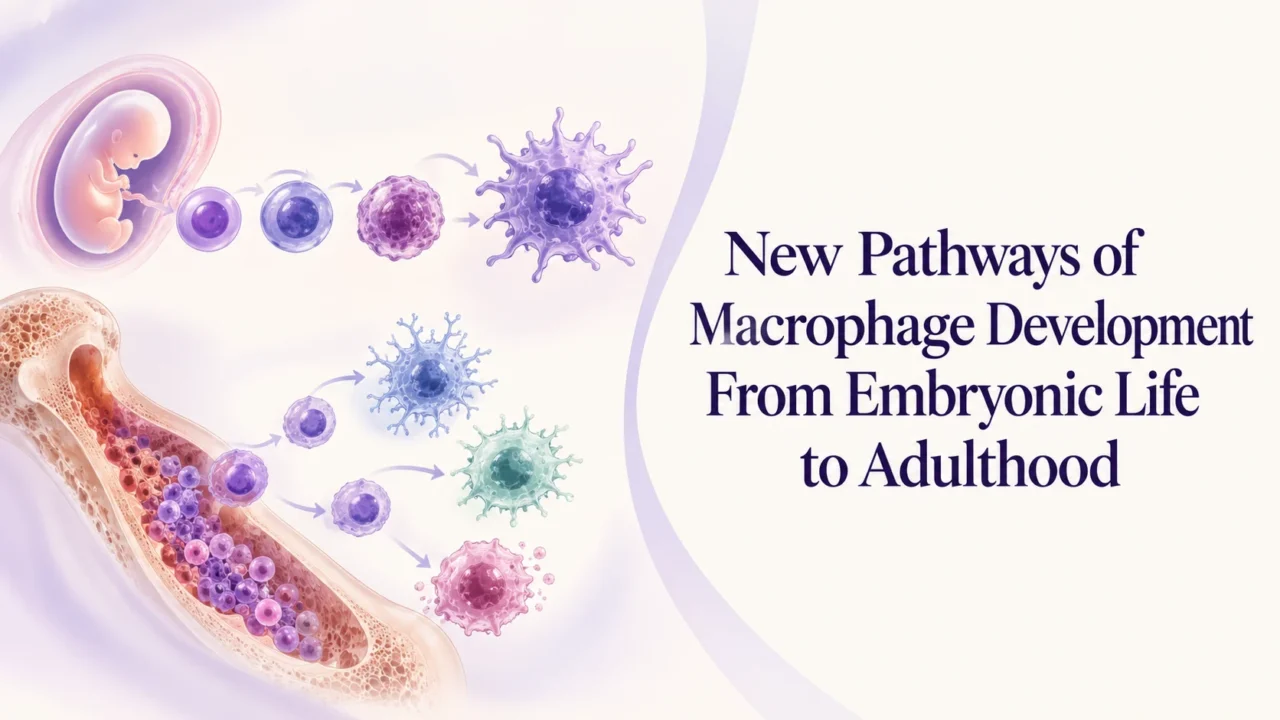
Shweta Tikoo: New Pathways of Macrophage Development From Embryonic Life to Adulthood
Shweta Tikoo, Ap. Professor at Medical University of Vienna, shared a post on LinkedIn about a recent article she and her colleagues co-authored, published in Nature Immunology, adding:
”Thrilled to share that our team’s latest research has been published back-to-back in Nature Immunology
These two companion publications unveil a fundamental shift in how we understand macrophage origins across both embryonic development and adult life.
- A novel erythromyeloid progenitor (EMPROR): A CD4-lineage erythro–myeloid progenitor within the adult bone marrow defines an alternative pathway for macrophage generation.
We discovered a rare population of adult bone marrow erythro-myeloid progenitors (termed EMPROR cells) that can replenish tissue-resident perivascular macrophages independently of conventional CCR2-positive monocytes. - A new site of hematopoiesis (MIXER): The maternal–fetal interface is an early hematopoietic niche enriched in distinct erythro-myeloid progenitors.
While looking for EMPROR cells during development, we identified a unique, extraembryonic hematopoietic niche at the maternal-fetal interface that produces distinct CD4 plus CSF1R− erythro-myeloid progenitors (eEMPROR cells), completely separate from the yolk sac. - To top it off, our findings were featured in a dedicated Nature Immunology News and Views piece titled ‘The EMPROR’s new groove’ by Karina Nance and Helen Goodridge, highlighting how these dual studies open new paradigms for macrophage biology.
A massive thank you to our brilliant co-authors, collaborators, and the entire team for the years of dedication that brought this coordinated milestone to life.
Special thanks to the amazing editorial team at Nature Immunology, Nature Portfolio, Springer Nature, especially Laurie Dempsey for her flawless handling of two interconnected manuscripts.
Grateful for the funding support, especially National Health and Medical Research Council (NHMRC) and Vienna Science and Technology Fund (WWTF).”
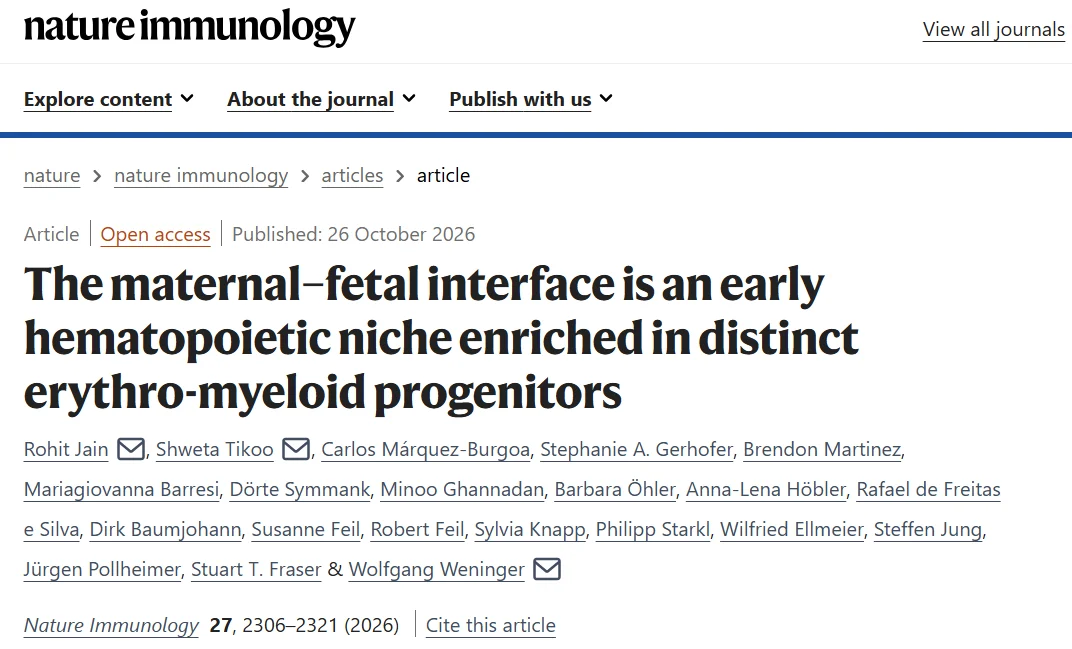
Title: The maternal–fetal interface is an early hematopoietic niche enriched in distinct erythro-myeloid progenitors
Authors: Rohit Jain, Shweta Tikoo, Carlos Márquez-Burgoa, Stephanie A. Gerhofer, Brendon Martinez, Mariagiovanna Barresi, Dörte Symmank, Minoo Ghannadan, Barbara Öhler, Anna-Lena Höbler, Rafael de Freitas e Silva, Dirk Baumjohann, Susanne Feil, Robert Feil, Sylvia Knapp, Philipp Starkl, Wilfried Ellmeier, Steffen Jung, Jürgen Pollheimer, Stuart T. Fraser, Wolfgang Weninger
Stay updated on all scientific advances with Hemostasis Today.
-
Oct 29, 2026, 15:54Negar Saleh: Integrating Interpretability Into AI-Based Pulmonary Embolism Prediction
-
Oct 29, 2026, 15:40Daniel Messiha: AI-Integrated PERT Workflow Improves Pulmonary Embolism Care and Speeds Up Intervention
-
Oct 29, 2026, 15:36Brigitta Nicorici: Pregnancy and Laboratory Medicine
-
Oct 29, 2026, 15:22Ugo Clinton։ Tranexamic Acid From Discovery to a Life-Saving Treatment
-
Oct 29, 2026, 15:01Owen McCarty: Targeting FXI and FXII to Reduce Device-Associated Thrombosis and Inflammation
-
Oct 29, 2026, 14:47Ingeborg Hers: Exploring New Frontiers in Platelet Biology and Thrombosis Research
-
Oct 29, 2026, 14:36Theodore Iwashyna: Could Hemoglobin Thresholds Lead to Unnecessary Blood Transfusions in ICU Patients?
-
Oct 29, 2026, 14:24Aryabhatta Sadhu: Contributing to Nepal’s First CAR-T Cell Therapy Case
-
Oct 29, 2026, 13:50Lainie Kazan’s Story and the Clinical Risks of Post-Injury Immobilization