


Fabrice Cognasse: The Future of Blood Banks From Transfusion Support to Precision Medicine
Fabrice Cognasse, Director of Research – Scientific Director at The EFS in Auvergne-Rhône-Alpes and INSERM, shared a post on LinkedIn about a recent article by Hind Hamzeh-Cognasse et al, published in Haematologica, adding:
“What if we fundamentally rethought the role of the blood bank?
Our article, Platelet transfusion biology: from hemostatic support to inflammatory and immune signaling, published in Haematologica Journal, opens up an important perspective on the future of transfusion medicine.
Hind HAMZEH COGNASSE Blandine MAITRE, PhD Fabrice Cognasse Michele P. Lambert
Platelets are far more than tools for hemostasis.
They are active biological players capable of interacting with the immune system, leukocytes, the endothelium, and inflammatory pathways.
Their function therefore depends not only on their number or their ability to prevent bleeding, but also on the donor, the product preparation and storage conditions, and the biological status of the recipient.
This perspective invites us to move beyond a predominantly quantitative approach to transfusion and embrace a more biological, integrated, and personalized approach.
What should the blood bank of the future look like?
A modern blood bank should progressively evolve into:
- A platform for biological insight, capable of better characterizing blood components and their functional and immunological properties.
- A key player in personalized transfusion medicine, integrating product characteristics and patient specific factors to guide therapeutic decisions.
- A hub for innovation and translational research, turning biological discoveries into meaningful clinical applications.
- A strategic partner to clinical teams, helping optimize transfusion efficacy while reducing immunological and inflammatory risks.
- A forward looking center of expertise, developing new biomarkers, advanced characterization methods, and, ultimately, more precise strategies for blood component selection.
The question is no longer simply whether a platelet concentrate meets quality standards and is available.
We must also understand what it can biologically contribute to a specific patient in a given clinical context.
This evolution does not challenge the fundamental principles of transfusion safety.
Rather, it builds upon them by incorporating a deeper understanding of biology, immunity, and the heterogeneity of blood components.
The blood bank of tomorrow will be more than a place for collecting, testing, preparing, and distributing blood components.
It will also be a center of biological expertise, innovation, and precision transfusion medicine.
By bringing together fundamental research, emerging technologies, biological data, and clinical needs, we can drive the sustainable transformation of transfusion medicine.
Will the future of transfusion be guided as much by the biology of the blood component as by the needs of the patient?
This is a question we must begin exploring together today.”
Title: Platelet transfusion biology: from hemostatic support to inflammatory and immune signaling
Authors: Hind Hamzeh-Cognasse, Blandine Maître, Michele P. Lambert, Fabrice Cognasse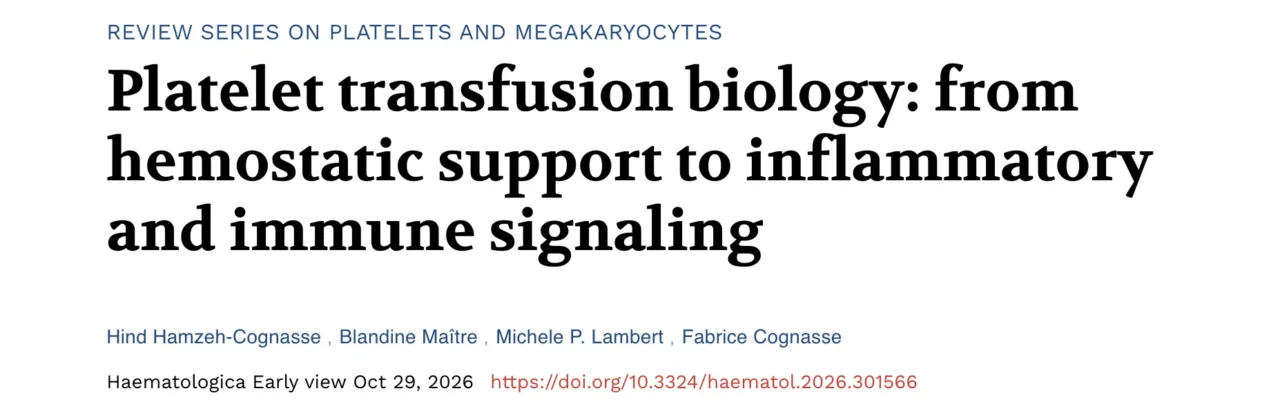
Stay updated on all scientific advances with Hemostasis Today.
-
Oct 30, 2026, 12:47Louise St. Germain Bannon: Turning Thrombosis Awareness into Stroke Prevention
-
Oct 30, 2026, 12:36Aryabhatta Sadhu: Sickle Cell Crisis Recognising When Treatment Must Change
-
Oct 30, 2026, 12:09Carmelo Gurnari: Clonal Dynamics in the Bone Marrow During Sepsis and Emergency Haematopoiesis
-
Oct 30, 2026, 11:49Advancing Global Care for Hemophilia and Bleeding Disorders – World Federation of Hemophilia
-
Oct 30, 2026, 05:18Flora Peyvandi: Molecular and Lab Markers Linked to Bleeding Severity in Factor VII Deficiency
-
Oct 30, 2026, 05:11Rana Al-Hrout: Exploring Approach to Macrocytic Anemia
-
Oct 30, 2026, 04:22Francisco Chacón-Lozsán: Acute Pulmonary Embolism in 2026 – Blood Pressure Is Not the Same as Perfusion
-
Oct 30, 2026, 04:15Samin Mohsenian: Launching the PRO-RBDD-FX Registry for Rare Coagulation Factor X Deficiency
-
Oct 30, 2026, 03:59Emil List Larsen: Identifying SERPINC1 Variants and Limitations of Routine Antithrombin Testing