


Sascha David: Therapeutic Plasma Exchange Associated with Lower 90 Day Mortality in Streptococcal Septic Shock
Sascha David, Editor in Chief – ICMx at European Society of Intensive Care Medicine – ESICM, shared a post on LinkedIn about a recent article he and his colleagues co-authored, published in Intensive Care Medicine Experimental, adding
“Another step forward in plasma exchange research for septic shock!
Very proud that our EXCHANGE and BonHanZA study group s have just published another paper exploring the potential of therapeutic plasma exchange (TPE) in septic shock!
This time, we focused on streptococcal septic shock, a particularly severe form of sepsis characterized by toxin-mediated inflammation and profound circulatory failure.
What did we find?
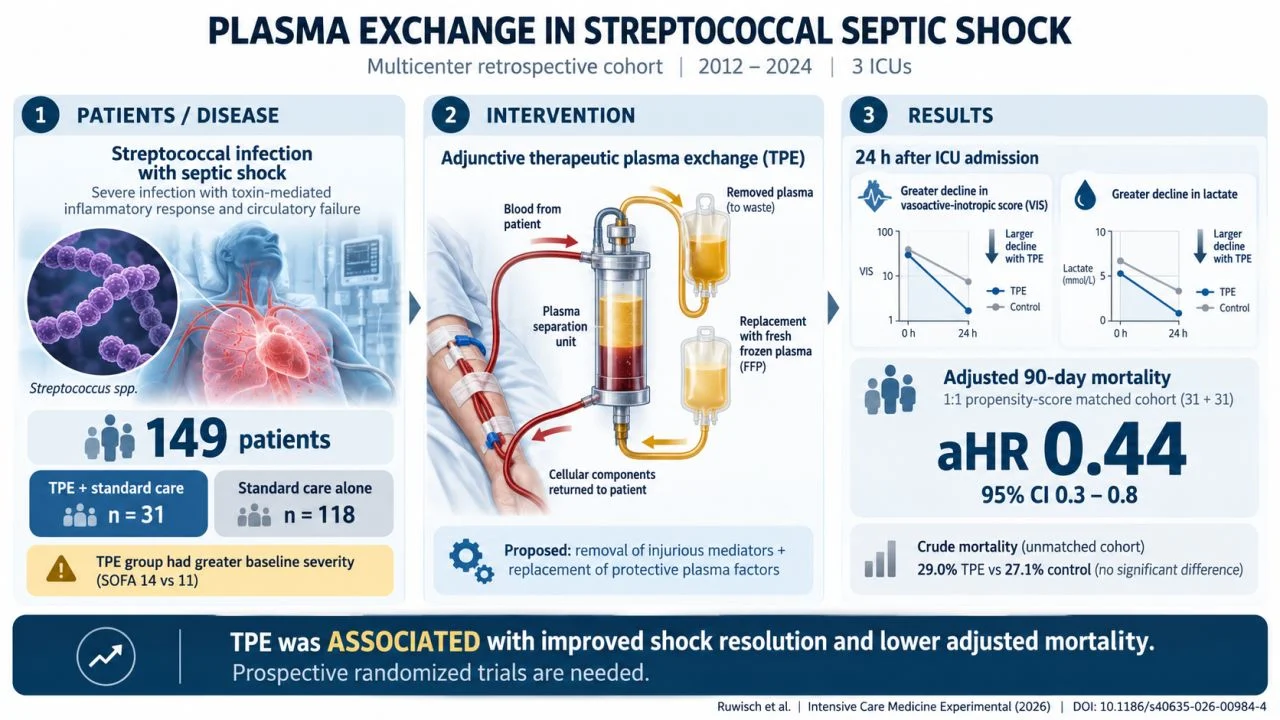
In this multicenter retrospective study involving 149 patients from Bonn, Hannover, and Zurich:
- TPE was associated with more rapid hemodynamic stabilization and improved lactate clearance.
- Despite greater disease severity at baseline, TPE-treated patients showed lower adjusted 90-day mortality in propensity-score analyses (aHR 0.44).
- These findings suggest that patients with specific infectious and biological characteristics may particularly benefit from TPE.
Of course, observational data cannot establish causality.
Prospective randomized trials, including our ongoing EXCHANGE-2 trial, will be essential to determine the true clinical benefit.
Huge congratulations to first author Jannik Ruwisch and the entire EXCHANGE and BonHanZA collaboration!
Step by step, we are moving towards a better understanding of who might benefit most from plasma exchange in septic shock.”
Title: Adjunctive therapeutic plasma exchange as rescue therapy in septic shock due to streptococcal infection: a multicentric retrospective cohort study
Authors: Jannik Ruwisch, Alix Buhlmann, Lennart Wild, Pedro David Wendel-Garcia, Thorben Pape, Daniel A. Hofmaenner, Christian Putensen, Philippe Kruse, Greta-Henrike Holtgrave, Heiko Schenk, Christian Bode, Sascha David, Klaus Stahl, Benjamin Seeliger, Bonn-Hannover-Zurich ARDS (BonHanZA) Study Group
Stay updated on all scientific advances with Hemostasis Today.
-
Oct 31, 2026, 19:40Andreas Calatzis: Revisiting a Widely Cited Study on Preoperative Screening for Primary Hemostasis Disorders
-
Oct 31, 2026, 19:40How Antiseizure Medication Selection May Influence DOAC Safety in Epilepsy – JAMA Neurology
-
Oct 31, 2026, 19:35Alejandro González Veliz: Balancing Ischemic Protection and Bleeding Risk in Antiplatelet Management
-
Oct 31, 2026, 19:25Jessica Garcia: Real-World Evidence on Efanesoctocog Alfa Prophylaxis in Pediatric Hemophilia A
-
Oct 31, 2026, 19:21Cedric Hermans: What If Higher Plasma FIX Levels Do Not Necessarily Mean better Haemostatic Protection?
-
Oct 31, 2026, 19:16Valance Washington: Celebrating Sravya Nimmala’s Outstanding Abstract Award
-
Oct 31, 2026, 16:41Ward Faisal: Ferric Carboxymaltose as an Alternative to Traditional Iron Preparations for Anemia
-
Oct 31, 2026, 16:35Bhavna Daryani: Using Technology to Make Anemia Screening More Accessible and Non-Invasive
-
Oct 31, 2026, 16:33Greg Jackson: Key Insights from the 22nd Annual McMaster Hematology and Thromboembolism Update